Imaginary dialogue between Émile Zola and Alfred Dreyfus
by Charactorium · Alfred Dreyfus (1859 — 1935) · Military · 6 min read
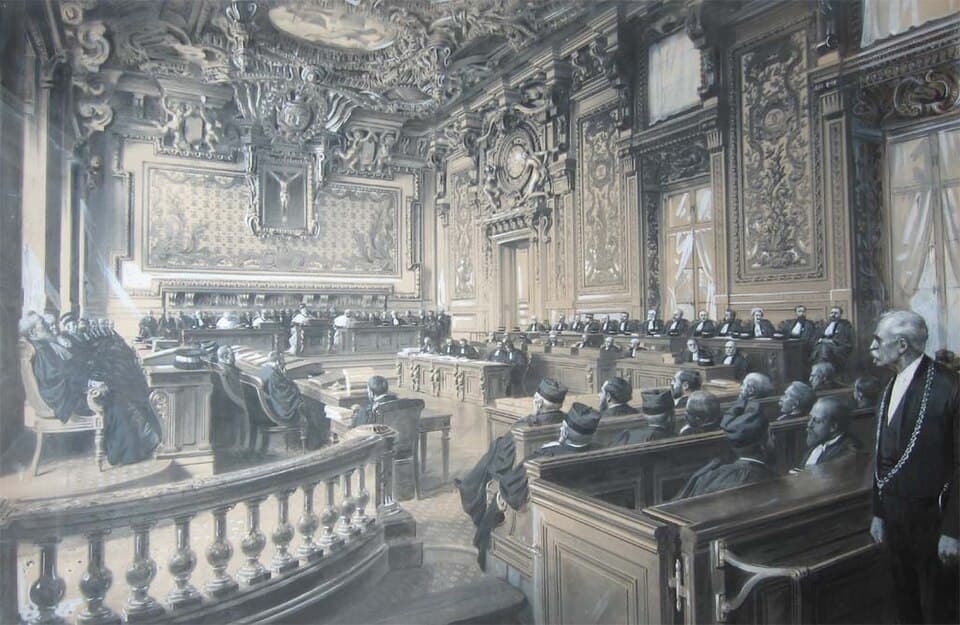
It is in a discreet apartment in the 7th arrondissement of Paris, in the autumn of 1900, that Émile Zola meets Alfred Dreyfus, pardoned the previous year but still stripped of his honor. A lamp illuminates a pile of yellowed letters, brought back from Guiana and carefully tied. The two men never really knew each other — one wrote, the other suffered. And it is with restrained emotion that the writer, returned from exile, finally comes to listen to the man for whom he risked everything.
—Captain, take me back to that morning in October 1894. How could an officer like you be arrested on a mere resemblance of handwriting?
That morning, I was summoned to Headquarters in civilian clothes, without any explanation. Commandant du Paty de Clam made me write under his dictation, claiming a hand injury — I understand today that he was looking in my letters for traces of the famous bordereau. Then came the word spy, a revolver placed before me, the tacit order to kill myself for honor. I refused: an innocent man does not take his own life. The entire accusation rested on handwriting judged similar to mine, nothing else. I immediately wrote to the Minister of War to protest my innocence and demand justice. You know, Monsieur Zola, from that day on I never stopped demanding it.
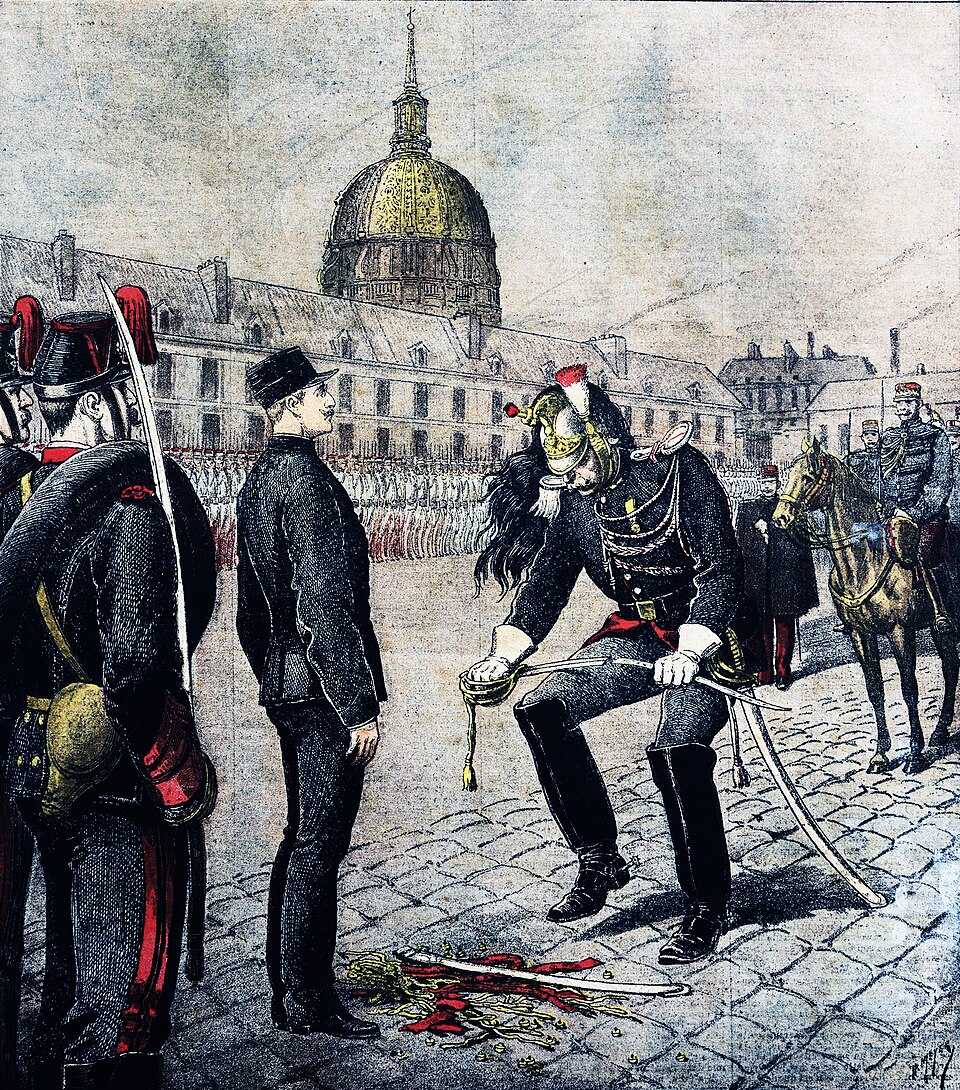
—And that ceremony in January 1895, in the courtyard of the École Militaire — how does one bear having one's stripes torn off before the crowd?
On January 5, 1895, they led me to the center of the courtyard, and a huge adjutant tore off my stripes, my buttons, broke my saber over his knee. At each gesture I shouted that I was innocent, that I still served the army that was disowning me. Behind the gates, the crowd howled its hatred, they called me traitor, they demanded my death. I had to parade before each group of officers, my uniform in tatters, my face offered to their spittle. That parade of infamy was crueler than the penal colony that followed. For they were not stripping me of a garment: they were tearing away fifteen years of duty, the only good I was proud of. I left that courtyard alive, but already condemned in the eyes of the world.
They were not stripping me of a garment: they were tearing away fifteen years of duty, the only good I was proud of.
—You were deported alone to that rock in Guiana. Four years, Captain — how does the mind hold up in such isolation?
Devil's Island was nothing but a pebble beaten by the sea, off the coast of Guiana. I lived there alone, guarded by men forbidden to speak to me. Fever gnawed at me, the heat crushed the tin hut where they locked me up. One night, for fear of an escape that was entirely fabricated, they put me in irons: the double shackle bound my ankles to the bed for hours on end. What kept me going were my wife Lucie's letters, read and reread, even censored. I kept a diary to avoid sinking into the madness of silence. Every day I told myself that the truth would eventually rise — without that thought, I think I would have died there.
—You wrote so much on that rock, to your wife, to yourself. What were you seeking in those pages, far from any eyes?
I wrote so as not to become an animal. To Lucie, I expressed my confidence, never my despair — she too had to hold on. And I recorded everything, dates, rare news, as if to keep a grip on time that no longer moved. Those years of suffering taught me the depth of hatred and injustice; but they also showed me the strength of those who fight for truth. On my rock, I didn't even know the names of those who were fighting for me in Paris. I wrote into the void, not knowing if a single line would cross the ocean. Writing was still believing that someday, somewhere, I would be read and believed.
—On your rock, you knew nothing of Colonel Picquart, who as early as 1896 had recognized Esterhazy's hand. What did you feel when you learned of it?
All of that I only learned on my return, piece by piece. Imagine the abyss: as early as 1896, an honorable officer, Colonel Picquart, had identified the real traitor, Esterhazy, that man riddled with debt who was selling our secrets abroad. And instead of doing me justice, Headquarters silenced him, transferred him, nearly broke him for daring to tell the truth. They preferred to sacrifice an innocent rather than admit an error. That is what still chills me: it was not one man's hatred that destroyed me, it was the pride of an entire institution resolved never to recant. While I counted the days in irons, they knowingly covered for the guilty, and they called that the honor of the army.
—When I published J'accuse in L'Aurore on January 13, 1898, Colonel Henry's forgery had not yet been uncovered. Did you know, in the penal colony, what I was risking?
No, Monsieur Zola — on Devil's Island, no rumor of your letter reached me. They cut me off from everything, that was the rule. I only learned much later of the impact of J'accuse, and the price you paid: a trial, a conviction, exile in England. A writer at the height of his glory risked his freedom for a captain he had never met. And the forgery fabricated by Colonel Henry to crush me — that lie that collapsed when its author was exposed — it was your cry that forced the light to uncover it. I owe you more than a retrial. You gave France the right to doubt its judges, and that, no verdict can ever repay you.
You gave France the right to doubt its judges.
—At the 1894 trial, you were convicted on a secret dossier that your defense never saw. Did you understand that at the time?
At the time, no — I still believed in the justice of my country. My lawyer, Maître Demange, pleaded in a closed room, without an audience. Only afterward did I learn of the maneuver: they had given the judges, in secret, a dossier that neither I nor my defense could read or discuss. How can you defend yourself against documents hidden from you? I was found guilty and sentenced to perpetual deportation. As I left, I could not understand how officers, my peers, could have believed me a traitor on shadows. Today I know: they needed a culprit quickly found, and my name, my faith, made me the convenient guilty one. The law had been violated in the shadows, and everything rested on that violation.
—You accepted the pardon of 1899 without giving up your fight. Do you still dream of one day taking back the uniform that was torn from you?
The pardon gave me back to Lucie and my children, but it did not give me back my honor: a pardon forgives a guilty man, yet I am innocent, and it is my honor that I demand. I accepted it because my body could not have lasted another day, not because I give up. Until a judgment fully rehabilitates me, my fight continues. Yes, I dream of taking back the uniform, not out of pride, but because serving France remains for me the only honor worth having. That France, the France of justice, I never stopped loving, even when it disowned me. If my rank is restored, I will take my place in the ranks, even if it is the last.
—My friend, your affair split France in two. Do you measure the hatred it awakened against your people, against the Jews of this country?
I never wanted to be a symbol, Monsieur Zola. I was just a French officer, born in Mulhouse, who loved his flag and believed the army incapable of injustice. They turned my name into a battle flag, and my religion into a pretext. That hatred of Jews unleashed by my misfortune, I had not measured it — I who felt French above all, they reduced me to an origin as if it were a fault. And yet I love this country no less. If my suffering serves so that a Frenchman never again has to prove his loyalty by his birth, then it will not have been in vain. You who wield words better than I, you know that a truth, once set in motion, never stops.
They turned my name into a battle flag, and my religion into a pretext.
—Before I leave you, my friend: if the retrial finally comes, what will you say to those who fought for you without knowing you?
I will tell them that their fight went beyond my person. You fought for a man, no doubt, but above all for an idea: that no citizen be delivered to arbitrariness, that no reason of state outweigh truth. If tomorrow a verdict rehabilitates me, it will not be my victory alone, it will be that of the Republic, that of justice over lies. I will then take back the uniform with the same faith as on the first day, and I will serve France without bitterness, for it will have known how to correct itself. To you, Monsieur Zola, I do not know what to say: one does not thank the man who gave you back your name. One tries, for the rest of one's life, to be worthy of it.
This imaginary interview was generated by artificial intelligence from sources documented in Alfred Dreyfus's profile. It dramatises what the figure might have said based on what we know about them, but does not constitute attested historical testimony. For primary sources and factual documentation, refer to the full profile.