Imaginary interview with Amartya Sen
by Charactorium · Amartya Sen (1933 — ?) · Economics · 6 min read
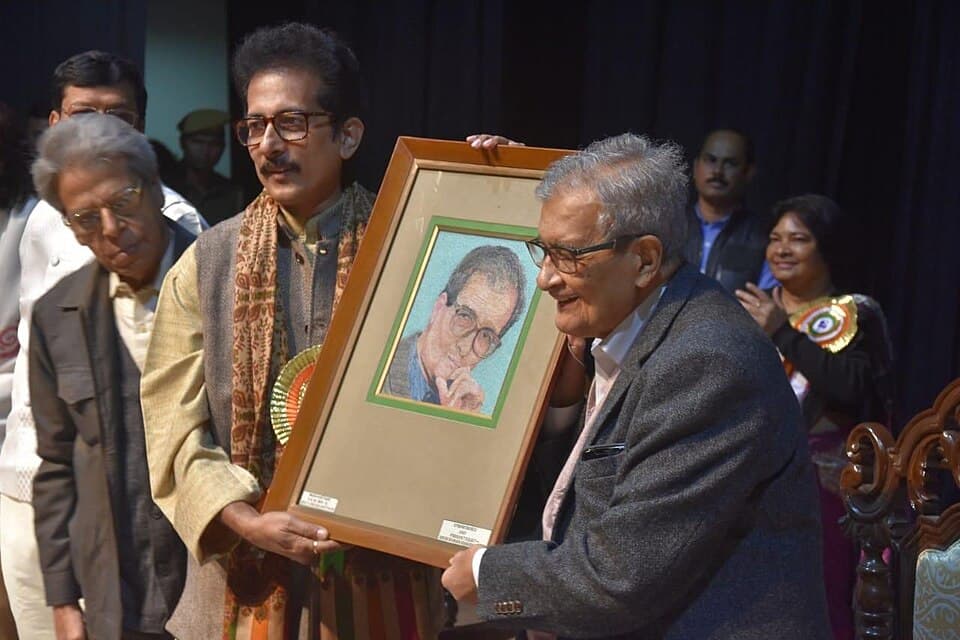
Late afternoon at Trinity College, Cambridge, where the man receives in an office lined with books and offprints, a cup of tea cooling near the window. The voice is soft, almost hesitant, but the argument always lands sharp. Amartya Sen, past ninety, speaks of the Bengal of his childhood as something still warm under his hand.
—They say your name was given to you by a poet. How did that happen?
It was Rabindranath Tagore, a friend of the family, who named me. Amartya means 'immortal' in Sanskrit — quite a burden for an infant, you'll agree. I grew up in his school at Santiniketan, in the heart of Bengal, where we had class outdoors, under the trees, without grades or exams that tighten your throat. We recited poems in the morning and debated everything in the afternoon, as if a seven-year-old had the right to disagree. I believe everything I became lies in that freedom: the idea that education is not training but the opening of what you are capable of doing. Much later, I put a learned word to that childhood intuition. But I learned it barefoot, at Santiniketan.
Education is not training but the opening of what you are capable of doing.
—Do you remember the moment famine entered your life?
1943. I was nine. The great Bengal famine took millions around us, and yet — this is what stayed with me all my life — the granaries were not empty. Rice existed. It passed from hand to hand at prices that day laborers, weavers, fishermen could no longer pay. My family ate; others, a few streets away, fell into the ditch. A child does not understand economics, but he sees injustice very clearly. Long after, in Poverty and Famines, I tried to say simply what I had seen: hunger is not primarily a shortage of food; it is a collapse of access to food. You can die of starvation in the midst of plenty when you have lost all entitlement.
You can die of starvation in the midst of plenty when you have lost all entitlement.
—Another scene from that period is said to have deeply marked you. Which one?
Yes. I was eleven when a man staggered into our garden, his back split open by a knife. His name was Kader Mia, a Muslim day laborer, caught in the Hindu-Muslim riots that preceded Partition. He had come looking for work in a dangerous neighborhood — dangerous for a Muslim — because his wife and children had nothing left to eat. We carried him, my father took him to the hospital, but he died. That day I understood that his poverty and his lack of freedom were one and the same: if he could have chosen, he would never have gone to be killed there. Misery does not only deprive you of bread. It takes away your right to say no.
Misery does not only deprive you of bread. It takes away your right to say no.
—You have spent a lifetime challenging a small letter: GDP. Why this obstinacy?
Because GDP measures what a country produces, never what its inhabitants can actually experience. Two nations can show the same income, and in one girls go to school and grow old, in the other they do not. The figure remains mute on that. With my friend Mahbub ul Haq, we wanted a less blind instrument: the Human Development Index, published by UNDP since 1990, which puts life expectancy, education, and income side by side. It is not perfect — no index is — but it forces the gaze away from mere accounting columns. I have always thought that what matters is what a person is able to be and do: to feed oneself, to read, to take part in the debate of one's community. The rest is bookkeeping.
GDP measures what a country produces, never what its inhabitants can actually experience.
—You often sum up your thought with the word 'freedom'. What exactly do you mean?
In Development as Freedom, I proposed seeing development as a process of expanding the real freedoms that individuals enjoy. The word is important: real. A man is free in law to go to school, but if hunger keeps him in the field, that freedom exists only on paper. My capabilities approach always asks the same thing: not 'how much do you have?', but 'what can you actually do with your life?'. An illiterate woman forced into marriage at thirteen may be fed; she is not free. Income is a means, never an end. The end is the range of lives a person has good reason to desire and the power to choose among them. That is where, and only where, I locate progress.
Income is a means, never an end.
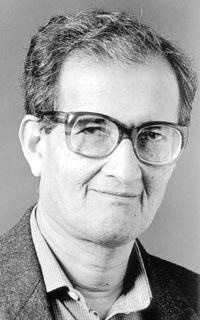
—In your work on justice, you refuse to describe the perfect society. Doesn't that disarm reflection?
On the contrary, it puts it to work. Philosophers have long sought the blueprints of a perfectly just city, and meanwhile injustice, for its part, did not wait for them. In The Idea of Justice, I wanted to reverse the approach. What moves us, rightly, is not noting that the world is not perfectly just — few of us hope that — but that there exist around us manifestly remediable injustices that we want to eliminate. Slavery, avoidable famine, a school closed to girls: no need for a complete theory of perfection to know they must be abolished. Justice is judged by what it changes in people's lives, not by the elegance of its architecture. I prefer a slightly less unjust world tomorrow to an ideal city that never arrives.
I prefer a slightly less unjust world tomorrow to an ideal city that never arrives.
—You insist a lot on debate, discussion. Is that an Indian heritage?
Deeply. People often imagine India as mystical and silent; in The Argumentative Indian, I wanted to remind that it is first a vast tradition of argument, tolerance, and public reason — emperors who organized debates between faiths, poets who contradicted priests. This public reason is not a drawing-room luxury. I have shown that no major famine has ever struck a democracy where the press is free and people can cry out their suffering: rulers eventually listen. Our understanding of the demands of justice cannot do without reasoned public discussion. Silencing people is already starving them a little. That is why I distrust those who claim to know the common good without ever having listened to those it concerns.
No major famine has ever struck a democracy where people can cry out their suffering.
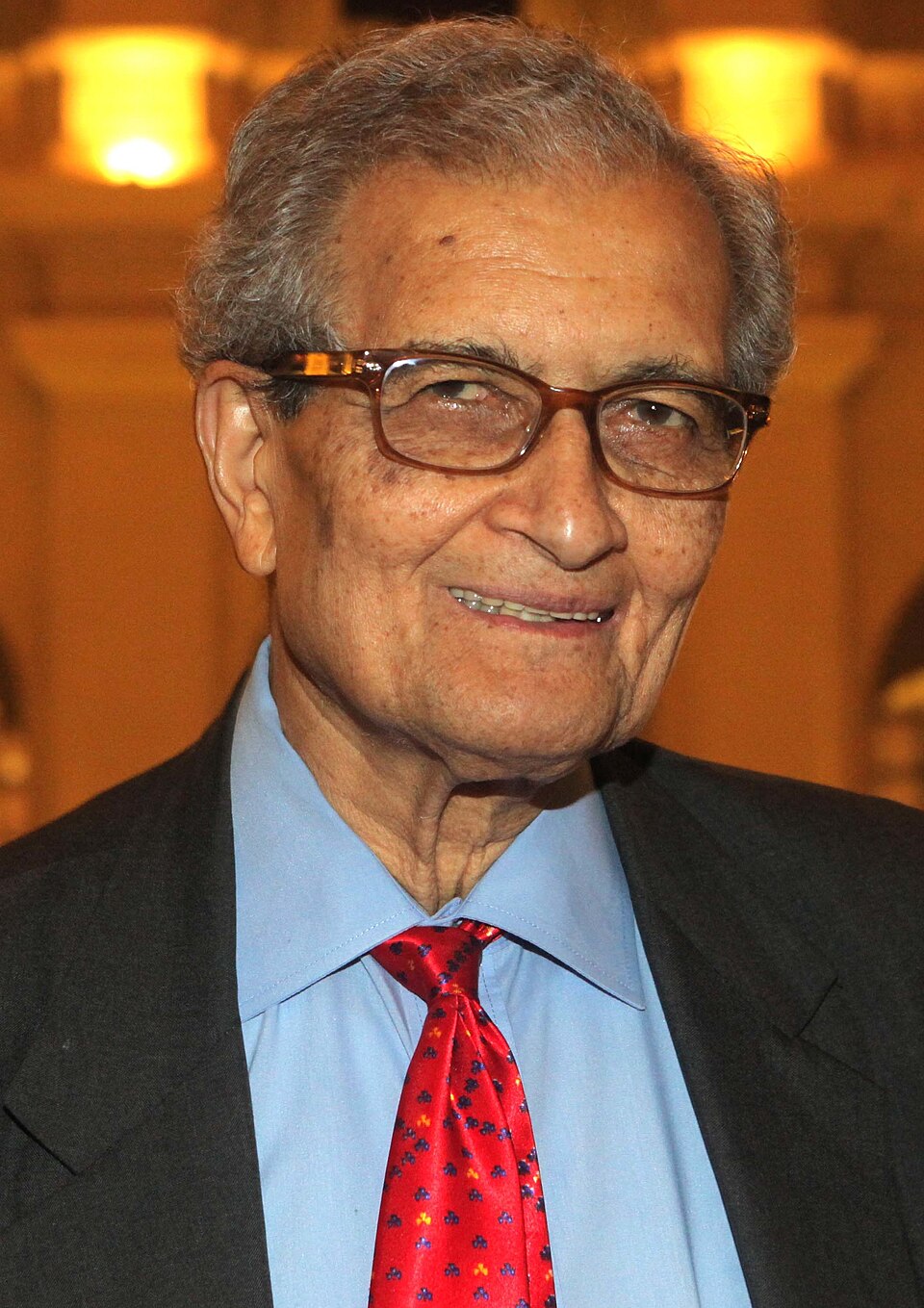
—As a student, you faced a very serious illness. How did you experience it?
At Cambridge, as a young man, I was diagnosed with mouth cancer. I did what, I suppose, an apprentice economist does: I went to read the survival statistics by treatment. I chose the radiotherapy myself, a massive dose, knowing the odds. I survived — but I have had lifelong aftereffects, and even today I must eat carefully, rice, dal, river fish, nothing hot. This experience did not stay in the 'personal health' box. It taught me from the inside what it means to have information, a choice, access to care — three things millions of people lack. My capability to decide, that day, probably saved me. I have spent the rest of my life wondering why it is denied to so many others.
My capability to decide, that day, probably saved me.
—The 1998 Nobel Prize brought you a considerable sum. What did you do with it?
I was awarded the prize in Stockholm, in December 1998, for my work on welfare economics. The money that comes with it is real, very concrete. I wanted it to go back to where my questions came from: I founded the Pratichi Trust, which works on literacy and health in India and Bangladesh. I have always argued that educating girls is one of the most powerful levers against poverty — a woman who reads reduces her children's mortality more reliably than many expensive programs. A gold medal in a display case feeds no one. But a village school, a clinic, a paid teacher: these are capabilities added, one by one, to real lives. That is the only use of the Nobel that seemed consistent with what I had written.
A gold medal in a display case feeds no one.
—Looking back, what does the old economist you are owe to the child of Santiniketan?
Almost everything. The big ideas did not come to me in seminars, even though I spent my afternoons debating with students at Trinity as at Harvard. They were already there, in germ, in a garden in Bengal: the body of Kader Mia, the full granaries while people died, the voice of Tagore repeating that a free mind is better than an obedient one. My trade only translated those images into equations of social choice, into ledgers of prices and harvests. I was named 'immortal' at birth; I do not believe it for a second. But if one idea should survive me, I would like it to be the simplest: measure a society not by what it possesses, but by the freedom it leaves to its most deprived member.
Measure a society not by what it possesses, but by the freedom it leaves to its most deprived member.
This imaginary interview was generated by artificial intelligence from sources documented in Amartya Sen's profile. It dramatises what the figure might have said based on what we know about them, but does not constitute attested historical testimony. For primary sources and factual documentation, refer to the full profile.