Kids interview Amartya Sen
by Charactorium · Amartya Sen (1933 — ?) · Economics · 5 min read
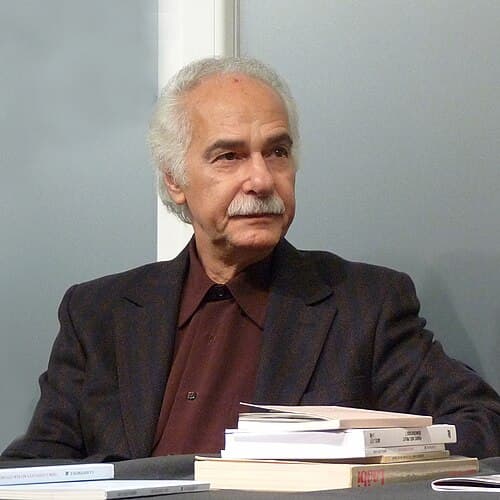
Two twelve-year-old students, on a school trip, are received by an old gentleman with a gentle smile. He sets down his papers, pours tea, and invites them to sit beside him. Amartya Sen looks at them with tenderness: no one had asked him such simple questions in a long time.
—Is it true that a great poet chose your first name?
Yes, my child, and I am still proud of it today. The poet Rabindranath Tagore, a friend of my family, leaned over my cradle. He chose the name Amartya for me. In Sanskrit, it means 'immortal.' A heavy gift, don't you think? Imagine being given such a name: you spend your life trying to live up to it! I grew up near his school in Santiniketan, a village in Bengal. There, we learned outdoors, sitting under the trees. That name has reminded me all my life that a human being is worth more than his wealth.
A human being is always worth more than his wealth.
—What was school like when you were little?
Ah, you'll be jealous! In my school at Santiniketan, there were almost no grades or scary exams. We had class outside, under the trees, and we discussed a lot. We had the right to disagree with the teacher, if we explained why. You see, in India, we have loved debating for a very long time. I even wrote a book about it later, The Argumentative Indian. That freedom to ask questions, like you are doing with me now, is where I learned to think.
We have the right to disagree, if we explain why.
—How old were you when you saw the great famine?
I was nine, my child. It was 1943, in Bengal. People came from the countryside, very thin, and collapsed in the streets. Millions died of hunger. But listen carefully, because it's strange: the granaries were not empty! Food existed, right nearby. Rice was there, in the markets. Only, the poorest had no money left to buy it. A nine-year-old doesn't understand everything. But that image never left me. Later, it became the heart of all my work as an economist.
The granaries were not empty: it was money that was lacking, not rice.
—Is there a story that scared you when you were a child?
Yes, and I have never forgotten it. I was eleven. It was a time of serious riots between neighbors of different religions. One day, a man came into our garden, bleeding. His name was Kader Mia. He was a worker, a Muslim, and he had been stabbed in the street. His family was starving, so he had come to look for work in a dangerous neighborhood. He died soon after. You understand? Poverty had forced him to risk his life. That day, I felt, with my child's heart, that misery also steals people's freedom.
Misery does not only steal bread, it also steals freedom.
—How do you prove that food was there during a famine?
Good question! You have to become a bit of a detective. I spent years comparing notebooks of figures: harvests, prices, wages, year after year. And surprise: during some famines, there was as much rice as usual! So why were people dying? Because the price went up, or because they lost their jobs. They no longer had the means to buy food. I told all this in my book Poverty and Famines, in 1981. As I write, a famine is when people do not have enough to eat — not necessarily when there is not enough food.
A famine is not when there is no more food, it is when people can no longer afford it.
—What do you mean by 'entitlements'?
I'll explain with your plate. Imagine you are hungry. To eat, you either need money to buy, or a field that feeds you, or a job that pays you. All that, I call your 'entitlements.' As long as you have them, you eat. But if you lose your job, or if prices skyrocket, those entitlements collapse. And then, even with full markets, you die of hunger. That is what my notebooks of figures showed. Hunger is not just a story of harvests: it is a story of means.
As long as you have the means to access food, you eat — otherwise, you don't.
—Why do you say a country's money is not enough to know if it is doing well?
Think with me. We often measure a country by its wealth, called GDP, all the money it produces in a year. But does money tell you if children go to school? If people live long and healthy lives? If a girl is free to choose her life? No! A country can be rich and still let many people suffer. So I proposed to look at something else: what each person is truly capable of being and doing. I call that capabilities. Real development is not about piling up wealth: it is about expanding people's real freedoms.
Real progress is not more money, it is more real freedoms.
—Did you invent the ranking of countries on health and education?
Not alone, my child! With a fellow economist, Mahbub ul Haq, we wanted a fairer measure than just wealth. In 1990, the United Nations created the Human Development Index, the HDI. It is a number that mixes three things: how long we live, how much we go to school, and how much we earn. That way, we can compare countries other than by their wallet. It is not perfect — a number never tells everything. But it forces leaders to ask: are people living better, really? And that is already a small victory.
A good number forces the powerful to ask: are people living better?
—What did you do with the money from your big prize?
Ah, the Nobel Prize of 1998! I was given a gold medal in Stockholm. A nice sum of money came with it. I could have kept it, you know. But I remembered the famine of my childhood. So I founded an organization, the Pratichi Trust, to help schools and health in India and Bangladesh. And I insisted on one thing: teaching girls to read. Because a girl who knows how to read pushes back poverty around her, better than anything else. A medal shines on a shelf. But a child who learns to read lights up a whole village.
A medal shines on a shelf; a girl who learns to read lights up a whole village.
—Do you dream of a perfect world, with justice everywhere?
No, and that may surprise you! Many scholars spend their lives designing the perfect society. I think it is a waste of time. Instead, look around you. There are injustices that can be fixed right now: a child without school, a sick person without care, a famine that could be prevented. I wrote a whole book about that, The Idea of Justice, in 2009. What should outrage us is not that the world is not perfect — it never will be. It is that there are injustices we could remove, right now, and we let them persist.
Don't dream of a perfect world: fix the injustices you can fix today.
This imaginary interview was generated by artificial intelligence from sources documented in Amartya Sen's profile. It dramatises what the figure might have said based on what we know about them, but does not constitute attested historical testimony. For primary sources and factual documentation, refer to the full profile.