Kids interview Ambroise Paré
by Charactorium · Ambroise Paré (1510 — 1590) · Sciences · 5 min read
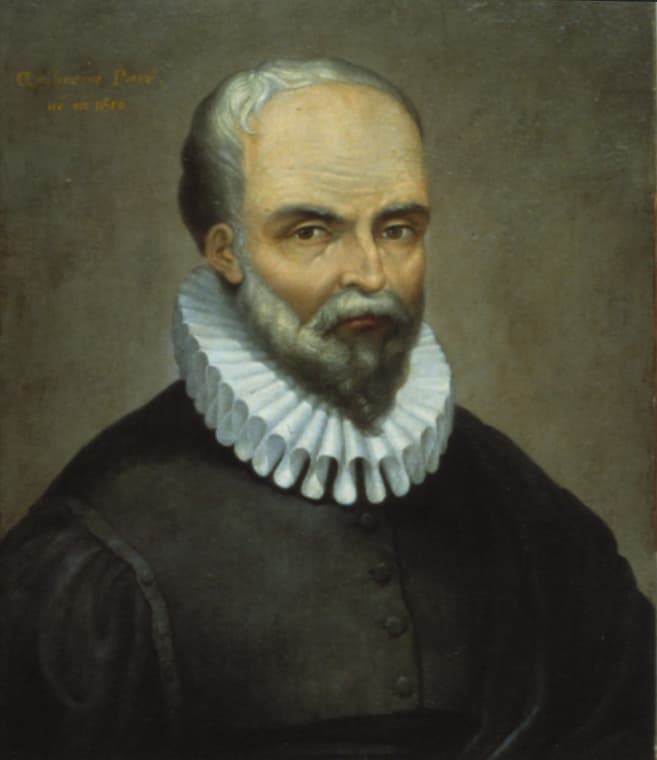
It is a discovery class morning. Two twelve-year-old students push open the door of an old surgeon's workshop, where a man with calm hands and a gentle gaze awaits them. Ambroise Paré, the barber who became surgeon to kings, invites them to sit near his instruments and to ask all their questions.
—How old were you when you started learning surgery?
You know, my child, I was not born among books. I come from Laval, a small town, and I first learned by watching, by touching, my hands in the work. The great physicians, they spoke Latin and read the Ancients. I, on the other hand, was what they called a barber-surgeon: we cut, we sewed, we also shaved. Imagine a boy who is not allowed to enter through the main gate of the University, so he goes through the courtyard, where the wounded are. That is where one learns the truth. The body never lies.
—Is it true that one day you ran out of boiling oil to treat the wounded?
Yes, and that night changed everything. It was in 1537, at the siege of Turin. At that time, they believed one had to burn gunshot wounds with boiling oil. One night, I ran out. Frantic, I mixed a little egg yolk, rose oil, and turpentine — a very gentle balm. I did not sleep: I was afraid I had let my wounded die. In the morning, surprise: those I had burned were still burning with fever. Those with the balm slept peacefully. I understood that gentleness healed better than fire.
Gentleness healed better than fire.
—It must have smelled horrible on the battlefields? Weren't you afraid?
Oh yes, it smelled of gunpowder, blood, and burnt flesh. One never forgets that smell, my child. I followed the king's army in the Italian Wars, amid the cries. Was I afraid? Of course. But when a man looks at you, his leg torn, you no longer have time to be afraid, you have time to act. In my book on arquebus wounds — the arquebus was a very heavy gun of my time — I wrote what I had seen with my own eyes. Not what the old books said. I experienced the contrary: that is what guided me.
—Why didn't you want to burn the wounded with red-hot iron anymore?
Because it was torture, my child, and it did not work so well. When one cut off a leg — an amputation — one stopped the blood by placing a red-hot iron on the flesh. They called it cauterization: burning to close. Imagine the pain, and the smell. I had another idea: tie the blood vessels with a small thread, like closing the neck of a sack. That is the ligature. In my Ten Books of Surgery, I wrote that I would use ligatures, much gentler and less painful. The patient no longer screamed. For me, that was worth all the diplomas.
—Did people scream during operations? What did you do, with nothing to put them to sleep?
You touch on something difficult. No, we had nothing to truly put them to sleep. One had to go fast, very fast, and be skilled with one's hands. We held the patient, we talked to him, sometimes we gave him a little wine. To pinch a bleeding vessel, I used a forceps — an iron tool that clamps, like two very strong fingers. The secret was not to tremble while remaining gentle at heart. Healing is not just cutting. It is also speaking, reassuring. I did my best, and I hoped Nature would do the rest.
—Is it true that you treated kings? How do you speak to a king?
Yes, and I myself could not believe it! I, the little barber from Laval, was the surgeon to four kings: Henry II, Francis II, Charles IX, and Henry III. At court, one speaks little and bows a lot. But a wounded king is a man like any other under my hands. Do you know what angered the scholars? I wrote my books in French, not Latin. For them, knowledge had to remain a secret, reserved for a few. I wanted young surgeons to read me and understand me. Knowledge that is hidden saves no one.
Knowledge that is hidden saves no one.
—The great physicians must not have liked you very much, then?
No, not always! Some looked down on me because I did not have their Latin. At the time, they believed that gunshot wounds were poisoned by gunpowder. I dared to say: no, it is not a poison, it is the wound itself that becomes infected if treated poorly. To prove it, I dissected, I looked inside the body. Anatomy, that is, the study of how we are made inside, was my true master. I preferred to believe my eyes rather than some dusty old book. That always disturbs people, a man who looks for himself.
—I was told you wrote a book about monsters. What was it?
Ah, my On Monsters and Marvels, written in 1573! Mind you, in my time the word monster did not mean an ogre. They called thus anything born differently than usual: a strange animal, a different child. I had seen many, and instead of being afraid, I wanted to understand. I noted what I had seen and considered, things born against the order of Nature. For me, everything in the body had a cause, even the unusual. Curiosity, you see, is the beginning of science. To tremble, on the contrary, is to remain ignorant.
—Did you really believe they came from God, or were you looking for a reason?
Good question, you think well! In my time, many said: it is a punishment from Heaven, an omen of misfortune. I, as a man of my time, left its share to God. But I also sought causes in Nature itself. I noted everything: what I had seen, measured, touched. I thought these astonishing births were not there to frighten us, but to be known, to advance medical science. To look instead of fleeing, to understand instead of judging: that is what I tried to do all my life, even before the strangest spectacle.

—Is it true that at 80 you were still inventing things? Like what?
Yes! Even old, the head keeps working. You see, after an amputation, a man finds himself without a leg or hand. Before, they abandoned him to his misery. I said to myself: what if we made him a new one, in metal and leather? I imagined wooden legs, arms, and even a mechanical hand whose fingers could bend using small springs. Imagine the joy of a soldier who can hold something again! Healing is not just saving a life. It is giving someone back their former life.
Healing is giving someone back their former life.
—And how did an iron hand stay on? Did it really work?
It was a work of clockmaking, my child, very precise! Imagine small gears and springs hidden inside, like in a lock. The fingers were locked in a position to hold a pen or the reins of a horse. It was not perfect, of course: the hand felt nothing, and often one had to help it with the other hand. But for a man who thought he was finished, it was enormous. I worked with very skilled locksmiths and blacksmiths, because a surgeon alone does not know how to bend metal. Together, we gave back a little hope. And hope, you see, also heals.
—If you are remembered today, what would you like us to remember?
What I would like? That you remember that a wounded person is first and foremost a human being, never flesh to burn. All my life, I tried to replace pain with gentleness, and fear with observation. I was just a boy from Laval without a great diploma, but I looked, I tried, I noted what worked. If one day you doubt because everyone claims the opposite of what you see — remember my rose oil, in 1537. Trust your eyes and your heart. And be gentle with those who suffer. That is the most beautiful job in the world.

This imaginary interview was generated by artificial intelligence from sources documented in Ambroise Paré's profile. It dramatises what the figure might have said based on what we know about them, but does not constitute attested historical testimony. For primary sources and factual documentation, refer to the full profile.