Kids interview Anansi
by Charactorium · Anansi · Mythology · 5 min read

Two young visitors, on a field trip, sat under a large tree. Between the branches, a web glistens in the sun. And the voice of a cunning old spider begins to tell stories.
—Hello! We saw your web. Is it true you're a spider?
Yes, my child, a spider. But not just any spider! I weave my web among the trees of the forest, where my people live, among the Akan, in the land now called Ghana. Imagine eight tiny legs facing enormous beasts: the leopard, the python. I am the weakest, you see? But I have something they don't: a well-filled head. They say I am cunning. Cunning means finding a clever trick when you can't win by force. And believe me, that's worth all the muscles in the world.
I am the weakest in the forest, but I have the best-filled head.
—How did you get all the stories in the world?
Ah, that! At first, all stories belonged to Nyame, the sky god. I went to see him and asked him to sell them to me. He laughed. He gave me a task he thought impossible: bring him a live python, a hornets' nest, a fierce leopard, and a being that cannot even be seen. Imagine the fear! But I used cunning for each one, one by one. I tricked the python with a branch, the hornets with water. When I returned with everything, Nyame couldn't believe his eyes. From that day on, the stories bear my name.
The sky god gave me an impossible task. I made it possible.
—What's that strange word for your stories?
You mean Anansesem? It's a word from my language, Twi, spoken by the Ashanti. It means "Anansi's words." Pretty, isn't it? When a storyteller opens his mouth in the evening, he speaks my name before anything else. For all those stories—the tricks, the beasts, the lessons—they say they are mine. Imagine a great basket where the memory of a whole people is kept: its fears, its laughter, its wisdom. That basket bears my name. I am not just a character among others, my child. I am the guardian of all words.
The memory of an entire people is kept in a basket that bears my name.
—The leopard is super strong. How did you avoid being eaten?
The leopard! Such a proud one. Strong, yes, with his fangs and claws. Next to him, I am tiny. But listen: one day, he wanted to devour me. Instead of fleeing, I spoke softly to him, flattered him, promised him a nice game. While he rejoiced, I spun my web around him, thread by thread. He didn't see it coming. When he tried to pounce, he was already trapped. You understand? The strong one looks at his muscles. The clever one looks at the trap he is setting. Strength strikes once. Cunning prepares its blow in silence.
The strong one looks at his muscles. The clever one looks at the trap he sets.
—Do you have magic objects for your traps?
Magic? Not really, my child. My tools are very simple, the kind you find in any village. A rope to tie up. A honey pot, nice and sweet, to lure the greedy: they dip their snout in and snap, they're stuck. And sometimes I hide behind a mask, change my appearance so I'm not recognized. To appear other than you are, that's called metamorphosis. The secret isn't the object. It's knowing how to use it at the right moment. A simple string in clever hands is worth a thousand weapons in stupid hands.
A simple string in clever hands is worth a thousand weapons in stupid hands.
—We heard you wanted to keep all the wisdom for yourself?
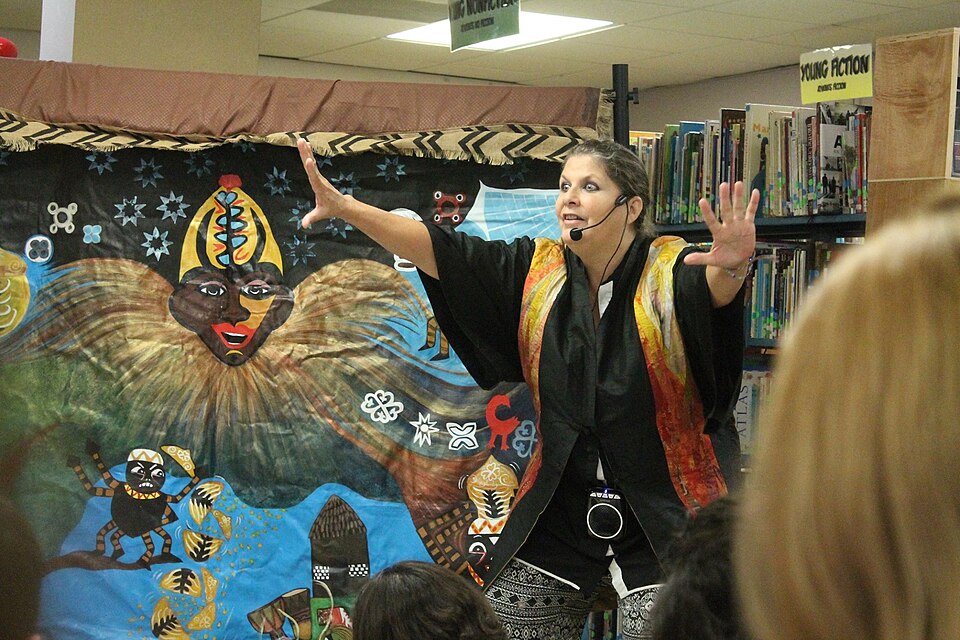
Ah… you've heard that story. It doesn't show me in my best light, it's true. I had gathered all the wisdom in the world, and I wanted to hide it in a pot, just for me. Greedy, yes, I admit it. I tried to climb to the top of a tree with the pot pressed against my belly. But the pot got in the way, I was slipping! My little son saw and shouted: "Put it on your back!" And then I understood: I didn't have all the wisdom, since a child knew more than I did. In anger, I dropped the pot. It shattered, and wisdom spread everywhere.
You can't keep wisdom for yourself: it breaks and spreads.
—When were your stories told? In the morning?
Oh no, never in the morning! It was in the evening, my child, when the sun fell behind the trees. The village gathered around the fire. Sometimes the talking drum sounded in the distance to call the people. And the storyteller, the griot, always began by speaking my name. Imagine the warm night, faces lit by the flames, the little ones pressed against the grown-ups. And the voice telling my tricks, my foolishness, my victories. They laughed, they were a little scared too. These stories weren't kept just for children. The adults listened as much as the little ones.
In the evening, around the fire, the storyteller spoke my name before anything else.
—And at the end, did the man state the moral, like in fables?
No, and that's what I like! Among us, the storyteller didn't say: "Here, the lesson is this." He left you to think about it yourself. My stories taught caution, distrust of pride, the art of getting by. But it's up to you to figure out why. You see, when I am punished for my greed, no one needs to explain it to you: you feel it. A child who finds the lesson himself keeps it forever. The one recited to him, he forgets by morning. That's the wisdom of my people: making the little ones' minds work.
The lesson a child finds on his own, he keeps. The one recited to him, he forgets.
—Is it true your stories traveled far, across the sea?
Yes, my child, and that's a sad story. Ships came to our shores. My people, Africans, were chained and taken by force far away, across the ocean, to islands like Jamaica. They were stripped of everything. Everything except one thing: they carried me in their minds. In the evening, in their suffering, they still told my tricks. Over there, they called me "Nancy." For them, I was hope: proof that the weak, through cunning, can stand up to the powerful. You cannot chain a story, you see.
You can chain a man. You cannot chain a story.
—And today, are you still known over there?
Yes, and it touches me deeply. Over there, across the sea, I had kind of cousins. In the south of a big country, storytellers told of a certain Brer Rabbit, small, clever, who tricked those bigger than him. Scholars noticed he looked a lot like me! It's because he descended from me, in a way. I left an Ashanti forest, tiny, and now I am the ancestor of a thousand stories, in a thousand languages. You too, today, you know my name. So the storyteller of old was right: as long as my tricks are told, I never truly die.
As long as my tricks are told, I never truly die.
This imaginary interview was generated by artificial intelligence from sources documented in Anansi's profile. It dramatises what the figure might have said based on what we know about them, but does not constitute attested historical testimony. For primary sources and factual documentation, refer to the full profile.