Imaginary dialogue between Cecil Balmond and Anish Kapoor
by Charactorium · Anish Kapoor (1954 — ?) · Visual Arts · 6 min read
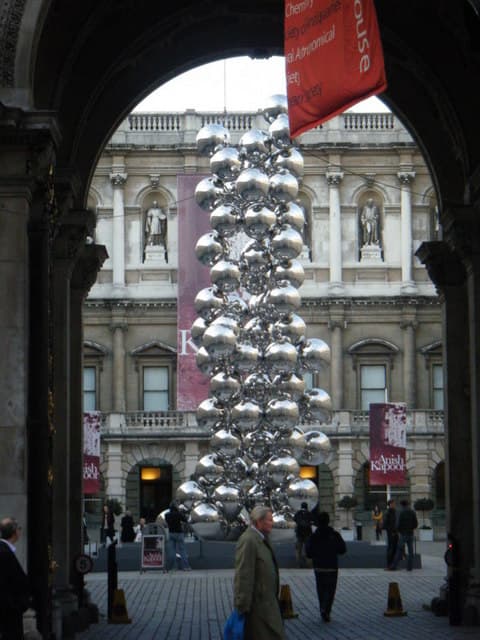
It is in the vast London studio of Anish Kapoor, among resin models and cans of red pigment, that Cecil Balmond comes to sit one afternoon in 2015. The smell of wax and cold metal still lingers in the air. The two men have known each other since the construction of the ArcelorMittal Orbit, where they battled together to turn an idea into steel. The engineer returns today not to calculate a span, but to understand what, in his friend, precedes calculation.
—Anish, before our tons of steel, there was the powder. That trip to India in 1979: what did it awaken in you?
You know me mostly through structures, Cecil, but everything started from almost nothing: powder on the ground. In Bombay, where I was born in 1954, color is not a decoration, it's a sacred material, that of temples and markets. When I returned to India in 1979, I realized I could lay raw pigment, without fixing it to a canvas, and let it breathe. 1000 Names was born from that: forms covered in red, blue, yellow, placed like apparitions. You who like every force to be justified, know that there was no calculation, only belief. Color had to have a physical presence, almost an existence of its own.
Color is not a decoration, it's a sacred material.
—You often speak of red as a flesh. In Marsyas, at the Tate Modern in 2002, that stretched membrane felt like a body. Was that intentional?
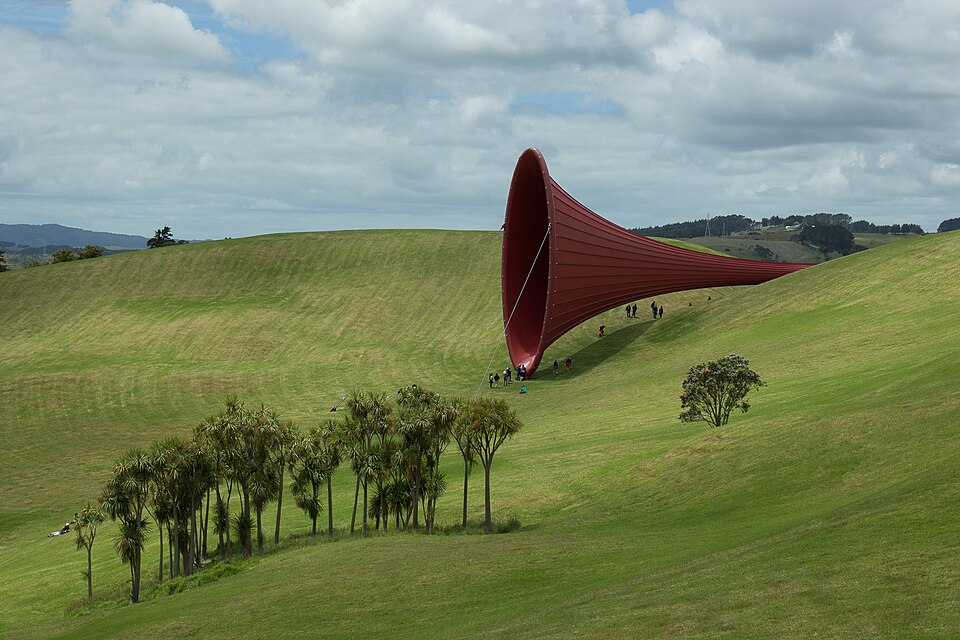
Absolutely, and you are well placed to feel it, you who think in tensions and rings. Marsyas was more than one hundred and fifty meters of red membrane stretched across the Turbine Hall, caught between three steel hoops. The title refers to the satyr flayed alive by Apollo: I wanted architecture to become a body, a skin stretched to the point of pain. Red is not just a color, it's a material, almost a flesh. I'm not trying to make a sculpture that speaks of form, but a sculpture that speaks of belief, of passion, of experience. The void inside that skin mattered as much as the skin itself. You don't look at Marsyas, you are swallowed by it.
I wanted architecture to become a body, a skin stretched to the point of pain.
—The void, precisely, keeps coming up in your work. For me it's an abyss to structure; for you, what exactly is it?
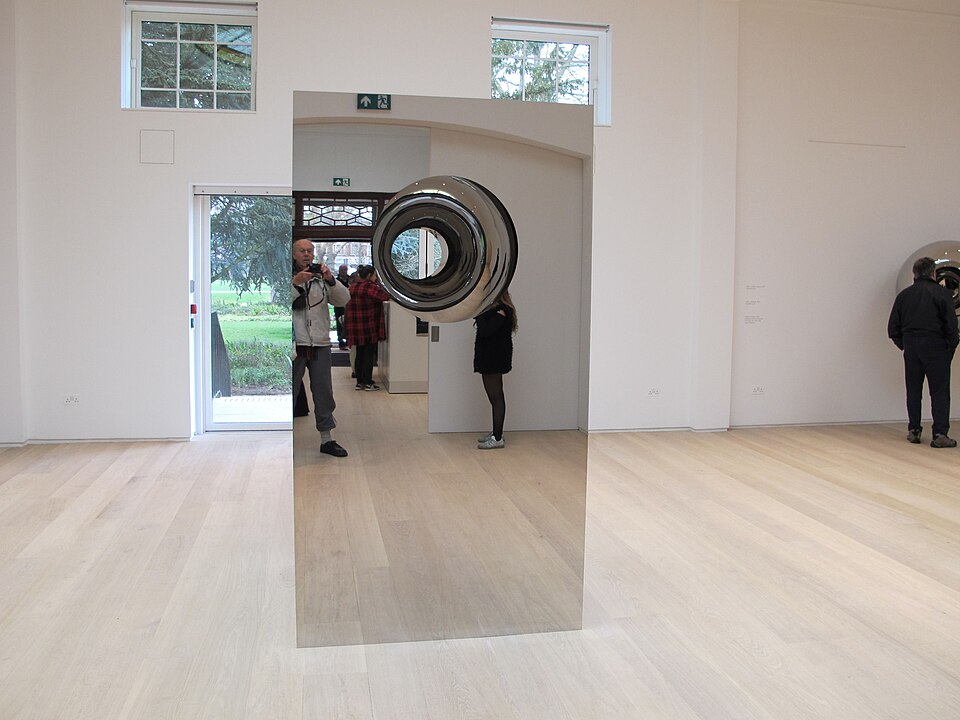
The void, Cecil, is not absence, it's a material in its own right. When I dig a hole in a wall or in the ground, I'm not removing material: I'm adding another, made of blackness, depth, vertigo. That's what I've been seeking from the beginning, from pigments to Descension, that whirlpool of black water that seems bottomless. People approach the edge and step back, startled. The void forces the body to react before the mind understands. You who calculate the resistance of solid things, imagine being able to give resistance to nothingness. That's my obsession: to make something stand that is made only of absence.
The void is not absence, it's a material in its own right.
—Let's talk about Chicago. Cloud Gate, in 2006, the locals nicknamed it "the bean". Did that nickname annoy you, you who dreamed of the immaterial?
On the contrary, it delighted me. That the people of Chicago affectionately call it The Bean is a sign that they have adopted it, that it has become theirs. What I wanted was something that seems immaterial, as if the sky had come down to us and you could walk under it. Polished stainless steel like a mirror swallows the horizon, distorts passersby, erases its own weight. You know better than anyone how many tons it took, how many invisible welds so that the surface had no seams. And yet the public does not see the metal: they see the sky, the city upside down, their own face stretched. The popular nickname is proof that the sculpture has disappeared in favor of the reflection.
The public does not see the metal: they see the sky, the city upside down, their own face.
—This obsession with the flawless surface, I experienced it with you. Where is the boundary, for you, between engineering and vision?
There is no boundary, Cecil, there is a dialogue, and we experienced it together. When we designed the ArcelorMittal Orbit for the 2012 Games, one hundred and fourteen meters of coiled red steel, the idea would have been just a dream without your calculations. But your calculations would have been just a tower without the dream. The artist alone gets lost in the impossible; the engineer alone remains cautious. Together, we found that controlled instability, that loop that seems about to tip over without ever falling. I offer an intuition, a flesh, a color; you respond with a span, a constraint, a limit. And it is in this friction that the work is born. Without you, half of my vertigo would have stayed in notebooks.
The artist alone gets lost in the impossible; the engineer alone remains cautious.
—You are often criticized for your monopoly on Vantablack, obtained in 2014. Why did you want to own a black all to yourself?
I knew this story would make you smile. Vantablack absorbs nearly 99.9% of light: it's no longer a color, it's a hole in reality, a surface that has no depth or relief. When I obtained the artistic exclusivity of this material, many cried scandal, and one of them even made the pinkest pink in the world, banning me from using it, out of revenge. I understand the anger, but this black requires long, dangerous, almost scientific research; it is not handled like a tube of paint. What I am pursuing is not just another pigment, it is the void I have been seeking all along, finally made palpable. A black so total that you cease to believe in it.
It's no longer a color, it's a hole in reality.
—At Versailles, in 2015, Dirty Corner triggered a storm. How do you experience this uproar around your work?
With difficulty, I won't lie to you, you who have seen me defend every project tooth and nail. Installing a large sculpture of steel and stones in the gardens of the Palace of Versailles, that symbol of classical order, was inevitably a provocation. I accept the clash of eras: the contemporary has the right to challenge the past, otherwise it is just decoration. But the controversy went beyond art; the work was vandalized, defaced with hateful inscriptions, and that upset me deeply. You can hate a form, you should never soil it with hatred. I hesitated for a long time about what to do with the traces. In the end, I believe that an attacked work carries, despite itself, the story of its time.
The contemporary has the right to challenge the past, otherwise it is just decoration.
—You arrived in London in 1973, alone, a young student from Bombay. What remains of that exile in your work today?
Everything, in truth. When I arrived in London in 1973 to study art, I was between two worlds: the India of my childhood and this gray, cosmopolitan city that would become mine. My roots are dual, Indian and Iraqi Jewish through my mother, and I believe my works carry this duality: the burning pigment of the East and the cold rigor of Western metal. This in-between is not a tear, it is my raw material. The red of my beginnings comes from the temples of my childhood; the polished steel comes from the workshops here. You who have also crossed cultures, you know that one never quite stops being a stranger. And that gap, that slight shift, is perhaps what allows me to see.
This in-between is not a tear, it is my raw material.
—When you start a work, do you first seek the form, or the sensation the viewer will have in front of it?
The sensation, always, before the form. I don't first draw an object; I seek an experience, a vertigo, a silence that seizes the body. The form is only the means to provoke that state. That's why my concave mirrors invert your image, my voids draw you to the edge, my reds cling to your skin. I want the viewer to be first a body before being a gaze. You, when you design a structure, you think of those who will walk through it, of how it will hold under their steps. I think of what will move through the one who stops. The form is the bark; the sensation is the fruit. If the work makes you feel nothing, then it has failed, no matter its beauty.
I want the viewer to be first a body before being a gaze.
—One last one, my friend. After so many works, from pigment to Leviathan, is there a subject that, deep down, has obsessed you from the start?
Only one, Cecil, and it has never changed: the threshold. That fragile line between fullness and emptiness, presence and absence, matter and spirit. 1000 Names already asked the question, and Leviathan, that purple membrane inflated in the nave of the Grand Palais in 2011, asked it again, on another scale: entering a work as one enters a body. I only make one single sculpture, really, that I start over in a thousand forms. Color, steel, black, hollow: they are different languages to say the same thing. I seek the moment when the object ceases to be an object and becomes belief. And I believe I will seek it until the end, without ever quite finding it.
I only make one single sculpture, really, that I start over in a thousand forms.

This imaginary interview was generated by artificial intelligence from sources documented in Anish Kapoor's profile. It dramatises what the figure might have said based on what we know about them, but does not constitute attested historical testimony. For primary sources and factual documentation, refer to the full profile.