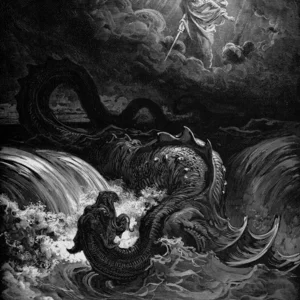

A sea monster from biblical texts and the mythologies of the ancient Near East, Leviathan embodies primordial chaos and the forces of evil. Described as a gigantic sea serpent, it appears notably in the Book of Job and the Psalms. During the Middle Ages, it became the guardian of the gates of Hell in the Christian tradition.
Leviathan
Leviathan
8 min read
Frequently asked questions
Famous Quotes
« "Can you pull in Leviathan with a fishhook or tie down its tongue with a rope?" (Job 40:25)»
« "It was you who crushed the heads of Leviathan and gave it as food to the creatures of the desert." (Psalm 74:14)»
Key Facts
- Mentioned in several books of the Hebrew Bible, notably Job (ch. 40–41), the Psalms, and Isaiah (c. 800–500 BCE)
- Its origins lie in Ugaritic mythology (Canaan, 14th–13th century BCE), where it appears as Lotan, a seven-headed serpent defeated by the god Baal
- In the Book of Job, God describes Leviathan as the mightiest of his creatures, a symbol of all that lies beyond human control
- In Jewish and Christian apocalyptic tradition (1st century BCE – 1st century CE), it becomes one of two eschatological monsters alongside Behemoth
- Thomas Hobbes adopted the name in 1651 for his philosophical treatise on the absolute state, securing the myth's place in modern thought
Works & Achievements
This Mesopotamian cosmogonic text features Tiamat, the saltwater dragon defeated by the god Marduk. It is the most direct mythological source from which the figure of the biblical Leviathan derives.
These Phoenician mythological texts describe the victory of the god Baal over Lotan (ltn), a seven-headed serpent of the waters. The linguistic and narrative parallels with the biblical Leviathan are direct and well-attested.
Chapters 40 and 41 contain the most detailed and poetic description of Leviathan in all of ancient literature. This magnificent portrait illustrates divine omnipotence in the face of the creature of chaos.
These liturgical texts evoke Leviathan in the context of praising God as creator and conqueror of primordial chaos. They reflect the integration of the myth into the official religion of Israel.
This Jewish apocryphal text portrays Leviathan as a female creature of the ocean depths, reserved for the eschatological banquet of the righteous. It profoundly influenced Christian representations of the monster.
A treatise on political philosophy in which Hobbes uses Leviathan as a metaphor for the all-powerful sovereign state. This secular reappropriation represents the myth's most enduring intellectual legacy in modern culture.
Anecdotes
In the Book of Job (chapters 40–41), God describes the Leviathan as an utterly untameable creature: flames shoot from its mouth, smoke pours from its nostrils like a boiling cauldron. This magnificent portrait is meant to show Job the absolute power of God in the face of the incomprehensible.
In Psalm 74, it is recalled that God crushed the heads of Leviathan and gave its remains as food to the creatures of the desert. This image of divine victory over the monster of chaos was central to the liturgy of the Temple in Jerusalem.
The Ugaritic texts discovered at Ras Shamra (in present-day Syria) in 1929 reveal a direct ancestor of the Leviathan: the serpent Lotan, defeated by the god Baal. This discovery showed that the biblical myth belongs to a mythological tradition shared across the ancient Near East.
During the Middle Ages, Christian theologians made Leviathan one of the princes of Hell, guardian of its gates and the embodiment of the sin of envy. It appears in medieval Mystery plays and pictorial depictions of the Last Judgment.
In 1651, the English philosopher Thomas Hobbes chose the name Leviathan for his landmark political treatise, using the biblical monster as a metaphor for the all-powerful state. This reappropriation illustrates the extraordinary symbolic longevity of the figure in Western culture.
Primary Sources
Can you draw out Leviathan with a fishhook, or press down his tongue with a cord? [...] He makes the deep boil like a pot; he makes the sea like a pot of ointment.
You divided the sea by your might; you broke the heads of the sea monsters on the waters. You crushed the heads of Leviathan; you gave him as food for the creatures of the wilderness.
In that day the LORD with his hard and great and strong sword will punish Leviathan the fleeing serpent, Leviathan the twisting serpent, and he will slay the dragon that is in the sea.
When you struck Lotan, the fleeing serpent, when you put an end to the twisting serpent, the tyrant with seven heads...
On that day, two monsters shall be separated: a female, named Leviathan, to dwell in the depths of the sea above the springs of waters; and a male, named Behemoth.
Key Places
Archaeological site where, in 1929, Ugaritic cuneiform tablets were discovered mentioning Lotan, the direct precursor of Leviathan. These texts dating from the 14th century BCE revolutionized our understanding of the myth's origins.
The Mediterranean Sea, called the Great Sea or the Sea of the Peoples in the Bible, forms the mythological setting of Leviathan. For the peoples of the ancient Near East, its deep waters were home to the forces of chaos.
The Temple of Jerusalem is where the Psalms celebrating God's victory over Leviathan were sung during royal liturgies. The figure of the defeated monster served to legitimize kingship and the divine order.
The intellectual and religious heart of Mesopotamia, Babylon was where the great cosmogonic myths were developed — including the Enuma Elish, in which Tiamat, a primordial water monster, foreshadows the Hebrew Leviathan.
Typical Objects

The Book of Job describes the Leviathan's scales as shields fused together, impenetrable to any weapon. They symbolize the invulnerability of chaos in the face of human effort.

The Leviathan breathes fire and exhales smoke according to the text of Job. These attributes link the monster to the volcano, the infernal forge, and the destructive powers of the underworld.

In Job 41:1, God challenges anyone to catch the Leviathan with a fishhook. This object becomes a symbol of human powerlessness before the creature, which only God can master.

In Jewish and Christian apocalyptic traditions, the Leviathan is chained in the depths of the ocean until the end of time. The chains represent the divine victory over chaos.

The primordial deep waters make up the Leviathan's natural domain. The Hebrew word tehom refers to this original abyss where the monster dwells, predating the ordered creation.

In medieval iconography, the Leviathan's gaping maw represents the entrance to Hell. This image, found in illuminated manuscripts and church tympana, shaped Christian eschatological imagination for centuries.
School Curriculum
Vocabulary & Tags
Key Vocabulary
Tags
Daily Life
Morning
At the origins of the world, before light separated darkness from the deep, Leviathan rests in the tehomot — the primordial abyss. It embodies the undifferentiated chaos before creation, motionless in the dark, icy waters at the bottom of the cosmic ocean.
Afternoon
When the divine order is threatened, Leviathan stirs and makes the sea boil like a cauldron. Its movements unleash storms and cataclysms — in the mythologies of the ancient Near East, every earthquake or tsunami can be explained by its convulsions in the depths.
Evening
According to apocalyptic texts, Leviathan is chained in the abyss until the end of time, when it will be released for the final battle. In Jewish tradition, its flesh will be served as a feast for the righteous after the Last Judgment — the ultimate victory of order over chaos.
Food
Leviathan devours everything that lives in the ocean depths: giant fish, abyssal creatures, and according to some rabbinic traditions, it feeds on a divine river called Yubal that flows into the sea. It is itself the prey that God reserves for the righteous at the eschatological banquet.
Clothing
Leviathan is clothed in scales described in Job as rows of shields fused seamlessly together, impenetrable to any blade or arrow. Its natural armor is so perfect that it is cited as an example of flawless divine craftsmanship — beyond any human imitation.
Housing
Leviathan dwells in the Tehom, the abyss of primordial waters that precedes creation in Hebrew cosmogony. In later traditions, it inhabits the depths of the Levantine Sea or the most unfathomable trenches of the ocean, where no light reaches and no human vessel can venture.
Historical Timeline
Period Vocabulary
Visual Style
Style mêlant l'iconographie du Proche-Orient ancien (reliefs assyriens, art ougaritique) et les enluminures médiévales chrétiennes : dragon serpentiforme colossal dans des eaux ténébreuses, palette de noirs abyssaux, bleus sombres et rouges infernaux.
Sound Ambience
Ambiance sonore des profondeurs océaniques primordiales : grondements abyssaux, tempêtes marines archaïques et résonances volcaniques évoquant la demeure du monstre du chaos dans les eaux ténébreuses avant la création.
Liens externes & ressources
Références
Œuvres
Enuma Elish (Épopée babylonienne de la création)
XIXe–XVIIe siècle av. J.-C.
Cycle de Baal (Tablettes ougaritiques)
XIVe–XIIe siècle av. J.-C.
Livre de Job (Bible hébraïque)
VIe–IVe siècle av. J.-C.
Psaumes 74 et 104 (Bible hébraïque)
Xe–Ve siècle av. J.-C.
Livre d'Énoch (1 Hénoch)
IIe–Ier siècle av. J.-C.
Leviathan (Thomas Hobbes)
1651