Imaginary interview with Anish Kapoor
by Charactorium · Anish Kapoor (1954 — ?) · Visual Arts · 6 min read
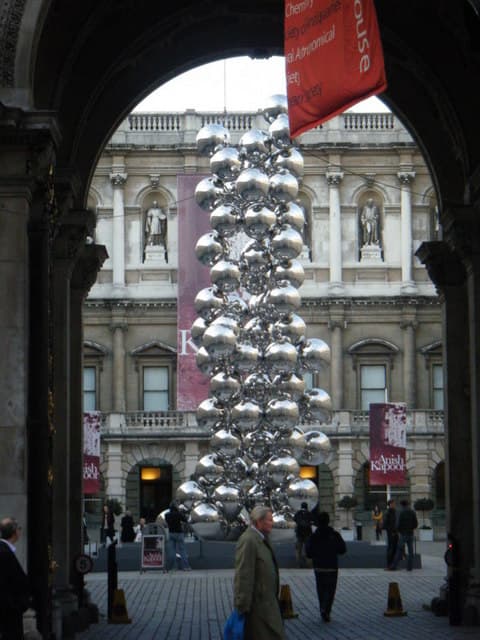
You have to push a heavy door of an old warehouse in south London to enter his studio: everywhere models, polished metal discs, puddles of dried red pigment on the floor. Anish Kapoor sits on a stool stained with color, his hands still powdery, and speaks slowly, as if searching for the void between each sentence.
—Do you remember the trip that changed your work?
I was born in Bombay in 1954, and I left India very young to come study here. But it was on returning, at the end of the seventies, that something opened up. I walked through the markets, past the temples, and there were these mounds of colored powder, pyramids of red, yellow, a blue almost violent, set right on the ground. Color wasn't decoration; it was a material, an offering. When I got back, I started 1000 Names — forms covered in pure pigment, as if rising from the ground, without a base, without explanation. I wasn't trying to represent India. I was looking for that presence, that way color has of existing even before you name it.
Color wasn't decoration; it was a material, an offering.
—Why stick to these pigments spread on the ground rather than classical sculpture?
Because a block of marble speaks of form, and form has never interested me for its own sake. When I spread pure pigment around an object, the boundary blurs: you no longer know where the sculpture ends and the air begins. The red seems to radiate, overflow, contaminate the space. I like to say I don't want to make a sculpture that speaks of form, but a sculpture that speaks of belief, or passion, or experience. These powders come from the temples of my childhood, but once placed here, in a studio in London, they become something else: a way to make visible what has no contour. Pigment is color that refuses to be a surface.
Pigment is color that refuses to be a surface.
—How was what Chicagoans ended up calling 'The Bean' born?
When I was offered a work for Millennium Park, I definitely didn't want another heavy monument placed there to crush the passerby. I wanted the opposite. What I wanted was something that seemed immaterial, as if the sky came down to us and we could walk under it. So I thought of this drop of polished stainless steel, without a single visible weld, so perfectly reflective that it swallows the skyline and turns it upside down. People immediately nicknamed it The Bean, because of its shape — and frankly, I liked that. You rename what you adopt. Cloud Gate is not a statue you look at: it's a mirror you slip under to see yourself distorted, dissolved into the city.
It's not a statue you look at: it's a mirror you slip under.
—What happens, in your opinion, in the mind of someone who leans over that surface?
They get lost, for a moment. The curve of the stainless steel stretches their face, multiplies it, inverts it, mixes their reflection with that of three strangers behind them and a piece of cloud. It's not a carnival trick, even if children enjoy it. It's a very ancient experience of perception: where am I, what is my size, where does my body end? I have always worked with the concave mirror, the one that inverts the image and digs a false void in front of you. In Chicago, with Cloud Gate, this illusion becomes collective, public, offered to thousands of people every day. The viewer is not in front of the work: they are inside it, they are part of it, they are even its subject.
—You often speak of red as something other than a color. What do you mean by that?
For me, color has a physical presence. Red is not just a color, it's a material, almost a flesh. When I project red wax and Vaseline against a wall, with a machine, it's not paint: it's meat, blood, something organic that spurts and falls. In 2002, in the Turbine Hall of the Tate Modern, I stretched Marsyas — a hundred and fifty meters of dark red membrane between three steel rings. I borrowed the name from the satyr in Greek mythology, flayed alive by Apollo. That immense skin, stretched to bursting, was exactly that: an open body. Red allows me to express the inside of the body without ever showing it.
Red allows me to express the inside of the body without ever showing it.
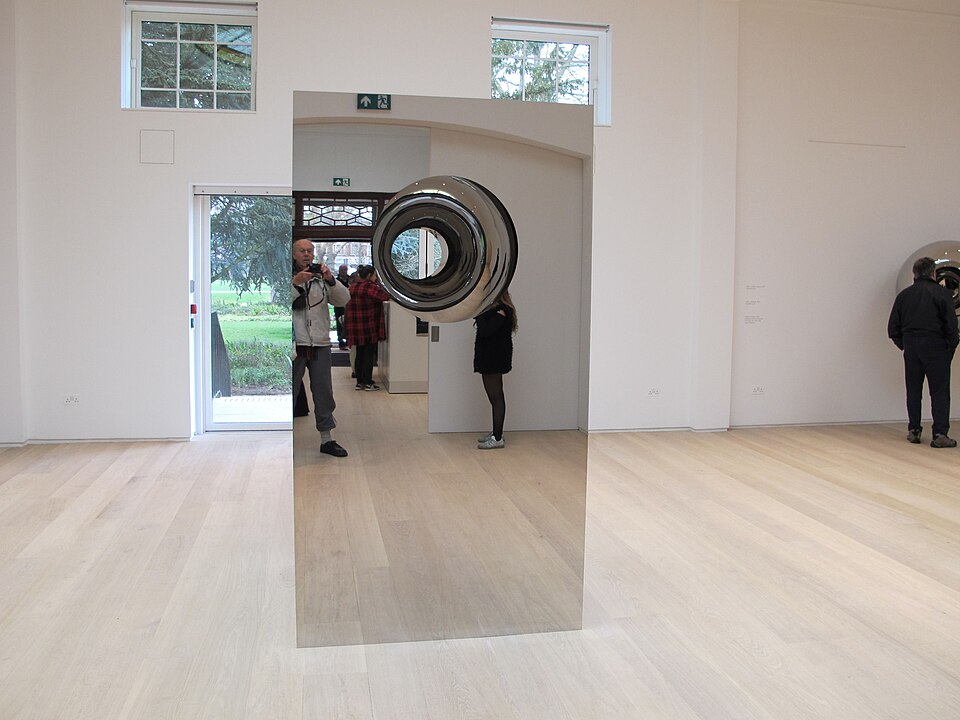
—Why this obsession with flesh and violence in works that are nonetheless abstract?
Because abstraction is not the opposite of the body, it is its naked truth. I don't sculpt figures, no faces, and yet everything I do speaks of us, of our interior, of our finitude. Marsyas has no human form, but everyone feels in front of that stretched PVC membrane that it is about skin, about torture. The greasy materials, the red wax slowly extruded like a oozing wound, say the same thing: we are fragile, perishable, made of matter. I grew up between a Jewish mother of Iraqi origin and an Indian culture saturated with rituals — two worlds where the body and the sacred never separate. Violence is not my subject; it is the price of all intensity.
—How do you approach a place as charged as the gardens of Versailles?
With the desire to disturb it a little, I admit. In 2015, when I installed Dirty Corner in the gardens of the Palace of Versailles, that long mass of steel and stones in the middle of the alleys designed by Le Nôtre, I knew it would be a shock. Versailles is order, symmetry, absolute power turned into geometry. Placing a dark, gaping, organic form there was to awaken what this garden represses. The controversy was violent, the work was even vandalized. I don't seek scandal for scandal's sake — but contemporary art that enters heritage does not have to apologize for existing. A living place must be able to withstand being asked a disturbing question.
Art that enters heritage does not have to apologize for existing.
—What attracts you to those gigantic spaces that literally need to be filled?
The vertigo of scale. In 2011, for Monumenta, I was given the immense nave of the Grand Palais in Paris, and I deployed Leviathan there — a deep purple inflatable structure so vast you could enter inside the beast. Outside, you saw a purple monster pressed against the glass roofs; inside, you were in a belly, bathed in colored light, tiny. That is what obsesses me: producing a shift in the body, not an image to look at from afar, but a space that swallows you. Whether it's the membrane of Marsyas at the Tate Modern or that Parisian whale, I always seek to transform architecture into an organism, to make the building breathe.
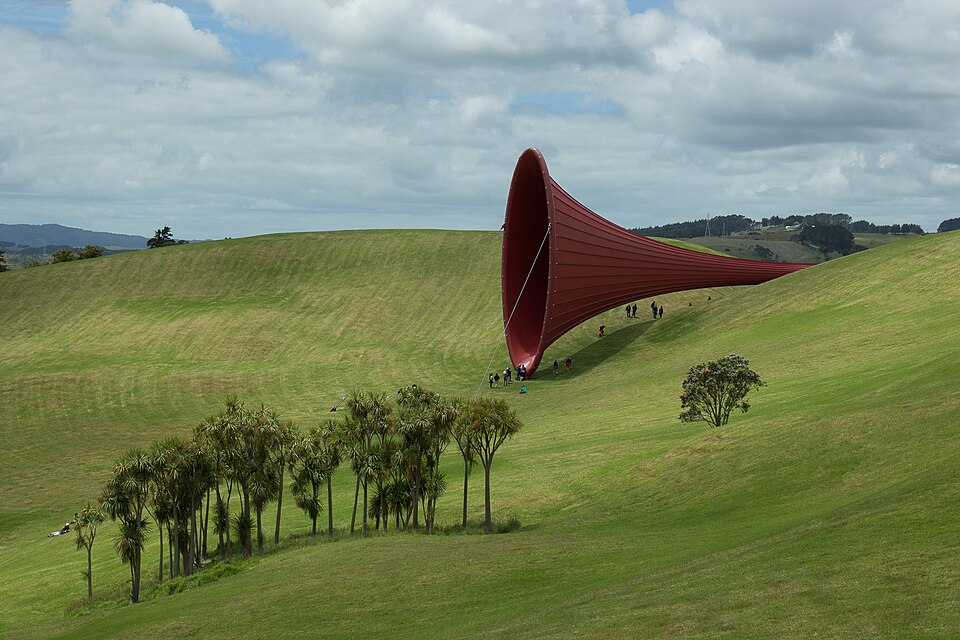
—You have been heavily criticized for having 'privatized' the blackest black. How do you experience it?
Vantablack is not really a color, it's a light trap: a microscopic forest of nanotubes that absorbs nearly all rays. In front of it, your eye sees nothing — a hole, an absence, a perfect void placed on a surface. That fascinated me immediately, because I have been pursuing this void forever. In 2014, I obtained the exclusive artistic use of it, and part of the art world reproached me furiously. Artist Stuart Semple even made the 'pinkest pink in the world' and forbade me, and only me, from using it, out of revenge. I understand the anger. But a material is never more than a tool: what interests me is not owning the black, it's digging the absence.
Vantablack is not a color, it's a light trap.
—What does this absolute black allow you to say that other materials did not?
Since my beginnings, I have dug cavities, night-blue concavities in stone, holes that seem bottomless. The viewer approaches and no longer knows if the hollow is two centimeters or two kilometers deep. With Descension, that vortex of black water swirling in the ground, I wanted the same fall: a living hole, a throat that sucks. Vantablack pushes this research to the extreme — it cancels all depth, all shadow, all reference. It looks like a piece of nothingness has been cut out and glued onto reality. What I seek there is not decorative: it is an almost metaphysical experience of the void, that moment when the eye, deprived of everything, must invent what it can no longer see.
—After so many works that reflect or swallow the viewer, what are you still searching for?
Always the same thing, basically, and I never tire of it. Whether you hold Cloud Gate, with its steel that makes the sky tangible, or a simple concavity full of pigment, the challenge remains to manufacture an experience that escapes form. I don't want people to say 'what a beautiful object'; I want them to feel a slight vertigo, a belief, a doubt about what they perceive. Every morning, in this studio in London, I discuss with my engineers, my fabricators, and often the dream far exceeds what matter allows. But it is that gap, between the immaterial I imagine and the steel that must be bent, that still keeps me standing before a work.
I don't want people to say 'what a beautiful object'; I want them to feel a slight vertigo.

This imaginary interview was generated by artificial intelligence from sources documented in Anish Kapoor's profile. It dramatises what the figure might have said based on what we know about them, but does not constitute attested historical testimony. For primary sources and factual documentation, refer to the full profile.