Kids interview Annie Oakley
by Charactorium · Annie Oakley (1860 — 1926) · Performing Arts · Sports · Society · 5 min read

Two twelve-year-old students visit an exhibition on the conquest of the West that morning. In front of an old poster, a little lady in a long skirt and big hat invites them to sit down. It’s Annie Oakley, and she has promised to tell them everything.
—What did you eat in the morning when you were little on your farm?
Ah, my child, we didn’t eat much! I was born in 1860 in Darke County, Ohio, into a poor Quaker family. My father died when I was very young. So from the age of eight, I would go out with a rifle into the woods. I hunted rabbit, quail, partridge. Imagine a little girl coming home in the evening with game for the whole family: that was my breakfast — I had to kill it first! I even paid off my mother’s farm mortgage that way. You see, I learned to aim straight because we were hungry.
I learned to aim straight because we were hungry.
—Is it true you met your husband during a shooting match?
It’s true, and what a story! I was barely fifteen. Near Cincinnati, a professional shooter named Frank Butler had bet that no one in the area could beat him. They entered me, that little country girl. Imagine his face when he saw his opponent! We shot, target after target. I beat him by a single target, just one! He was annoyed, but also… how should I say… charmed. He courted me, then married me. And the funniest part: the man I had beaten became my assistant and manager for life.
I beat him by a single target, and he became my husband.
—How did you get the nickname Little Sure Shot?
That’s a beautiful story, and it still moves me. In 1884, a great Sioux chief, Sitting Bull, came to see me shoot. You know, a Wild West Show is a traveling spectacle that reenacts the conquest of the West, with cowboys and Indians. Sitting Bull was so amazed by my precision that he wanted to adopt me, like a daughter. He called me Watanya Cicilla. The organizers translated that as Little Sure Shot. That name followed me on all the posters. Imagine: a little woman from Ohio, baptized by a great warrior chief.
A great Sioux chief named me, and that name never left me.
—What was your most impressive act on stage?
Oh, I had many! The audience held its breath. I shot a cigarette held between Frank’s lips — my husband. One bullet, pfft, and the ash flew off! I also snuffed out a candle flame with a single shot. And I riddled playing cards thrown in the air with bullets. You know, in the United States, a free ticket was long called an Annie Oakley, because it was punched with holes like my cards! But listen to me: behind the show, there were hours and hours of work. Luck doesn’t exist in shooting.
Luck doesn’t exist in shooting: there is only work.
—Did you really shoot before kings and queens?
Before the greatest, my child! In 1887, we went to London for Queen Victoria’s Jubilee. She watched me shoot, me, the little hunter from Ohio! Then, in 1889, we were in Paris for the Universal Exposition, with that brand new Eiffel Tower rising into the sky. Imagine the journey: in the morning I hunted rabbit to survive, and now the monarchs of Europe were applauding. They even say that in Berlin, I shot the ash off a cigarette held by the future Kaiser. I never forgot where I came from.
In the morning I hunted to survive, and one day queens applauded me.
—Was it hard being a woman in a sport reserved for men?
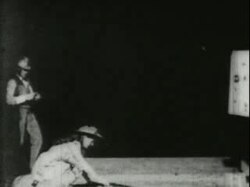
Hard, yes, but what joy to prove them wrong! In my time, they said a woman couldn’t handle a gun like a man. So one day, I hit 4,472 glass targets out of 5,000 in a single day. Those targets are glass balls thrown into the air by a machine. Imagine holding a rifle for hours without weakening! I sewed my own costumes, long skirts, to show that you could be a respectable lady AND the best shooter in the world. The two don’t conflict, my child.
You can be a respectable lady and the best shooter in the world.
—Why did you want to teach other women to shoot?
Because I believed, deep in my heart, that every woman should know how to defend herself. I taught thousands of women how to handle firearms. And in 1898, when war with Spain threatened, I wrote to President McKinley. I offered to raise a company of fifty elite lady shooters, who would provide their own guns! They didn’t listen to me, of course. But I wanted to say one simple thing: a woman is not fragile by nature. She is fragile because she is taught nothing. I wanted to teach them.
A woman is not fragile by nature: she is fragile because she is taught nothing.
—They told lies about you in the newspapers? That must have hurt.
Very much, my child. In 1903, the newspapers of a powerful man, William Randolph Hearst, wrote that I had been arrested for theft to buy cocaine. It was completely false! Another woman had given my name. But my name, you see, was my entire honor. So I fought, not with a rifle this time, but in the courts. I filed about fifty lawsuits all across the country. It lasted for years, until 1910. I won most of them. I was defending my reputation, but also that of all women who are slandered without proof.
My name was my entire honor, so I fought for it.
—Why didn’t you just drop the lawsuits? It must have been tiring, right?
Tiring, you can’t imagine! Traveling from town to town, over and over, repeating the same truth before judges. I could have stopped, pocketed some money, and kept quiet. But you know what? A false accusation, if you let it live, grows. People end up believing it. I told myself: if I, the famous Annie Oakley, give up, what ordinary woman would dare to defend herself? So I held on. Shooting had taught me patience. You don’t win a match in one shot; you win target after target.
A lie that you let live ends up growing.
—If we could see you today, what would we notice first?
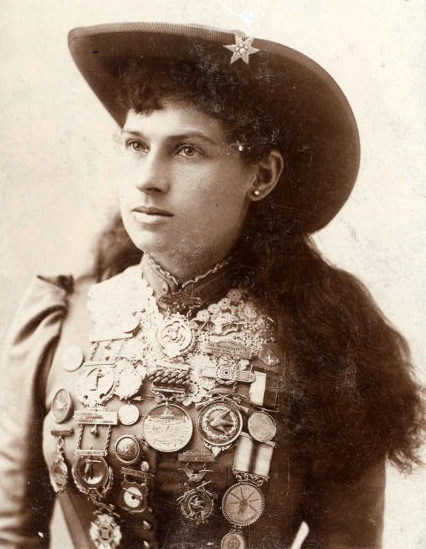
A little woman, smaller than you imagine, with a big hat adorned with a star! In 1901, a serious train accident injured my back. They say my hair turned white overnight from the shock. I underwent several operations. But I got back on stage and kept shooting straight into old age. What I want you to remember, my child, is not my skill. It’s this: I started from a penniless farm, and I never let anyone decide for me what a girl could do. Aim high, always.
Never let anyone decide for you what a girl can do.
This imaginary interview was generated by artificial intelligence from sources documented in Annie Oakley's profile. It dramatises what the figure might have said based on what we know about them, but does not constitute attested historical testimony. For primary sources and factual documentation, refer to the full profile.