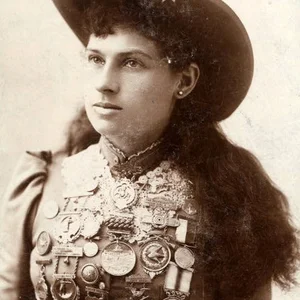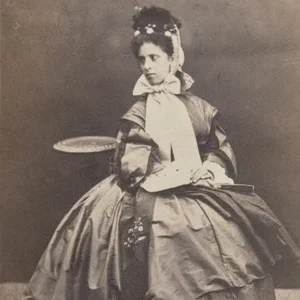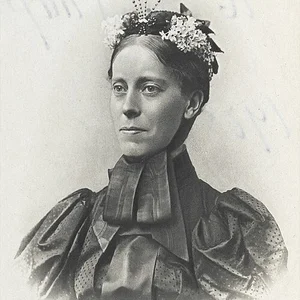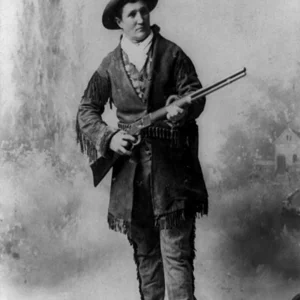

Martha Jane Cannary (c. 1852-1903), known as Calamity Jane, was a scout, stagecoach driver, and iconic figure of the American conquest of the West. A legend in her own lifetime, she performed in Wild West shows and was associated with the gunfighter Wild Bill Hickok.
Calamity Jane(1852 — 1903)
Calamity Jane
États-Unis
6 min read
Frequently asked questions
Key Facts
- Born around 1852 in Princeton, Missouri, under the name Martha Jane Cannary
- Settled in the 1870s in the Black Hills and the mining town of Deadwood, South Dakota
- Associated with the legend of Wild Bill Hickok, killed in Deadwood in 1876
- Performed in the late 19th century in traveling Wild West shows (Buffalo Bill)
- Died in 1903 in Terry, near Deadwood, and was buried beside Wild Bill Hickok
Works & Achievements
Dressed as a man, she accompanied expeditions, mule drivers, and soldiers across the Western territories — a rare occupation for a woman of her time.
She tended to smallpox victims whom many others fled from, an act that earned her genuine local recognition.
An autobiographical pamphlet that she wrote and sold herself, a key document in the building of her own legend.
She performed in leather costume and bearing arms, becoming a living attraction of frontier memory.
Even in her own lifetime, she became a character in dime novels and a lasting symbol of the free woman of the American West.
Anecdotes
In 1896, Calamity Jane had a small eight-page pamphlet printed, *Life and Adventures of Calamity Jane, By Herself*, which she sold for a few cents during her appearances. This account, in which she presents herself as a fearless scout, blends real events with spectacular exaggerations: it did much to forge her legend during her own lifetime.
According to a story she liked to tell, her nickname “Calamity” was given to her by an officer she supposedly rescued from an ambush, after she warned that defying this woman would bring down “calamity.” Historians regard this version as unverifiable: the nickname more likely came from her rowdy temperament and her boisterous reputation.
During the smallpox epidemic that struck the mining camp of Deadwood around 1878, several accounts report that Martha Jane nursed the sick whom many others fled out of fear of contagion. This generosity, in sharp contrast with her reputation as a brawling drunkard, earned her genuine affection across the region.
Late in her life, she performed in traveling “Wild West” shows and dime museums, such as those run by Kohl & Middleton, where she posed in a leather outfit with her guns. The public paid to see “the real Calamity Jane,” turned into a living attraction of the conquest of the West.
When she died in 1903, she was buried in Mount Moriah Cemetery in Deadwood, right beside the grave of Wild Bill Hickok. It is said this was her final wish; since she had always implied a great closeness with the famous gunslinger, this shared burial place permanently sealed their association in legend.
Primary Sources
“My maiden name was Marthy Cannary. I was born in Princeton, Missouri, May 1st, 1852.” (a heavily embellished account that she sold herself)
Period articles recounting the presence and antics of “Calamity Jane” in the streets and saloons of Deadwood during the Black Hills gold rush.
Mentions of a woman, dressed as a man, accompanying the columns of soldiers and mule drivers heading toward Sioux territory.
Key Places
Town where Martha Jane Cannary is said to have been born around 1852, into a poor family that later set off westward.
Mining camp where her family migrated during her childhood, at the heart of the Montana gold rush. Orphaned young, she learned there how harsh frontier life could be.
A major military post along the western trails, a starting point for expeditions into Indian territories. Calamity Jane is said to have gravitated around these columns of soldiers and mule drivers.
Turbulent gold camp in the Black Hills where she settled in 1876 and built her reputation. It is the town with which her name remains most closely associated.
Small mining settlement near Deadwood where Martha Jane died in 1903, sick and destitute.
Cemetery where she was buried in 1903, right next to the grave of Wild Bill Hickok. The site has become a place of memory for the legend of the Old West.
Typical Objects
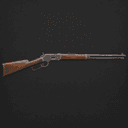
An iconic lever-action rifle of the West, capable of firing several shots without reloading. Calamity Jane was famous for her marksmanship and often posed armed for photographers.
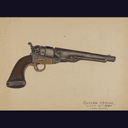
A handgun common among men and women alike on the frontier. It was part of the outfit Calamity Jane wore to play her role as a fearless figure of the West.
📷 CC0 · Wikimedia Commons ↗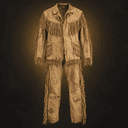
A fringed leather jacket and trousers, often worn by scouts and trappers. Calamity Jane frequently dressed as a man, which was rare and remarked upon for a woman of her time.
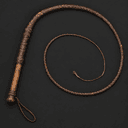
A long whip used to guide the team of horses or mules pulling the stagecoach. Calamity Jane boasted of having driven stagecoaches along the dangerous trails of the Black Hills.
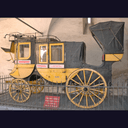
A horse-drawn carriage carrying passengers, mail, and goods between the towns of the West. It connected isolated mining camps despite the risk of attacks.
📷 CC BY-SA 3.0 · Wikimedia Commons ↗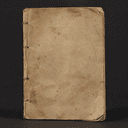
A small printed booklet of a few pages in which Calamity Jane told the story of her life, and which she sold to the public herself. It was one of the main tools through which she built her own legend.
School Curriculum
Vocabulary & Tags
Key Vocabulary
Tags
Daily Life
Morning
On the trails, the day began early, at dawn: horses or mules had to be hitched, harnesses and loads checked before setting off. In mining camps like Deadwood, people woke later, especially after a night spent in the saloons.
Afternoon
Afternoons were spent driving a team, hauling mail or freight, or doing small jobs for a few coins. Life was unstable, made up of irregular work as a mule driver, a helper, or an occasional scout.
Evening
In the evening, social life in the West centered on the saloons: people played cards, drank, and swapped stories. Calamity Jane was a regular there, renowned for her colorful manner, her tall tales, and her fondness for whiskey.
Food
Frontier food was rough fare: bison or beef, salt pork, beans, flour cakes (biscuits, camp bread), and strong coffee. Fresh fruit and vegetables were scarce in the isolated camps.
Clothing
She often wore men's clothing: a fringed leather outfit (buckskin), trousers, a shirt, boots, a wide-brimmed hat, and weapons on her belt. This choice, scandalous to many at the time, was part of her persona.
Housing
She never had a stable home: sometimes in a tent or under the stars while traveling, sometimes in makeshift rooms, mining-camp cabins, or modest boarding houses in towns like Deadwood.
Historical Timeline
Period Vocabulary
Liens externes & ressources
Références
Œuvres
Travail d'éclaireuse et de conductrice auprès des convois et des colonnes militaires
années 1870
Soins aux malades lors de l'épidémie de variole de Deadwood
vers 1878
« Life and Adventures of Calamity Jane, By Herself »
vers 1896
Apparitions dans les spectacles du « Wild West » et les musées de curiosités
années 1880-1890
Construction d'une figure légendaire de la conquête de l'Ouest
fin du XIXe siècle