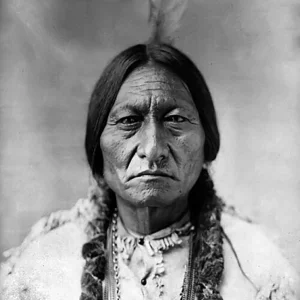

Sitting Bull (c. 1831-1890) was a chief and medicine man (wičháša wakȟáŋ) of the Hunkpapa clan of the Lakota Sioux. A leading figure of Native American resistance against the expansion of the United States, he embodied the defense of the territory and the way of life of the Plains.
Sitting Bull(1831 — 1890)
Sitting Bull
États-Unis
7 min read
Frequently asked questions
Key Facts
- Born around 1831 in the region of present-day South Dakota, among the Hunkpapa Lakota people
- Led and inspired the Sioux and Cheyenne coalition at the Battle of the Little Bighorn (June 25, 1876), where Lieutenant Colonel Custer and the 7th Cavalry were wiped out
- Went into exile in Canada in 1877 to escape the U.S. Army, before surrendering in 1881
- Took part in Buffalo Bill's Wild West Show in 1885, becoming a celebrity
- Killed on December 15, 1890 during his arrest, amid the Ghost Dance movement, shortly before the Wounded Knee Massacre
Works & Achievements
Sitting Bull managed to gather around him a great number of bands determined to resist American expansion, becoming a leader recognized well beyond his own tribe.
Spiritual leader of the united camp, he embodied the resistance during the most resounding defeat inflicted on the American army during the Indian Wars.
A set of drawings recounting his own exploits, which became a precious source on his life and on the warrior culture of the Plains, today preserved in museum collections.
A prolonged refusal to submit, leading his band out of reach of the American army, a gesture that made him a lasting symbol of Native freedom.
His presence in Buffalo Bill's show made him a famous figure throughout North America, arousing both admiration and controversy.
He allowed the Ghost Dance religious movement to be practiced in his camp, which precipitated his arrest and his death.
Anecdotes
In the spring of 1876, during a great Sun Dance on the Rosebud River, Sitting Bull had a hundred small pieces of flesh cut from his arms and danced for hours until he fell into a trance. There came a vision: American soldiers falling head first into the Indian camp, “like grasshoppers.” A few weeks later, the victory at Little Bighorn seemed to confirm his prophecy.
His childhood name was “Slow” (Húŋkešni), because he did everything with care and deliberation. At about fourteen, after riding alongside the warriors and striking a Crow enemy in battle (an act of bravery called “counting coup”), his father passed on his own name to him: Tȟatȟáŋka Íyotake, “The Buffalo Bull Who Sits Down.”
In 1885, Sitting Bull traveled for a few months with Buffalo Bill Cody's “Wild West Show.” There he struck up a friendship with the sharpshooter Annie Oakley, whom he affectionately nicknamed “Little Sure Shot.” It is said that he often gave the money he earned to the poor children and beggars he came across in the cities.
After Little Bighorn, hunted by the U.S. Army, Sitting Bull led his band to Canada in 1877, which he called “the Land of the Grandmother” (in reference to Queen Victoria). He stayed there four years, but the disappearance of the buffalo and the resulting hunger forced him to return and surrender in 1881.
On December 15, 1890, Indian police came to arrest him at dawn in his cabin on the Standing Rock Reservation, fearing that he would join the Ghost Dance movement. A scuffle broke out, shots were fired, and Sitting Bull was killed. His death came just two weeks before the Wounded Knee Massacre.
Primary Sources
A series of drawings in which Sitting Bull depicts his own feats: hunts, horse captures, and battles against the Crows and the soldiers, each scene linking him to his name through a figure of a buffalo.
“What treaty that the white man ever made with us have we, the red men, broken? Not one. What treaty has the white man ever kept? Not one.”
“I am a red man. If the Great Spirit had desired me to be a white man, he would have made me so in the first place.”
“I am the last of my people to lay down my rifle,” he said as he handed over his weapon through his young son Crow Foot.
Key Places
The region where Sitting Bull was born around 1831, on the Hunkpapa hunting grounds. It was also near there, on the Grand River, that he was killed in 1890.
Site of the great victory of the allied nations over Custer's 7th Cavalry on June 25 and 26, 1876. Sitting Bull was the spiritual leader of the large gathered camp.
The region where Sitting Bull and his band took refuge from 1877 to 1881, which he called “the Grandmother's Land.” Hunger eventually forced him to return.
Military post where Sitting Bull surrendered on July 20, 1881, handing over his rifle through his son Crow Foot.
Reservation where Sitting Bull spent his final years after his captivity and where he was killed in 1890. A grave and memorials there keep his name alive.
Site of the Sun Dance of June 1876 where Sitting Bull had his vision, and very close to the field of the Battle of the Rosebud a few days later.
Typical Objects
A headdress adorned with eagle feathers, each one marking a feat of war by its wearer. It signaled the rank and honor of a respected Lakota chief.

A ritual long-stemmed pipe whose bowl is carved from red stone (catlinite). Smoked during councils and prayers, it sealed agreements and connected people to the Great Spirit.

A short-handled striking and throwing weapon tipped with a blade or a stone. As much a tool of close combat as a symbol of warrior status.

A disc of thick bison hide, adorned with designs and feathers received in a dream and believed to grant spiritual protection. Its power was judged to be as much magical as material.

The hunting and war weapon of the Plains horsemen, fearsome and silent against bison and enemies alike. Still widely used even after the arrival of firearms.

A conical tent made of poles and sewn hides, raised and taken down quickly to follow the herds. The typical mobile home of the nomadic nations of the Plains.

A series of drawings through which Sitting Bull himself recounted his feats of war and his hunts. A form of autobiography in pictures, without alphabetic writing.
School Curriculum
Vocabulary & Tags
Key Vocabulary
Tags
Daily Life
Morning
The morning began early, at sunrise, often with a prayer turned toward the east and the day's star. The horses were checked, weapons were prepared for the hunt, and the women rekindled the tipi fire for the first meal.
Afternoon
The afternoon was devoted to hunting bison on horseback, to breaking horses or, for a medicine man like Sitting Bull, to healing, dreams and counsel. The women tanned the hides, prepared the meat and kept up the camp.
Evening
In the evening, the camp gathered around the fires to share food, recount feats of war and pass on stories and songs. The councils of the chiefs and elders were often held at nightfall, the pipe passing from hand to hand.
Food
The diet rested above all on the bison: meat eaten fresh, roasted or dried, and pemmican (pounded dried meat mixed with fat and berries). To this were added game, roots, wild fruits and berries gathered with the seasons.
Clothing
Clothing was made from deer and bison hides: tunics and leggings for the men, dresses for the women, moccasins embroidered with porcupine quills or beads. Renowned warriors wore shirts and headdresses adorned with eagle feathers marking their exploits.
Housing
People lived in the tipi, a conical tent of poles covered with bison hides, easy to put up and take down in order to follow the herds. The camp moved with the seasons and the migrations of the game, the hearth occupying the center of the dwelling.
Historical Timeline
Period Vocabulary
Liens externes & ressources
Références
Œuvres
Unification des bandes lakotas, cheyennes et arapahos
années 1860-1876
Victoire de Little Bighorn
25-26 juin 1876
Autobiographie pictographique
vers 1870
Exil et résistance au Canada
1877-1881
Tournée avec le Wild West Show de Buffalo Bill
1885
Soutien à la Danse des Esprits
1890