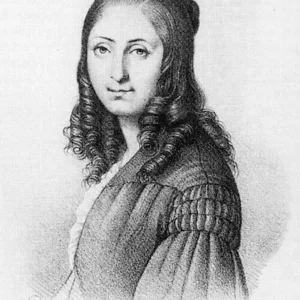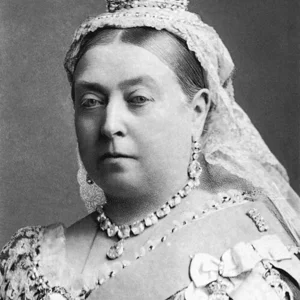

Victoria ascended to the British throne at 18 in 1837 and reigned for 63 years, becoming one of the most influential monarchs in history. Her reign coincided with the height of the British Empire and the Industrial Revolution. She gave her name to an entire era: the Victorian age.
Victoria(1819 — 1901)
Victoria
Royaume-Uni de Grande-Bretagne et d'Irlande
8 min read
Frequently asked questions
Famous Quotes
« We are not amused.»
« The important thing is not what they think of me, but what I think of them.»
Key Facts
- Ascended to the throne at 18 in 1837, following the death of her uncle William IV
- Proclaimed Empress of India in 1876 by the British Parliament
- Her 63-year reign was the longest in British history until Elizabeth II
- Married Prince Albert of Saxe-Coburg and Gotha in 1840, with whom she had nine children
- At her death in 1901, the British Empire covered approximately 25% of the world's land surface
Works & Achievements
Victoria becomes Queen of the United Kingdom at 18, succeeding her uncle William IV. She ushers in a new era marked by political stability and the expansion of the British Empire.
Victoria marries her cousin Albert of Saxe-Coburg and Gotha, a union that strengthens dynastic ties across Europe and introduces a new vision of royal life centered on family and duty.
Victoria and Albert organize the Great Exhibition in London, a showcase of industrial progress and British power. The event reinforces the prestige of Victorian Britain on the world stage.
Victoria is proclaimed Empress of India, consolidating British control over the Indian subcontinent. The title symbolizes the zenith of the British Empire.
Under Victoria's reign, the United Kingdom experiences a period of stability that fosters the rise of the middle class, the expansion of male suffrage (1884), and a wide range of social reforms.
Victoria becomes the embodiment of virtue, respectable family life, and moral order, lending her name to an entire era — the Victorian Age. Her influence extends far beyond British politics.
Anecdotes
In 1840, Queen Victoria married her cousin Prince Albert in a grand ceremony in London. She wore a white silk gown — a revolutionary choice that shaped Western bridal fashion for generations. This love match became the ideal model of married life for the Victorian era.
In 1861, following the death of her beloved husband Albert, Victoria entered a deep mourning that would last 40 years. She wore black every day and withdrew from public life, earning her the nickname 'the Widow of Windsor.' This extraordinary grief was a testament to the profound love she had for Albert.
In 1897, at the age of 78, Victoria celebrated her Diamond Jubilee, marking 60 years on the throne as Queen of the United Kingdom. The grand occasion drew delegations from across the British Empire and stood as a symbol of Britain's power at its peak. It was one of the most spectacular celebrations of the 19th century.
Victoria became the grandmother of numerous European monarchs, earning her the nickname 'the grandmother of Europe.' Her grandchildren sat on the thrones of Russia, Germany, Norway, and other kingdoms, weaving a web of royal kinship that shaped European politics well into the 20th century.
In 1887, Parliament granted Victoria the title 'Empress of India,' symbolically uniting her crown with that of Britain's vast colonial empire on the subcontinent. The title reflected the height of British imperial power and the queen's unparalleled political reach.
Primary Sources
I am in perfect health and never felt better in my life. I have no trial, no worry of any kind. I have a very happy home, a devoted husband, and excellent children.
We are not amused.
I will be good. I understand now what they mean and I will be good.
We have every reason to believe that the severe trials through which we have been called to pass have been blessings in disguise.
His pure and noble nature, his great talents and his devotion to duty have earned for him the esteem and affection of all who knew him.
Key Places
Birthplace of Queen Victoria on 24 May 1819. This royal palace was her childhood residence and remains a major symbol of her private life.
Victoria's principal official residence as queen. She established it as the seat of British royal power during her long reign of 64 years.
Scottish residence acquired by Victoria and her husband Albert in 1848. She made it her favourite retreat, and it became a symbol of the royal couple's modern outlook.
Seaside palace built at the request of Victoria and Albert from 1845. It served as their private summer residence and the heart of their family life.
Site of Victoria's coronation on 28 June 1837 and the church where the great royal ceremonies took place. She is also commemorated there after her death.
Funerary monument built by Victoria in memory of her husband, who died in 1861. It stands as a testament to the queen's deep love for Prince Albert.
Typical Objects

The diamond and gemstone crown worn at her coronation in 1838. A symbol of Victoria's royal power and her 63-year reign over the British Empire.

The white silk dress worn at her marriage to Prince Albert in 1840. This gown popularized the white wedding dress across Europe, transforming bridal traditions.

A symbol of the 19th-century British Industrial Revolution. Victoria championed technological innovation and rode the early railways, helping to modernize transportation.

A photographic portrait of Victoria and her family. She was one of the first monarchs to be widely photographed, bringing the image of royalty to a broader public.

Victoria kept a daily journal for over 70 years, offering a personal account of her life and times. These diaries are an invaluable historical source on the 19th century.

A symbol of the expansion of the British Empire during Victoria's reign. The Victorian era marks the height of British colonial power.

A major invention of the 19th century enabling rapid long-distance communication. Victoria supported its development, connecting the far-flung reaches of her Empire.

Victoria wore mourning dress for 40 years following the death of Prince Albert in 1861. This attire became emblematic of the strict Victorian dress code.
School Curriculum
Vocabulary & Tags
Key Vocabulary
Tags
Daily Life
Morning
Queen Victoria wakes in her royal apartments, usually around 8 o'clock. She takes a light breakfast of tea, porridge, and toast before consulting her secretaries and reviewing the official dispatches requiring her attention. She dresses with the help of her ladies-in-waiting, donning the formal gowns and rigid corset demanded by Victorian court etiquette.
Afternoon
The afternoon is devoted to affairs of state: audiences with ministers, signing official documents, and managing government business. Victoria also receives distinguished visitors and presides over formal audiences. She reserves time for personal pursuits as well, such as painting, writing in her daily diary, or strolling through the gardens of the royal palaces.
Evening
In the evening, the Queen presides over formal dinners or family meals depending on the occasion. She attends concerts, theatrical performances, or diplomatic receptions in the ballroom. Before retiring, she dedicates time to personal correspondence — particularly to her children and wider family — before withdrawing for the night at around 10 o'clock.
Food
Victoria's diet favours refined dishes and the finest ingredients: choice meats, delicate fish, and imported fruits and vegetables. Royal meals consist of several elaborate courses, accompanied by fine wines. She regularly drinks tea imported from her colonies, and has a fondness for the pastries and confections that grace her table.
Clothing
Victoria wears long gowns of rich fabric, fitted over the corset that was obligatory even at home. Her outfits are adorned with lace, brooches, and precious jewels. Following the death of her husband Albert in 1861, she adopted black-and-white mourning dress, which she would wear for the rest of her life, along with the distinctive widow's cap she became known for.
Housing
Victoria reigns from Britain's most prestigious royal palaces: Buckingham Palace in London, Windsor Castle, Balmoral in Scotland, and Osborne House on the Isle of Wight. These magnificent residences contain hundreds of rooms, elaborate gardens, and are run by a considerable staff. Each palace is equipped with the most modern amenities of the Victorian era, reflecting the power and prestige of the British monarchy.
Historical Timeline
Period Vocabulary
Visual Style
Un style pictural néoclassique et majestueux évoquant les grands portraits officiels du XIXe siècle, combinant la précision académique avec la splendeur impériale. L'ambiance allie élégance solennelle et richesse matérielle caractéristique de l'époque victorienne.
Sound Ambience
Une ambiance sonore raffinée évoquant les palais victoriens du XIXe siècle : mélodies classiques au piano, tintements de cloches, crépitement des feux de cheminée et pas majestueux sur le marbre, créant une atmosphère d'autorité impériale tempérée par l'élégance britannique.
Liens externes & ressources
Références
Œuvres
Accession au trône britannique
1837
Mariage avec le prince Albert
1840
Exposition universelle de 1851
1851
Proclamation d'Impératrice des Indes
1876
Stabilité politique et réformes sociales
1837-1901
Influence culturelle et morale
1837-1901