Imaginary dialogue between Anna Girò and Antonio Vivaldi
by Charactorium · Antonio Vivaldi (1678 — 1741) · Music · 5 min read
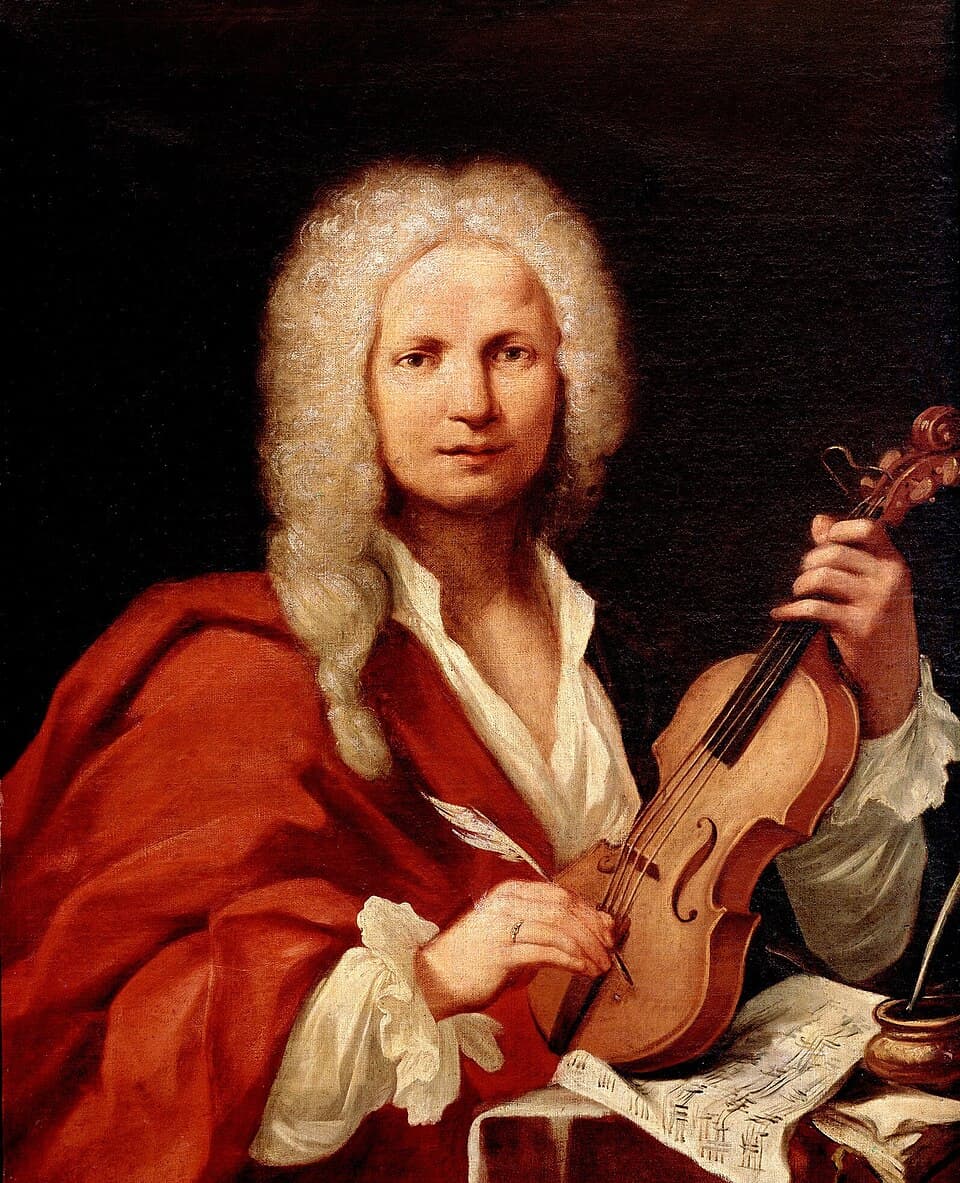
It is on the Riva degli Schiavoni, a stone's throw from the Ospedale della Pietà, that Anna Girò meets Antonio Vivaldi one autumn evening in 1739. The light of a candle trembles over stacked scores, and through the window one hears the lapping of the lagoon. The singer has known the maestro for years: she has sung the lead roles in his operas, shared his triumphs and the rumor that dogs them. This evening, sensing that he is thinking of leaving Venice, she comes to get him to talk about the man behind the Prete Rosso.
—Don Antonio, they still call you il Prete Rosso all over Venice. Why did you leave the altar so soon after your ordination in 1703?
Anna, you who have seen me recite my breviary between two rehearsals, you know that I never renounced my priesthood. I was ordained in 1703, and for nearly a year I went up to the altar. But this ailment that constricts my chest since birth — this oppression that doctors call asthma — forced me three times to leave mass before finishing it. So I stopped, by my own choice, not by prohibition. I owe the nickname Prete Rosso to this red hair you know well; it amuses me more than it wounds me. God did not want me at the altar, but He gave me the violin. That is my way of serving Him, and I believe He hears it just as well.
God did not want me at the altar, but He gave me the violin.
—You spent nearly forty years at the Pietà. Travelers come from all over Europe to hear your pupils: what makes them so rare?
These girls, Anna, are orphans, children without a name whom the state raises behind the grilles of the ospedale. They are taught only one thing: to excel in music. And they excel to the point that a passing French president, that Charles de Brosses, swore he had heard them sing like angels. Violin, flute, organ, oboe, cello: they master everything. It is for them that I wrote most of my concertos, and my Gloria in D major. The public sees only silhouettes behind a lattice, but I know every bow, every breath. Forty years shaping those voices... perhaps it is there, more than at the altar, that I have truly been a priest.
—They say you compose faster than your copyist can copy. Is that maestro vanity, or the truth I have seen with my own eyes?
You have seen me do it, Anna, so you are not fooled: yes, I can throw a concerto onto paper faster than my copyist can copy it. It is not vanity, it is necessity — the Pietà demands something new every Sunday, the theaters every season. They say I have written more than five hundred concertos, and some wits murmur that it is always the same one, rehashed. Let them try! Beneath the apparent resemblance, each piece seeks its own color, its own challenge. The title of my opus 8 says it plainly: Il cimento dell'armonia e dell'inventione, the contest of harmony and invention. Composing quickly is not composing soullessly.
—Your Four Seasons are all the rage. Why did you add those sonnets that tell of the storm, the barking dog, the ice of winter?
Because I want people to HEAR what the music tells, Anna. In the Four Seasons, I wanted to paint the bird's song in spring, the bite of cold, the storm breaking over the harvest. I added sonnets to the score, so that the listener might grasp the feelings that the notes seek to express. The ritornello — that refrain of the orchestra that returns between the soloist's passages — serves as my thread: it brings the ear back to the landscape between each episode. A concerto lives from this movement: fast, then slow, then fast. Music is not an abstract ornament; it imitates life, the wind, the water of our lagoon. That is what I pursue relentlessly.
—At the Sant'Angelo, you are not only a composer but an impresario. Isn't that a burden, the accounts, the singers to pay, the risks?
A burden, and a freedom, Anna. As impresario of the Sant'Angelo, I carry everything on my shoulders: hiring the voices, paying the set designers, calculating the takings, bargaining over every libretto. A failed opera can ruin me; a success fills my coffers. Many reproach me for thus mixing the priest, the composer, and the merchant. But who better than I knows what my music demands on a stage? I prefer to risk my own gold than depend on the whim of a director. Venice devours novelties; one must produce, produce again. You who step onto those boards know the price of each evening — the anxiety before the curtain rises, and the intoxication when the hall finally applauds.
—Don Antonio, let's speak plainly. In 1737, Cardinal Ruffo closed Ferrara to you because of me, because of our closeness. How did you bear that infamy?
Plainly, then: that ban hurt me more than anything. Cardinal Ruffo closed Ferrara to my operas on the pretext that a priest could not live near a singer. But what do they know of us, those gentlemen in purple? You sing my roles better than anyone, you carry my music to the public — that is our bond. They turned you into a scandal; I know what you are worth on a stage, and what you are to me: a faithful friend, a voice I have shaped. Let them reproach me for my temper and my affairs, so be it. But to sully your name to reach me, that I do not forgive. Calumny costs more than a failed opera.
Calumny costs more than a failed opera.
—Do you remember when I sang in your Orlando furioso? What did you expect from a voice like mine in that opera drawn from Ariosto?
How could I forget it, Anna? Orlando furioso is one of my most accomplished operas, and I wrote certain arias thinking of your voice, its suppleness, your way of sustaining fury without ever shouting. Ariosto gave me Orlando's madness, Alcina's enchantments — everything that dramma per musica loves: magic, passions, reversals. A composer can write the most beautiful notes; without an interpreter who embodies them, they remain mute on paper. You give flesh to what I imagine. When the audience holds its breath at your aria, it is our joint work that triumphs, not mine alone. That is why I am so keen to have you in my casts.
—They say you are weary of Venice, tempted to head north. Are you truly thinking of leaving the lagoon to seek fortune elsewhere?
I am thinking of it, yes, and it pains me. Venice tires quickly; fashions change, and the public already runs to younger pens. Emperor Charles VI once received me with a favor that no Italian prince ever showed me — he loves my music, he said. In Vienna, perhaps I will find the protector that my own city now refuses me. A musician without a patron is a boat without oars, Anna. I do not leave lightheartedly: everything I have built is here, at the Pietà, at the Sant'Angelo. But a man must go where his art is still wanted. If the emperor extends his hand, I will go, even if I must start all over there.
—Maestro, you speak of fashions that pass. Are you not afraid that after you, Venice will forget even the name of the Prete Rosso?
Fear, yes, I admit it to you alone. Our Venice devours the new and discards the old like a libretto after the last performance. I have hundreds of scores piled up, concertos that no one may ever play again when my hand has stopped. A living composer already neglected — what will remain of the Prete Rosso under the dust? I have neither fortune nor son to keep my memory alive. But I tell myself this: true music has a long life. One day, perhaps, someone will open these notebooks again and hear anew the spring, the storm, the lagoon. If even a single page of mine survives to make an unknown heart beat, I will not have written in vain.
If even a single page of mine survives to make an unknown heart beat, I will not have written in vain.
This imaginary interview was generated by artificial intelligence from sources documented in Antonio Vivaldi's profile. It dramatises what the figure might have said based on what we know about them, but does not constitute attested historical testimony. For primary sources and factual documentation, refer to the full profile.