Imaginary interview with Ban Zhao
by Charactorium · Ban Zhao (45 — 116) · Philosophy · Literature · 5 min read
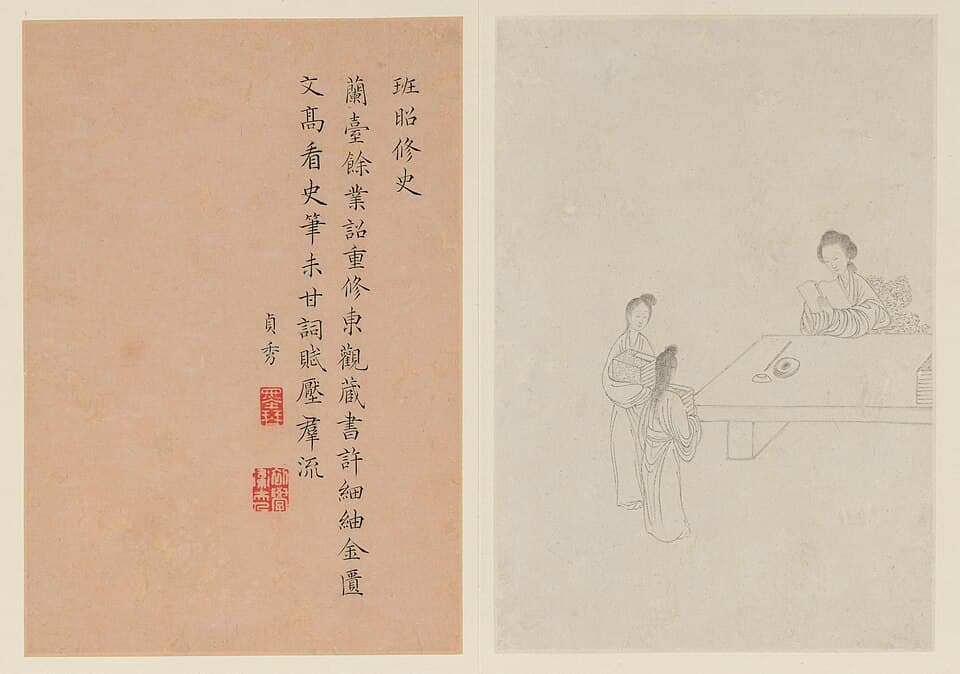
In the heart of Luoyang, in the Eastern Pavilion where the Han archives sleep, a woman in dark robes looks up from a bamboo scroll. The oil lamp lights her wrinkled face: it is Ban Zhao, whom the palace ladies call the Grand Lady. She agrees to set down her brush for a moment to speak about her life as a historian.
—How would you describe the house where you grew up?
I was born in Fufeng, in a home where one breathed ink as others breathe cooking smells. My father Ban Biao was already gathering materials for a great history of the Han; my brother Ban Gu bent over scrolls, and my other brother, Ban Chao, dreamed of the Western roads before leaving, in the year 73, to reopen the routes to Central Asia. They say he once threw down his brush to take up the sword. I, I kept that brush. In our family, letters and arms were twin brothers, and I chose to serve letters, because it is through them that a name crosses the centuries while horses, they end in dust.
In our family, letters and arms were twin brothers.
—What happened the day the emperor entrusted you with the Book of Han?
My brother Ban Gu died in prison, in the year 92, and with him the work of our whole house stopped. The Hanshu remained unfinished like a dike half-built that lets the river through. Emperor He summoned me — me, a woman — to finish what the men of my family could not complete. I crossed the threshold of the Eastern Pavilion, that Dongguan where the official texts are kept, and I took up the eight chronological tables and the Treatise on Astronomy. My hands trembled before the columns of names and reigns, but I told myself that completing the work of a dead man is to prevent him from dying entirely.
Completing the work of a dead man is to prevent him from dying entirely.
—What was the hardest part of this work as a historian?
The Treatise on Astronomy cost me more nights than all the rest. I had to match the movements of the heavens to the dates of the reigns, verify every eclipse, every conjunction, using the armillary sphere — the hun yi, that sphere of bronze rings that imitates the celestial circles. One wrong character, and the order of the world seemed faulty under an emperor's reign. I worked at the inkstone before dawn, grinding the stick on the yàntái until the ink was black enough to last a thousand years. People think writing history is telling stories; no: it is weighing. Every word I placed on silk weighed the weight of a dynasty.
People think writing history is telling stories; no: it is weighing.
—For whom did you first write the Lessons for Women?
I did not write the Nüjie, around the year 106, to instruct the empire. I wrote it for my daughters, who would soon leave my house for their in-laws', and whom I feared would be clumsy, ill-armed, exposed to shame. I spoke of humility: to show herself respectful and reserved, to come after others, to suffer insult without complaint. They reproach me today for this restraint. But let them understand me: under the San cong si de, the three obediences, a woman without education is only a servant. I wanted my daughters to know how to read, calculate, reason — for a woman who knows is a woman who cannot be deceived.
A woman who knows is a woman who cannot be deceived.
—Many read you as a woman who chained women. What would you say to them?
I know this reproach, and I do not flee it. Yes, in the Nüjie, I taught deference to the husband and in-laws, as required by the rújiā, the Confucianism that governs every Han household. But look closely: our fathers teach the Classics to their sons from age eight and leave their daughters in ignorance. Is that not the true imbalance? I wrote that girls should be educated as much as boys. In a world where women are considered household furniture, to demand that they be taught rites and letters is not to tighten the chain — it is to reach out toward dignity.
To demand that girls be educated is not to tighten the chain, it is to reach out toward dignity.
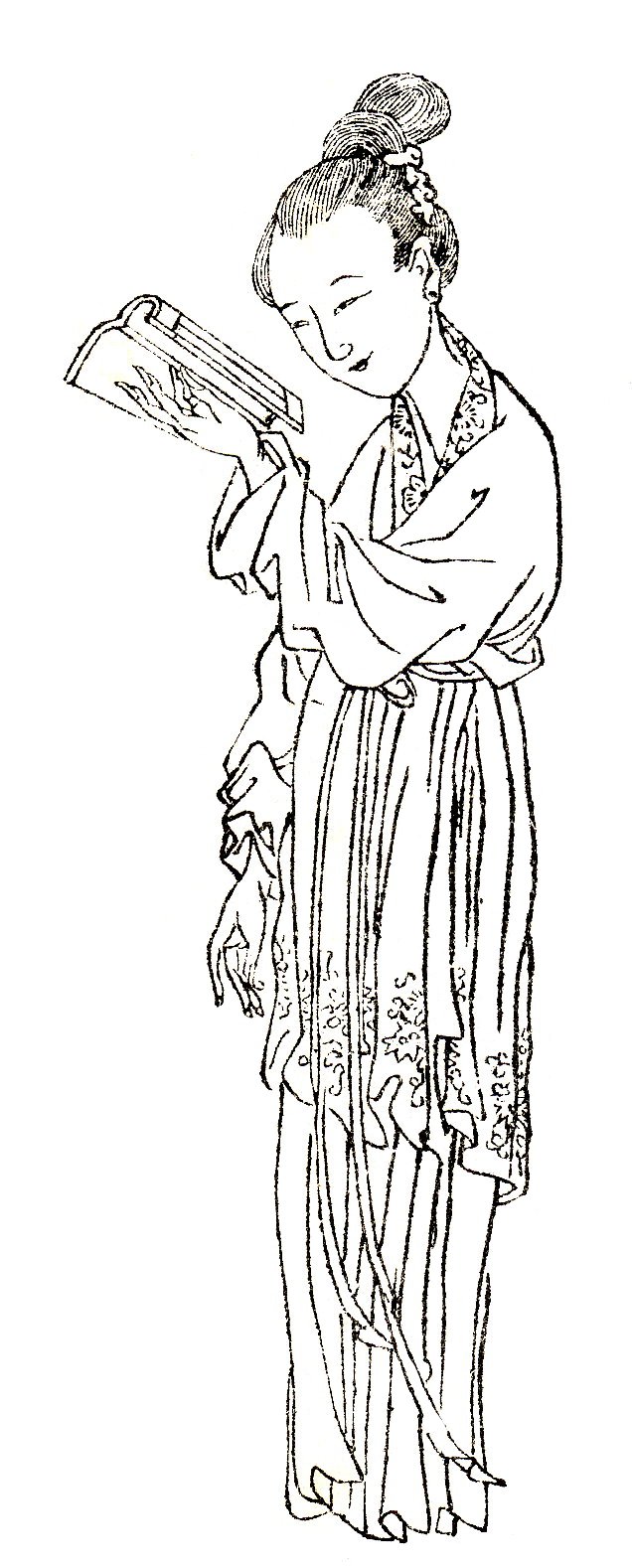
—How did you become the preceptress of the palace ladies?
Empress Deng Sui, who became regent, summoned me to the Luoyang palace. She held me in such esteem that she consulted me on state affairs, and the court ladies called me the Grand Lady. My afternoons were spent teaching them what is usually reserved for men: calligraphy, Han history, mathematics, and astronomy — I showed them how to read the course of the stars on the rings of the armillary sphere. Seeing these young women, veiled in silk, leaning over the columns of the sky like scribes — that was my sweetest victory. I had opened a door I thought walled up for my sex.
Seeing these young women leaning over the columns of the sky: that was my sweetest victory.
—What did an ordinary day at the palace demand of you?
I rose before the roosters' crow to trace my characters with the brush, the máobǐ of animal hair — calligraphy is for us what prayer is for monks, a discipline of the soul before being an art. Then the scribes brought me silk scrolls and bamboo tablets from the imperial library, and I checked the copies of the Hanshu before teaching. The clepsydra, that water clock that drips in the silence of the Dongguan, marked my hours better than any servant. At evening, by the lamp, I reread the sources and sometimes received a scholar who came to debate a point of doctrine. A scholar's day is nothing glorious: it is a thousand small patient gestures.
Calligraphy is for us what prayer is for monks.
—Your poems often speak of separation. Where does this melancholy come from?
I composed the Dong Zheng Fu, the Fu on the Eastern Journey, around the year 110, on the road that took me away from my family. The fu, that genre where prose and verse mingle, is the only garment ample enough to contain grief. I spoke of the plains stretching out of sight, the wind on the yellowed grasses, and my heart suffering from the distance. People know me as the historian of precise tables, but behind the columns of dates there was a woman who watched those she loved grow distant. History counts emperors; the fu, it counts tears. I needed both to be whole.
History counts emperors; the fu, it counts tears.
—At the end of your life, what occupies your thoughts?
My son is posted far away, and old age has made me like a scroll whose silk is cracking. I wrote an elegy to express this separation, this time that flows like the water of the clepsydra without any hand being able to hold it back. I am not afraid to end my days here, in Luoyang, where I spent all my adult life among the archives. What troubles me is knowing whether I will still be read. The Hanshu will bear my family's name as long as the Han are studied; but the verses of an old woman, who will keep them? If I could imagine being read in a century, I would die with a lighter heart.
Old age has made me like a scroll whose silk is cracking.
—What would you say to those who think a woman had no place in Han history?
I would show them the eight tables of the Hanshu and ask them to distinguish my hand from that of my brother Ban Gu. They could not, because scholarship has neither sex nor face: it has rigor or it does not. Born into a lineage where my father wrote history and my brother Ban Chao traced the Western roads, I simply held my part of the family burden. A woman can wield the máobǐ as firmly as a man wields a sword, and the jade seal I placed at the bottom of documents had the same authority as that of an official. People remember the generals; but it is the brushes that decide what will be remembered.
People remember the generals; but it is the brushes that decide what will be remembered.
Read further
This imaginary interview was generated by artificial intelligence from sources documented in Ban Zhao's profile. It dramatises what the figure might have said based on what we know about them, but does not constitute attested historical testimony. For primary sources and factual documentation, refer to the full profile.