Imaginary interview with Blaise Pascal
by Charactorium · Blaise Pascal (1623 — 1662) · Philosophy · Sciences · 5 min read
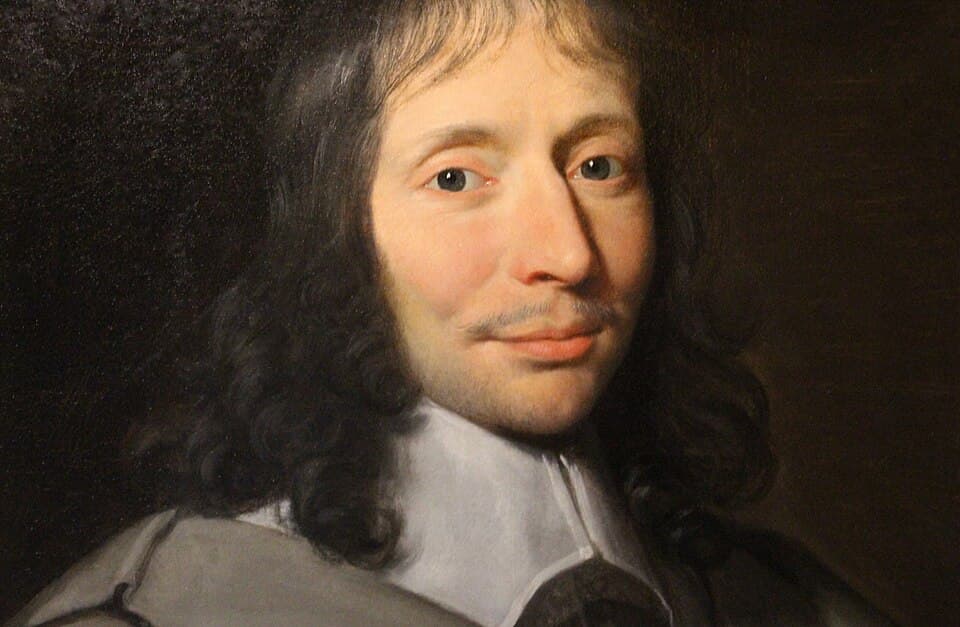
Paris, winter 1661. In a Left Bank study cluttered with papers, a copper machine, and glass tubes, a man with a face hollowed by pain receives us between bouts of fever. He is thirty-eight years old and speaks as one reasons: in flashes.
—They say that at sixteen your writings already troubled the greatest scholars. What exactly happened?
I was sixteen and amusing myself with conic sections—those curves drawn from a sliced cone. I found a theorem—the mystic hexagram, as I called it—and my father took the sheet to the mathematicians of Paris. Descartes, I was told, at first refused to believe a child could be its author; he suspected my father was holding the pen for me. That flattered me less than it taught me: that day I understood that geometry requires neither beard nor titles, only a mind willing to see. Truth does not regard the age of the one who finds it.
Geometry requires neither beard nor titles, only a mind willing to see.
—How did that same youth lead you to build a machine of copper and wheels?
My father Étienne was appointed intendant in Rouen, charged with collecting the taille tax, and I watched him exhaust himself night after night over columns of figures. At nineteen, I wanted to entrust this labor to toothed wheels rather than to a man. Thus was born the Pascaline: you turn the dials, the carries pass automatically from one drum to the next, and the sum appears without thought. I had about fifty built, but copper is expensive and the clockmaker slow: few wanted them. No matter—I had proved that a mechanism could bear part of reason's burden.
I wanted to entrust this labor to toothed wheels rather than to a man.
—Your contemporaries still speak of Aristotle as an authority. Why did you attack his famous principle?
For centuries we were told that nature abhors a vacuum, that it contracts to never suffer one. A fine way to attribute human feelings to matter! In 1646, in Rouen, I repeated Torricelli's experiment: an inverted mercury tube, and up there, above the column, that space that nothing fills. If nature had such repugnance, why did it let this void form? I understood that it was not a passion of nature, but simply the weight of the air pressing on the mercury. Aristotle had placed a soul where there was only a balance.
Aristotle had placed a soul where there was only a balance.
—How does one prove something as impalpable as the weight of air?
By weighing it where it weighs less. If the mercury tube is held up by the weight of the air column above us, then climb a mountain, and that column shortens, and the mercury must fall. I did not have the strength to climb the Puy de Dôme myself; my brother-in-law Florin Périer undertook it in 1648, carrying his barometer from the foot to the summit of the Auvergne peak. The mercury dropped by more than three inches. The proof was there, written by the mountain itself: nature has no repugnance for the void; all the effects attributed to this horror proceed from the weight and pressure of the air.
The proof was there, written by the mountain itself.
—You are said to have reduced a simple dice game to equations. Where did that curiosity come from?
From a man of the world, the Chevalier de Méré, a very witty gambler, who posed me a tabletop enigma: how to divide the stakes fairly if the dice game is interrupted before the end? Here was a question the ancients would have scorned as unworthy, yet it hides an abyss. I wrote about it to Fermat, that magistrate of Toulouse, and in 1654 we exchanged ideas on what no one had dared: submitting chance to calculation. My arithmetic triangle provided the combinations ready-made. Pure chance, believed to be the realm of unreason, obeyed numbers. God may play dice, but He counts.
Pure chance, believed to be the realm of unreason, obeyed numbers.
—What did you say to those who deemed it unworthy of a scholar to deal with games of chance?
I replied that the subject matters less than the rigor one brings to it. My treatise on the arithmetic triangle deals with combinations and dice, but its method applies to anything where the future is uncertain: commerce, marine insurance, and—I dare say—the wager on eternity. For I carried this calculation even into my Pensées: faced with the infinity of a life after death, a reasonable man must weigh his stake as a gambler weighs his. The same triangle that divides the stakes of an interrupted game can illuminate the gravest of choices. Nothing base remains base for one who knows how to read order in it.
The subject matters less than the rigor one brings to it.
—You took up your pen against the Jesuits. What threw you into that quarrel?
Friendship, first, and justice. My sister Jacqueline was a nun at Port-Royal-des-Champs, that abbey where God is taken seriously, and our Jansenist friends were being persecuted there in the name of a theology of grace. I wanted to defend them. But rather than a bulky treatise that no one reads, I wrote letters—eighteen—as a man of the world would write to a friend in the provinces. In them, I made the good fathers themselves speak, and their casuistry condemned itself out of its own mouth: by refining cases of conscience to the point of allowing everything. People laugh, and in laughing they understand. Laughter is sometimes the shortest path to truth.
By refining cases of conscience, they ended up allowing everything.
—Those letters, the Provincial Letters, are striking in their brevity. Was that a deliberate effort?
The greatest. People think it is easy to be brief; it is the opposite. Cut, tighten, throw three pages into the fire to save ten lines: that is the true labor. I once wrote to my correspondent, about one of my letters: I have made this one longer only because I have not had the leisure to make it shorter. That was not a conceit. A long sentence often hides a lazy thought; one piles up words for lack of having found the only one that fits. Against the heaviness of the doctors, I wanted a clear, lively language that an honest man could read without boredom. Truth gains by being sharp.
A long sentence often hides a lazy thought.
—You are said to carry a paper sewn into your garment. What does it contain?
You touch there what I show least. On the night of November 23, 1654, something seized me—not the God of philosophers and scholars, the one we demonstrate, but a God felt in the heart, a fire. I recorded that hour on a parchment that I sewed with my own hands into the lining of my doublet, to carry it always against me. No one has read it; you will not read it either. It is my Memorial, my fixed point. When my mind loses itself in its reasonings, I feel that paper under the cloth and I remember that there was a night when I no longer needed to prove.
There was a night when I no longer needed to prove.
—How does one live after having known such a night? Did your daily life change?
Everything changed. I gave away my goods, stripped my home, traded my gentleman's clothes for unadorned attire—and under the shirt, a hairshirt that reminds me that this body is only a passing guest. Mornings at prayer, afternoons at research or at Port-Royal, evenings scribbling those paper fragments I am gathering for a great defense of the faith that I may never finish. Illness hardly leaves me; I sleep poorly, eat little. But I know better than anyone, I who have weighed the air and measured chance: man is but a reed, the weakest in nature; but he is a thinking reed. A drop of water is enough to kill him; but no drop can keep him from understanding that he dies.
No drop can keep him from understanding that he dies.
This imaginary interview was generated by artificial intelligence from sources documented in Blaise Pascal's profile. It dramatises what the figure might have said based on what we know about them, but does not constitute attested historical testimony. For primary sources and factual documentation, refer to the full profile.