Imaginary dialogue between Pierre de Fermat and Blaise Pascal
by Charactorium · Blaise Pascal (1623 — 1662) · Philosophy · Sciences · 6 min read
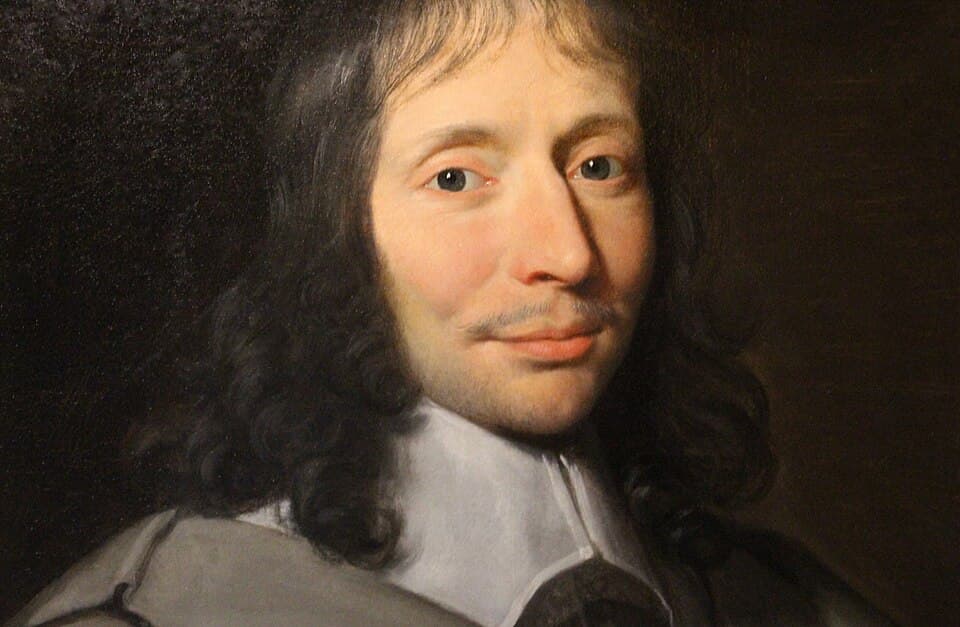
In a modest dwelling on the Left Bank, in Paris, in the autumn of 1660, Pierre de Fermat — a magistrate from Toulouse who rarely leaves his parliament — finally meets the man whose writing he knows but not his face. On the table, a Pascaline with copper wheels gleams in the candlelight, next to sheets covered in dense fragments. Six years have passed since they, by letter, untangled together the Chevalier de Méré's dice problem, without ever meeting. Fermat has come with the curiosity of a friendly rival, eager to press his junior to justify himself.
—My dear Pascal, it has been six years since our letters unraveled the Chevalier de Méré's dice. Do you remember what drove you to it?
How could I forget, Fermat? That devil of a Méré, an inveterate gambler and occasional philosopher, kept pestering me with a seemingly naive question: how to divide the stakes fairly if the game is interrupted before the end? Common sense stumbled, and the arithmeticians before us contradicted each other. I understood that we must count not what had happened, but what could happen — weigh the future, so to speak. Your letters came to me from Toulouse, and our two paths, starting from opposite points, converged on the same number. My Treatise on the Arithmetical Triangle was born from that: this table of numbers where each cell is the sum of the two above it contains, I believe, the entire science of future chance.
I understood that we must count not what had happened, but what could happen.
—Before the dice, you had already built this machine here. They say it was born from your father's accounts. Is that true?
Quite true. My father Étienne was appointed intendant in Rouen in 1640, tasked with assessing and collecting the taille — endless columns of figures that kept him awake until dawn. At nineteen, seeing him exhaust himself like that was unbearable to me. So I imagined these toothed wheels that carry over the tens automatically: you turn, and the addition is done without tiring the mind. I had nearly fifty made, in copper and wood, seeking a craftsman worthy of my design. But the price was so high that no merchant wanted them. No matter: I had wanted to relieve a father, not build a fortune.
—I have heard from Toulouse that you had a mountain in Auvergne climbed to track down the void. Does nature truly abhor it?
Nature has no horror, Fermat — it is the air that weighs, that is all. Torricelli had left a void at the top of his mercury tube; Aristotle's disciples cried that nature, seized with repugnance, held the column up. I thought otherwise: if the weight of the air supports it, then, by climbing where the air is thinner, the column should fall. My health kept me in Paris; so I asked my brother-in-law Florin Périer to climb the Puy-de-Dôme in the year 1648, barometer in hand. The mercury dropped by more than three inches. All Auvergne could have testified: what the School called the horror of a vacuum was merely the weight of the air. I only weighed it.
What the School called the horror of a vacuum was merely the weight of the air.
—You look gaunt, your complexion gray. It is whispered that a night in November 1654 changed you. What happened?
What happened, Fermat, is what no demonstration can prove. On the night of November 23, 1654, between ten and midnight, a fire seized me — not of pyres, but a burning certainty, without form or reasoning. The God of philosophers, the one deduced, fell silent; another made himself felt, alive, present. I could do only one thing: take the pen and fix that moment on a small parchment, hastily, almost without grammar. Since then, I have carried it sewn into the lining of my doublet, against my heart, and resew it into each new garment. You, who seek truth in numbers, may think me mad. But that evening, I knew a proof that geometry does not give.
—And this hairshirt they say you wear against your skin? The Pascal of the salons I imagined, however, loved the world.
You imagined correctly, and he existed. I tasted the world, its salons, its games, its table — I was one of those honnêtes hommes who please and discourse on everything. But I eventually saw in it what I call diversion: that agitation by which we flee from thinking about our misery and our end. The king, the gambler, the hunter — all run to avoid staying still in a room, alone with themselves. Since that night, I have stripped myself: few furnishings, little meat, fasts, and yes, a belt of spikes that I press when a thought of vanity comes. Not that I despise my body — but I no longer want it to divert me from the essential.
—That leads me to Port-Royal. These Provincial Letters that caused such a stir — what threw you, a geometer, into the theologians' quarrel?
Friendship first, and then justice. My friends at Port-Royal, those gentlemen who had opened my eyes, were being dragged before the Sorbonne; they wanted to condemn Antoine Arnauld for having maintained that God's grace cannot be commanded. I was only a geometer, true, but I knew how to wield a pen. So I wrote, under a false name, letters in which a naive man gravely questions the doctors — and lets them betray themselves through their answers. Laughter, you see, cuts deeper than argument. All Paris was snatching them up before the censors understood where the blows came from. I did not defend a party; I defended the idea that God's truth is not bargained over like a court affair.
—They say you are especially targeting Jesuit casuistry. Isn't that picking a fight with very learned men?
Learned they are — too much, perhaps. Their casuistry cuts morality into a thousand particular cases, until they always find a doctor who permits what another forbids. By endlessly accommodating consciences, they make sin convenient: that is my grievance. I oppose to their subtleties efficacious grace, which truly acts, against their so-called sufficient grace which, lacking divine will, suffices for nothing. Do not think I wrote this lightly: I revised certain letters eighteen times. One of them, I recall, I left longer than the others — not having had the leisure to make it shorter. Brevity, my dear Fermat, costs more hours than verbosity.
—Descartes also claims to have suggested the idea of that vacuum experiment. Between us, to whom does the honor belong?
Ah, Descartes. He came to visit me in 1647, while I was bedridden, and we argued for two days. He maintained that what sat at the top of the tube was not a void, but his famous subtle matter — the horror of a vacuum dressed in a new fashion. Later, he hinted that the idea of climbing a mountain came from him! I leave you to judge, you who weigh evidence: I had conceived the experiment in its very reasoning, the weight of the air. That man had once refused to believe that a sixteen-year-old boy could have written my Essay on Conics. The great Descartes, I think, has trouble suffering that another should find something before him.
—These scattered sheets on your table — I sense a great design. What do you hope to do with them, my friend?
A great design, yes, and one that my health may never complete. I want to convince those freethinkers, those libertines who pride themselves on believing nothing, not with theological proofs, but by showing them man as he is: a reed, the weakest in nature, which a drop of water can kill — but a thinking reed, who knows he dies, which the universe that crushes him does not. To a gambler like Méré, I would say this: bet that God exists. If you win, you win everything; if you lose, you lose nothing. All our dignity lies in thought — it is from there we must raise ourselves, not from the space we will never fill.
—Before I leave: I have often urged you to come to Toulouse. Why did you never come to pursue with me what we began?
The journey, Fermat — my body can no longer bear it. Your letters came to me when mine went to you; we have carried on, each in his own home, the finest commerce of minds that I know, and I did not need the roads to consider you a friend. Know this: of all my correspondents, you are the one before whom I bow in geometry. If God lends me a few more years — which I doubt, seeing my pains increase each month — I would like to finish these Pensées before the numbers. But may I always remember that, over a dice problem, two men who had never met together gave birth to a new science. That, no illness can take from me.
Two men who had never met together gave birth to a new science.
This imaginary interview was generated by artificial intelligence from sources documented in Blaise Pascal's profile. It dramatises what the figure might have said based on what we know about them, but does not constitute attested historical testimony. For primary sources and factual documentation, refer to the full profile.