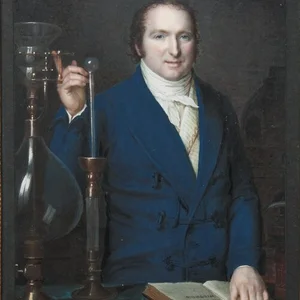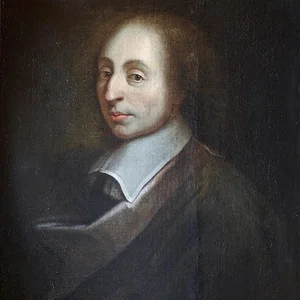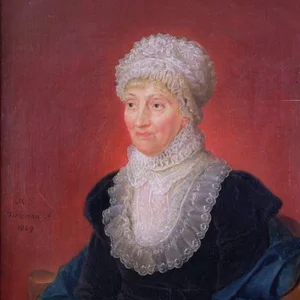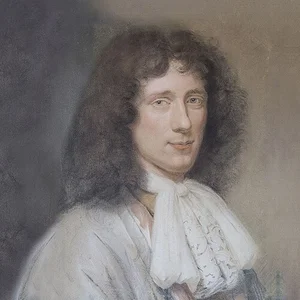

Florin Périer (c. 1605-1672) was a magistrate and jurist from the Auvergne region, a councillor at the cour des aides (tax court) of Clermont. The brother-in-law of Blaise Pascal, in 1648 he carried out the Puy de Dôme experiment, which demonstrated the weight of air.
Florin Périer(1605 — 1672)
Florin Périer
6 min read
Frequently asked questions
Key Facts
- Born around 1605 in Auvergne, died in 1672
- Married Gilberte Pascal, the elder sister of Blaise Pascal
- Carried out the Puy de Dôme experiment on 19 September 1648 at the request of Blaise Pascal
- Showed that the height of the column of mercury decreases with altitude, proving the existence of atmospheric pressure
- Councillor at the cour des aides (tax court) of Clermont-Ferrand
Works & Achievements
Carried out, at Pascal's request, the measurement of the fall in mercury level with altitude. It experimentally demonstrated the weight of air and the existence of atmospheric pressure.
A detailed account of the experiment, written by Périer and published by Pascal. This rigorous text gave the observation its scientific and historical value.
Simultaneous measurements from a second barometer left at the foot of the mountain, organized by Périer. They ruled out the hypothesis of a variation caused by the weather rather than by altitude.
After Pascal's death, Périer and his family helped preserve and publish his scientific writings and the Pensées. They ensured the transmission of his legacy.
A judicial and fiscal office held throughout his adult life. It anchored Périer in the upper ranks of Auvergne's legal nobility.
Anecdotes
In 1648, Florin Périer climbed the Puy de Dôme with a mercury barometer to test an idea of his brother-in-law Blaise Pascal: if air has weight, the column of mercury should drop as one ascends. At the summit, the mercury had fallen by about three and a half inches compared to the base: atmospheric pressure had just been demonstrated.
Pascal, too unwell to make the climb himself, entrusted the experiment to Périer because he had complete confidence in his magistrate's rigour. Périer took care to leave a witness and a second tube of mercury at the foot of the mountain to make sure that the drop truly came from the altitude and not from chance.
Florin Périer had married Gilberte Pascal, Blaise's elder sister: he was therefore both a relative and a scientific collaborator of Pascal. It was this family closeness that made him the ideal person to carry out an experiment decisive for the history of science.
To be quite sure of his measurements, Périer repeated the observation at several heights along the slope of the Puy de Dôme, noting the mercury level at each stage. This careful, step-by-step method gave all the more convincing proof of the steady decrease in pressure with altitude.
A magistrate by profession, Périer was not a scientist by trade but an Auvergnat man of law; yet his name remains attached to one of the founding experiments of modern physics, proof that in the 17th century scientific curiosity also stirred the notables of the provinces.
Primary Sources
In it Pascal publishes the letter in which he asks Périer to carry out the experiment, followed by Périer's report describing the fall of the mercury at the summit of the Puy de Dôme.
In it Périer reports that, on 19 September 1648, the quicksilver fell in the tube by about three and a half inches between the bottom and the top of the mountain, in the presence of several notable witnesses from Clermont.
These treatises, published after Pascal's death, draw on the results of the experiment conducted by Périer to establish the existence and the measurement of atmospheric pressure.
Key Places
Town in the Auvergne region where Périer worked as a counsellor at the tax court and where the Pascal family lived. It is the starting point of the experiment.
A dormant volcano peaking at roughly 1,465 metres, near Clermont. It was on its slopes and at its summit that Périer carried out the decisive experiment on air pressure.
A religious establishment in Clermont from which Périer took certain control readings, at the foot of the mountain, while the ascent was taking place. It served as a fixed point of reference.
Florin Périer's native province, a region of moderate mountains at the heart of the Massif Central. Its terrain offered the ideal setting for measuring pressure at different altitudes.
Typical Objects

A glass tube filled with mercury and inverted into a basin, whose column measures the pressure of the air. It is the central instrument of the Puy de Dôme experiment.

A liquid metal used to fill the barometer's tube, whose high density makes the column measurable. Its height varied with altitude.

The official black garment of court councillors, a mark of Périer's judicial office at the cour des aides of Clermont. It signalled his rank within the society of the robe.

A rule graduated in feet and inches used to read off the height of the mercury column. The precision of the measurement was essential to the value of the experiment.

Writing implements with which Périer recorded his observations and drafted the report sent to Pascal. The written account gave the experiment its value as proof.

A handwritten collection of the acts and decisions of the cour des aides where Périer sat. It bears witness to his office as a councillor in charge of fiscal affairs.
School Curriculum
Vocabulary & Tags
Key Vocabulary
Tags
Daily Life
Morning
As a magistrate, Périer began his day with the business of the cour des aides: reviewing tax files, holding hearings, and drafting legal documents. He often spent the morning in his robe, surrounded by clerks and registers.
Afternoon
The afternoon blended judicial duties with the life of a local notable: visits, correspondence, and managing the family estate. It was also the time he occasionally devoted to his scientific exchanges with Pascal.
Evening
The evening brought the family together around Gilberte Pascal and the children, in an atmosphere of piety shaped by their closeness to Port-Royal. They would read, discuss the news, and sometimes the learned discoveries of the day.
Food
The table of a 17th-century notable from the Auvergne offered bread, soups, vegetables from the garden, local cheeses, and meat on feast days. Local wine accompanied meals, which followed the rhythm of the lean days imposed by the Church.
Clothing
For his official duties, Périer wore the black robe of men of law, a mark of his rank. Around town, he dressed like a well-off bourgeois: a doublet, hose, a linen collar, and a hat.
Housing
The family lived in a bourgeois townhouse in Clermont, built from the dark volcanic stone typical of the region. The dwelling had several rooms, a study for his writings, and everything needed for the life of a magistrate of the robe.
Historical Timeline
Period Vocabulary
Liens externes & ressources
Références
Œuvres
Expérience du Puy de Dôme
19 septembre 1648
Lettre-compte rendu à Blaise Pascal
1648
Observations témoins à Clermont
1648
Participation à la diffusion de l'œuvre de Pascal
1662-1672
Carrière de conseiller à la cour des aides de Clermont
vers 1630-1672