Kids interview Blaise Pascal
by Charactorium · Blaise Pascal (1623 — 1662) · Philosophy · Sciences · 4 min read
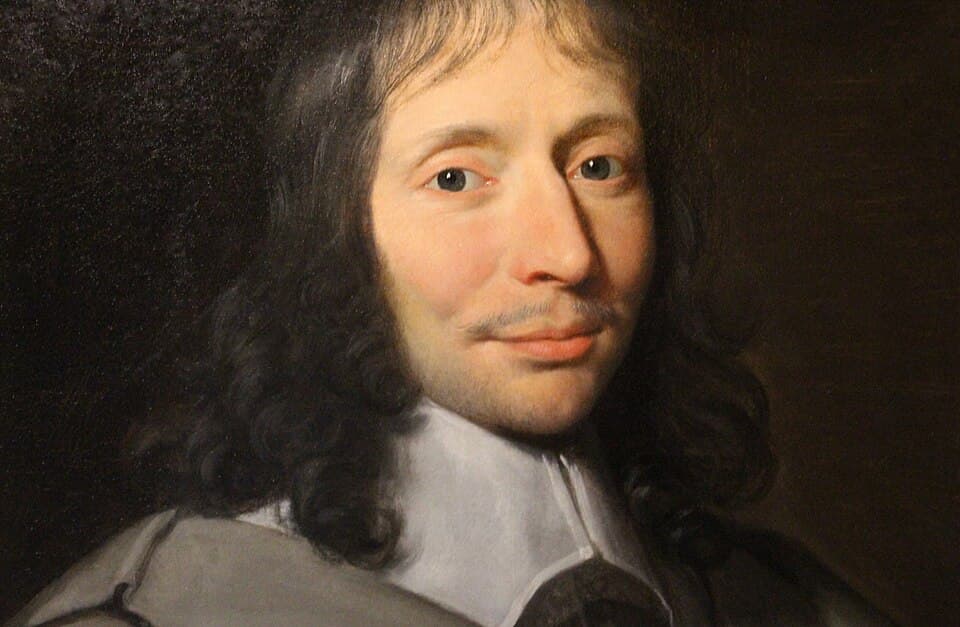
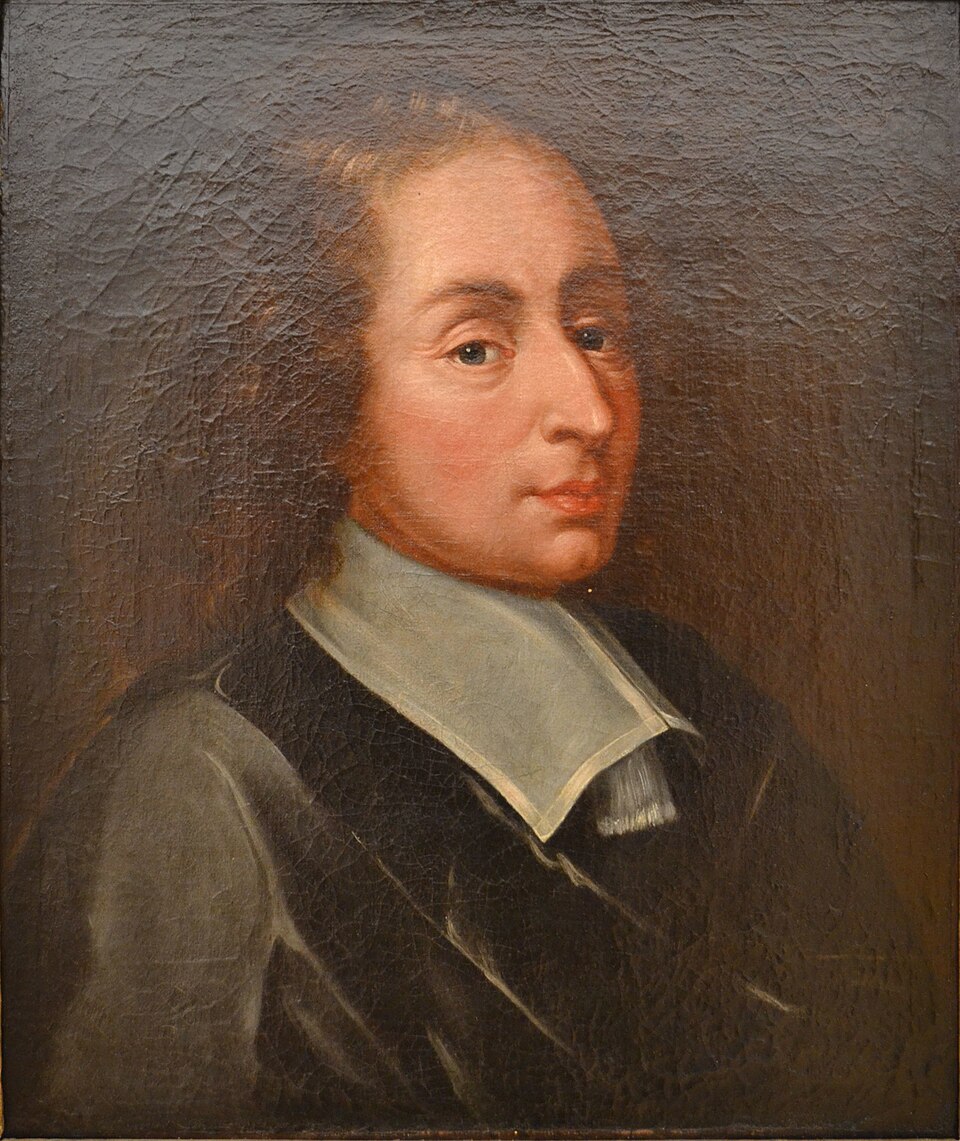
Two twelve-year-old students visit an old stone house in the Latin Quarter. In a study filled with books and strange cogwheels, a pale, smiling man awaits them. It is Blaise Pascal, and he has agreed to answer all their questions.
—They say you were already very good at math as a little kid. How old were you?
You know, my child, I was sixteen when I wrote my Essay on Conics. A conic is just the curve you get by cutting a cone at an angle, like when you slice a carrot diagonally. I hid a little geometric secret in it. It was shown to the great Descartes, the most famous scholar in France. He refused to believe it! He thought a boy of my age couldn't have figured it out alone. Imagine the look on my face. I was half annoyed, half very proud.
At sixteen, they didn't believe me — and that was almost a compliment.
—Is it true you invented a calculating machine? Why?
Yes! My father Étienne was a tax intendant in Rouen, and he spent his evenings adding up tax figures. Mountains of numbers. I saw him exhausted, and it saddened me. So at nineteen, I built a box full of little cogwheels: the Pascaline. You turn a wheel, it drives the next one, and presto, the addition does itself. Imagine a clock that counts money for you. I had about fifty of them made. But they were terribly expensive, so almost nobody could buy one. Too bad. My father, though, was happy.
I built a machine because I didn't like seeing my father tired.
—Did you prove that a vacuum exists? What was the problem?
Ah, the vacuum! In my time, all scholars repeated an old idea of Aristotle: nature supposedly had a 'horror of the vacuum,' it would always fill it. It was called the horror of the vacuum. I wanted to see for myself. I took a long glass tube filled with mercury, inverted it into a basin, as the Italian Torricelli had done. And there, at the top of the tube, an empty space appeared! No air, nothing. Imagine a bubble of nothingness trapped in the glass. It was proof that the vacuum really exists. Aristotle was wrong, and I had seen it.
Rather than believe old books, I preferred to look.
—And the Puy de Dôme, then? Did you climb all the way to the top?
Not me, alas, I was too ill to climb. But in 1648, I asked my brother-in-law Florin Périer to do it. He took my mercury tube and climbed the Puy de Dôme, a dormant volcano near us in Auvergne. At the bottom, the mercury rose to a certain height. At the top, it was lower! Proof that air weighs less when you go up. Imagine: air, that invisible stuff, has weight, like a blanket lying on the world. The higher you go, the thinner the blanket. I waited for the result with a pounding heart.
Air is invisible, but it weighs like a blanket on the world.
—Is it true you invented a science with a dice game?
Almost! A friend of mine, the Chevalier de Méré, loved to gamble. One day he stumped me: if you stop a dice game before it's over, how do you split the money fairly between the players? Nobody knew how to answer. So I wrote to another scholar, Pierre de Fermat, and we thought about it together, by letter. Imagine two friends sending each other puzzles by mail, like a ping-pong of brains. And from that little dice game was born an entire science: the calculus of chances, what we now call probability.
A whole science was born from a simple interrupted dice game.
—There's a triangle named after you. What's it for?
You have sharp eyes! It's my Treatise on the Arithmetical Triangle. Imagine a pyramid of numbers: at the top, a 1. Below, each number is the sum of the two directly above it. It's very simple, and yet this triangle is magical. It tells you, for example, how many ways you can choose three marbles from a bag. It's used to count possibilities, to measure chance. I linked it to my dice problem. You see, sometimes a very simple figure hides enormous power. That's mathematics: beauty that is useful.
A very simple figure can hide enormous power.
—You wrote letters to make fun of people. Who were they?
You mean the Provincial Letters! I wrote eighteen letters, one after another, to defend my friends from the abbey of Port-Royal, very strict Christians called Jansenists. On the other side were powerful religious men, the Jesuits. I thought they stretched morality a bit too much to excuse the faults of the rich. So I stung them with humor, casually, so that everyone would understand. Imagine a well-aimed pebble that trips a giant. Those letters were a huge success all over Paris.
A small pebble of humor, well aimed, can trip a giant.
—Weren't you afraid of getting into trouble by attacking such powerful people?
Of course I was! I signed them without my real name, out of caution. In my time, displeasing the Church could cost you dearly. But I had a secret weapon: clarity. Instead of writing long and complicated, I wrote short and clear, so that even a child like you could understand. In fact, I once confessed in one of those letters that I had made it so long because I hadn't had time to make it shorter! Because writing short is the hardest. It requires reworking the same sentence ten times.
Writing short is the hardest: it requires starting over ten times.
—They say something incredible happened to you one night. What was it?
Yes... the night of November 23, 1654. I can't really explain it to you, my child, because it happened in my heart. For two hours, I felt a presence, an immense joy, like a gentle fire inside. I felt as if God was there, very close. Right after, I took a small piece of paper and wrote down what I had just experienced. This parchment, I sewed into the lining of my doublet, my jacket. Nobody knew. It was only found after my death, against my heart.
That night, I felt like a gentle fire inside me.
—After that night, they say you changed your life. Is that true?
Completely. Before, I liked fine clothes, salons, brilliant conversations. Afterward, I stripped myself of almost everything. I ate simply, bread, soups, sometimes I fasted. I even wore a hairshirt, a belt that pricks the skin, so as not to become attached to comfort. And in the evening, ill, I scribbled my thoughts on scraps of paper. They were collected after my death into a book, the Pensées. That's where I wrote that the heart has its reasons, which reason does not know. That means we sometimes feel true things that logic alone cannot prove.
The heart has its reasons, which reason does not know.
This imaginary interview was generated by artificial intelligence from sources documented in Blaise Pascal's profile. It dramatises what the figure might have said based on what we know about them, but does not constitute attested historical testimony. For primary sources and factual documentation, refer to the full profile.