Kids interview Boudicca
by Charactorium · Boudicca (30 — 61) · Politics · Military · 4 min read
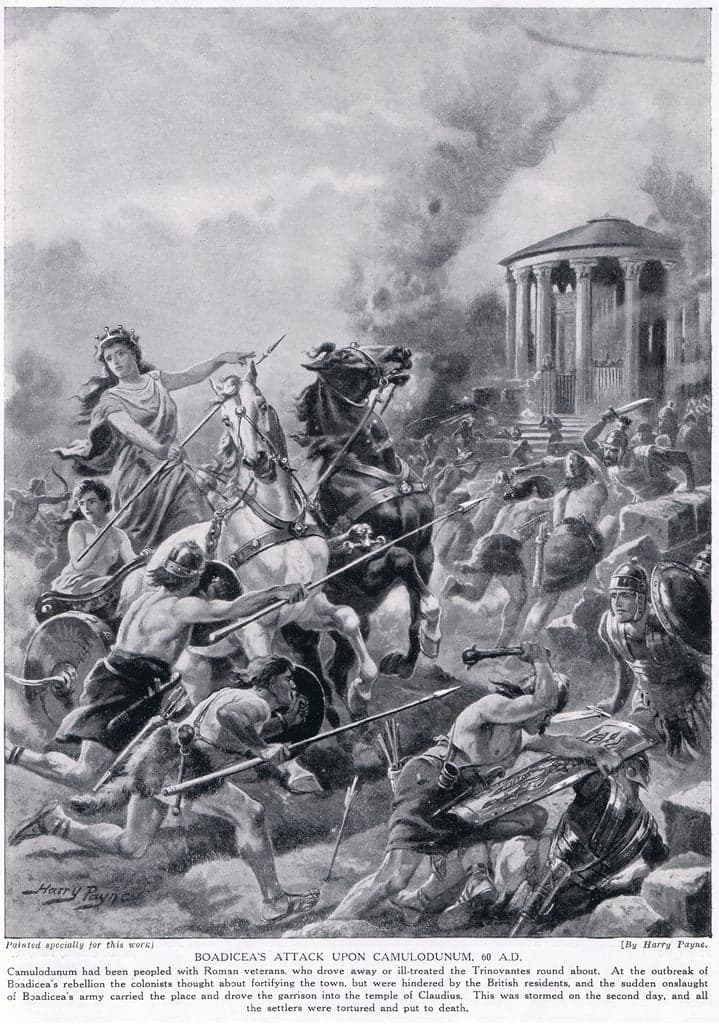
Two young visitors, on a school trip, stop before a great Celtic queen with long red hair. She holds a gold torc and looks at them gently. She beckons them closer to tell her story.
—What was your life like before the war, when your husband was still king?
You know, my child, before the war, everything was calm. My husband Prasutagus was what they called a client king: he kept his crown, but had to remain loyal to Rome. Imagine a powerful friend who protects you, but also watches you. We, the Iceni, raised fine horses and wore gold jewelry. Before he died, my husband wrote a will: he divided our kingdom between Rome and our two daughters. He believed that would keep us safe. He was wrong. That's when everything fell apart.
A king who is a friend of Rome keeps his crown, but never his freedom.
—Why did you rebel? What made you so angry?
Ah, that question still hurts, little one. When my husband died, in the year 60, the Romans tore up his will. They took our entire kingdom at once. Imagine someone entering your home and taking your house, your lands, your herds. But they did worse. The procurator Catus Decianus, the man in charge of money, had me flogged in public, before all my people. And my two daughters were raped. A queen humiliated like a slave. That day, I stopped being afraid. Anger became stronger than fear.
That day, anger became stronger than fear.
—Is it true that you burned entire cities? How did you do it?
Yes, it's true, and I don't hide it. I gathered a huge coalition: my people, the Iceni, and our neighbors the Trinovantes, and other tribes too. We first marched on Camulodunum, which you call Colchester today. That was the first great Roman city, with a giant temple dedicated to the emperor. We razed it. Then Londinium, your London. Then Verulamium. Three cities in a few months. Do you know that even today, under the streets of London, they find a layer of red ash? That's the memory of our fires.
Under the streets of London still sleeps the red ash of my fires.
—Weren't you afraid to attack Roman soldiers? They were strong, weren't they?
They were very strong, yes. The Roman legions were the best soldiers in the world. But at first, luck was with us. An entire legion, the Legio IX Hispana, tried to stop us. We ambushed and crushed them. Imagine thousands of warriors bursting from the woods screaming. The governor Suetonius Paulinus was far away, in the west, on the druids' island. He didn't even try to defend Londinium: he preferred to abandon it to save his men. For a few weeks, my child, we made Rome tremble.
For a few weeks, we made Rome tremble.
—Is it true that you hid a hare in your clothes before battles?
Ha! You've heard that story? A Roman historian, Cassius Dio, told it. Yes, before each battle, I released a little hare hidden in my cloak. I watched which way it ran. For us, its run was a message from the gods. It was my way of asking Andraste, our goddess of victory, if the fight would be favorable. Do you find that strange? Among us, war and the gods were never separate. Every morning, before anything, I made offerings to Andraste. We never went into battle without her consent.
Among us, war and the gods were never separate.
—Who were the druids? Did they help you with the war?
The druids, my child, were our wisest men. Priests, judges, scholars, and keepers of all our stories all at once. We wrote almost nothing: they held everything in their heads. Imagine an entire library housed in a man's memory. They settled our disputes and spoke to the gods for us. Do you know that Rome hated them? At the very moment I was burning the cities, Governor Paulinus attacked their sacred island, Mona, far in the west. Rome wanted to cut out the soul of our people. That's why he wasn't there to defend his cities.
An entire library was housed in the memory of a single druid.
—If we could have seen you in person, what would we have noticed first?
They said I was tall, taller than many men. Cassius Dio wrote that I had long red hair that fell to my hips, and a harsh, rather terrifying voice. Around my neck, I wore my torc: a rigid twisted gold collar. It was the emblem of Celtic kings and queens, my sign of power. A queen without a torc is no queen. I also wore a checkered wool tunic fastened with shiny brooches. So imagine: a huge woman, hair of fire, a carrying voice, gold at her neck. I was not easily forgotten.
A huge woman, hair of fire, gold at her neck: I was not easily forgotten.
—How did you speak to your whole army before battle?
I mounted my chariot, my child. They called it an esseda: a light two-wheeled chariot pulled by fast horses. It was the war machine of our nobility. I drove it myself, my two daughters at my side. I rode along the ranks of my warriors, and I shouted so that my voice reached them all. I reminded them of the humiliation, the tears, the stolen lands. Imagine thousands of men falling silent at once to listen to a woman standing on her chariot. My anger became their anger. That's what it means to be a Celtic queen.
My anger became their anger: that's what it means to be a Celtic queen.
—You were so many! How could you lose the battle?
That is the great sorrow of my life, little one. We were tens of thousands, perhaps more. Tacitus even speaks of 230,000 fighters, but I think he greatly exaggerates. Paulinus, on the other hand, had only about 10,000 legionaries. But he was clever: he placed himself in a narrow defile, between hills, so we couldn't surround him. And we had made a terrible mistake. Our families, our wagons, our impedimenta, our baggage, formed a great arc behind us to watch the victory. When we needed to flee, that wall of wagons trapped us. Numbers do not make victory.
Numbers do not make victory.
—What happened to you after the defeat? How does your story end?
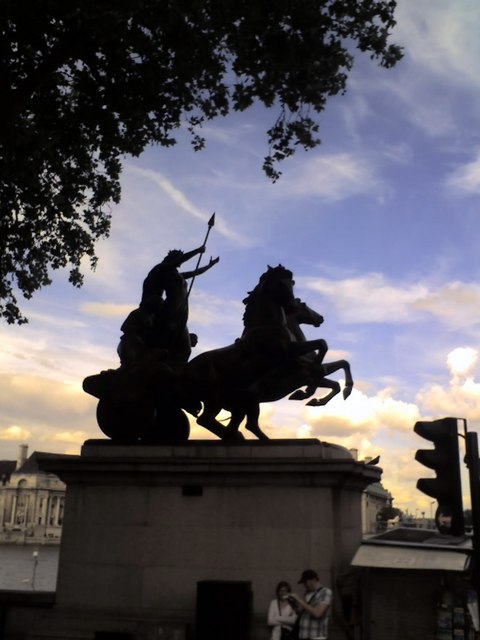
My story ends in shadow, my child, and no one is quite sure. Tacitus says I took poison to avoid falling alive into Roman hands. Cassius Dio says I died of illness. What is certain is that after me, in the year 61, the repression was terrible for my people. But listen well: I was not forgotten. Much later, the English erected a statue of me standing on my chariot, facing their Parliament, in London. The city I had burned paid me homage. Losing a battle is not always losing forever.
The city I had burned once paid me homage.
This imaginary interview was generated by artificial intelligence from sources documented in Boudicca's profile. It dramatises what the figure might have said based on what we know about them, but does not constitute attested historical testimony. For primary sources and factual documentation, refer to the full profile.