Imaginary dialogue between Tacite and Boudicca
by Charactorium · Boudicca (30 — 61) · Politics · Military · 5 min read
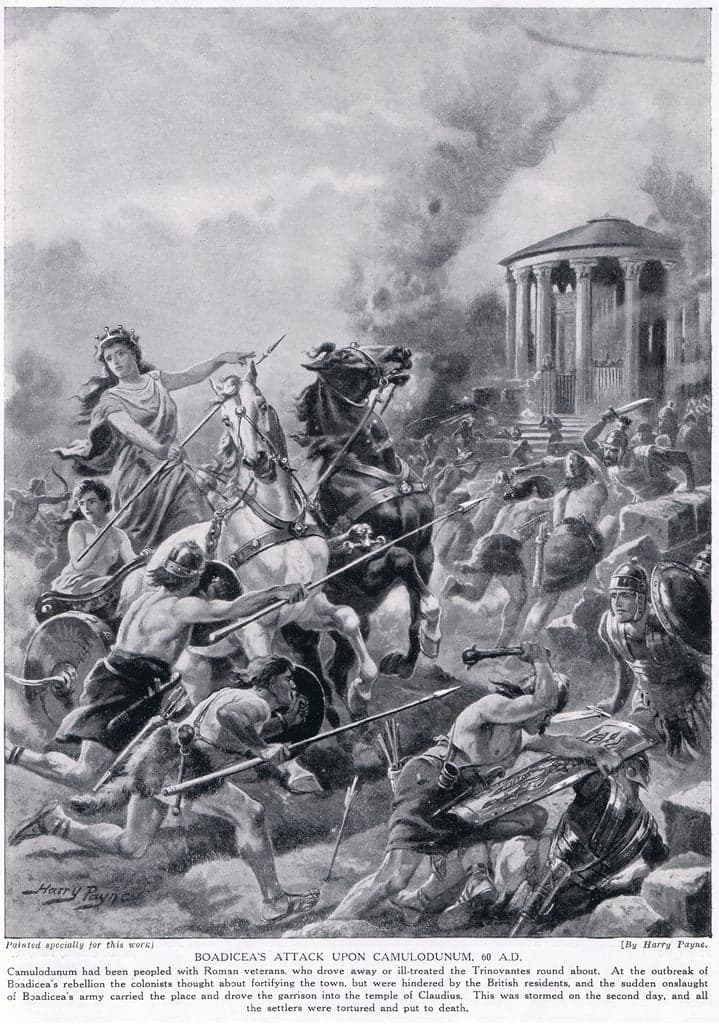
It is on a windswept heath, on the borders of Norfolk of the Iceni, that Tacitus says he gathered the testimonies of the revolt, long after the ashes. He imagines meeting the queen before her great roundhouse, a gold torc around her neck, the central hearth smoking behind her. Stepfather of Agricola who served in Britain, he comes not to judge but to record the facts in writing, before memory is lost. The low light makes her hair glow red; he holds his tablets, she still holds her anger.
—Queen, my stepfather Agricola spoke to me of these lands. Tell me: your husband Prasutagus's will — what did it truly promise Rome?
My husband was no fool, Tacitus. By bequeathing half the kingdom to your emperor and the other half to our daughters, he believed he was buying peace, as a client king should. He thought this deference would protect his household. It turned out quite otherwise. No sooner was he buried than your centurions treated our kingdom as prey and our house as plunder. What your people call inheritance, the procurator called confiscation. I understood that day that a king allied to Rome is merely a man who is lent his throne, long enough to take inventory.
A king allied to Rome is merely a man who is lent his throne.
—They say the procurator Catus Decianus and his agents went even further. What in you broke that day?
You want to write it, then write it without averting your eyes. I was stripped before my people, flogged like a slave caught in fault. And my two daughters, barely women, were handed over to your soldiers. It was not my back that bled that day, but my name, my lineage, the dignity of the Iceni. Catus Decianus thought he was subduing a troublesome widow; he awakened a queen. A mother's pain, you do not measure in your financial records. It is only quenched in fire. From that wound was born the coalition, not from a strategist's calculation.
It was not my back that bled that day, but my name.
—Those who saw you speak of a tall woman with a harsh voice. How did you stand before your warriors before battle?
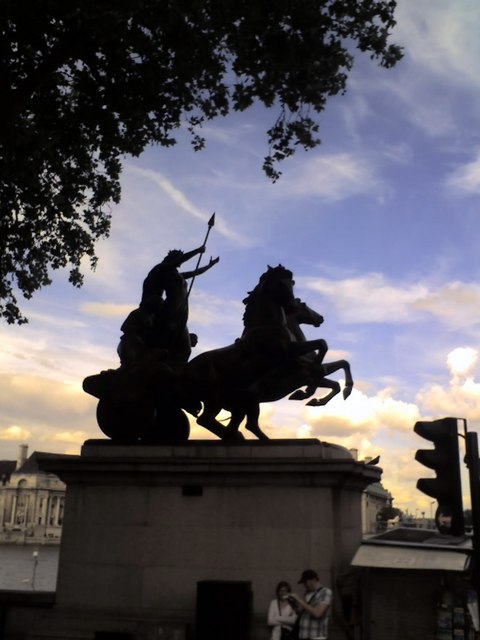
I mounted my esseda, my daughters at my side, so that all could see a woman driving her own chariot. My height, my hair loose to my waist, my voice that carried over the wind — none of this was vanity, Tacitus; it was a weapon. A people does not follow a written order; it follows a presence. The gold torc at my neck proclaimed my rank better than any decree of Rome. I passed through the ranks, named the tribes one by one, reminded them of their dead and their daughters. Among us, a queen is not hidden in a palace: she stands upright, visible, where the arrows fall.
A people does not follow a written order; it follows a presence.
—I have heard of a strange rite: a hare released before battle. Explain what you expected from the goddess Andraste.
Your generals read the flight of birds and entrails; do not act surprised. Before giving the signal, I released a hare hidden in my clothes and watched its course. If it fled in the right direction, Andraste, our goddess of victory, was with us. It was not the superstition of a weak woman; it was the language by which I spoke to my people. By invoking Andraste, I asked not only for victory: I bound each warrior to a sacred oath, stronger than fear. Blood and omen marched together. A leader who commands without the sacred commands only bodies; I wanted souls.
A leader who commands without the sacred commands only bodies.
—Let us come to Camulodunum. Why was that city, with its temple of Claudius, your first target rather than another?
Because it was the insult made stone. You had taken our lands to settle your veterans, and in the middle you had erected a temple to a dead emperor whom we were forced to worship as a god. That temple, financed by our own tributes, was the altar of our servitude. We razed it, and with it the entire city. Your excavators will one day find beneath the soil a layer of red ashes a hand's breadth thick: that is my answer to colonia. There was no serious garrison left, your reinforcements arrived too late. In a few days, the first capital of your Britain was nothing but a blackened field. We wanted it to be seen burning all the way to Rome.
That temple, financed by our own tributes, was the altar of our servitude.
—Then came the Legio IX Hispana, sent to stop you. How does a queen without legions defeat a regular Roman army?
One does not defeat a legion on its own ground, Tacitus: one surprises it on ours. The Legio IX rushed in, self-confident, through woods and defiles it did not know. We were everywhere at once, invisible, then upon it suddenly. Its infantry was cut to pieces; only cavalry could flee to its camp. Your historians will one day say that this legion almost vanished. Know that it was no miracle, but numbers, anger, and knowledge of every marsh. Then Londinium fell without a fight: your governor Paulinus preferred to abandon it rather than die for its merchants. The city burned, like the others.
One does not defeat a legion on its own ground: one surprises it on ours.
—Three cities in ashes — Camulodunum, Londinium, Verulamium. Feeding and moving such a coalition — how did you manage?
You ask the question of a man who has seen legions march, and you are right: a crowd is not an army. Each tribe came with its wagons, its herds, its grain stores. We lived off the land, taking your depots as we won. Verulamium fell like the other two, for the Britons loyal to Rome found no help there. But I will not hide the truth from you: this mass that was our strength was also our weakness. One cannot discipline a hundred tribes like a single cohort. As long as we advanced and burned, momentum held everything together. The day we would have to hold the line, against your shields, I already dreaded it.
This mass that was our strength was also our weakness.
—Let us speak of the final battle. Paulinus had chosen a narrow defile, barely ten thousand men. What did you see coming that day?
I saw the ground close around us like a trap. Paulinus had backed into a forest, in a bottleneck where our numbers were useless: we could only strike along a narrow strip. Your javelins, then the wedge of your legionaries, opened our ranks. And behind us — that is my fault, Tacitus, I entrust it to you — I had placed our wagons, our women, our children in a semicircle so they could witness the victory. When we had to retreat, this wall of baggage imprisoned us. Our people died against their own families. Confidence had blinded me. We had come to witness a triumph; we were trapped in our own crowd.
We had come to witness a triumph; we were trapped in our own crowd.
—After such a disaster, a queen might flee, hide, negotiate. What outcome did you face?
None of those, and you know it already, you who write the end of the vanquished. Flee, to one day be dragged in a triumph through your streets, exhibited like a captured beast? Never. I had begun this war free, I would not end it a captive. Some will say disease took me; those who knew me know I chose poison, as one chooses one's last freedom. My daughters had been defiled alive; I would not let Rome make me its ornament. Write this without glossing: a queen of the Iceni decides her own hour. That was my last victory, and the only one Paulinus could not take from me.
I had begun this war free, I would not end it a captive.
—One last thing, queen. If my tablets are to fix you for those who never knew you, what do you want them to remember?
Do not make me a screaming fury, Tacitus, nor a saint. Write that a woman, a mother, a queen, refused to have her body, her daughters, and her land disposed of as property without an owner. Andraste did not grant me victory in arms, true; but she granted me the victory of refusal. Your legions hold Britain today, and Agricola will hold it even better. Yet, whenever a client people realizes that an imposed peace is but patient servitude, it will remember that a queen once burned three of your cities. That is what I leave you: not the story of a defeat, but proof that one can say no.
She did not grant me victory in arms; but the victory of refusal.
This imaginary interview was generated by artificial intelligence from sources documented in Boudicca's profile. It dramatises what the figure might have said based on what we know about them, but does not constitute attested historical testimony. For primary sources and factual documentation, refer to the full profile.