Imaginary interview with Boudicca
by Charactorium · Boudicca (30 — 61) · Politics · Military · 6 min read
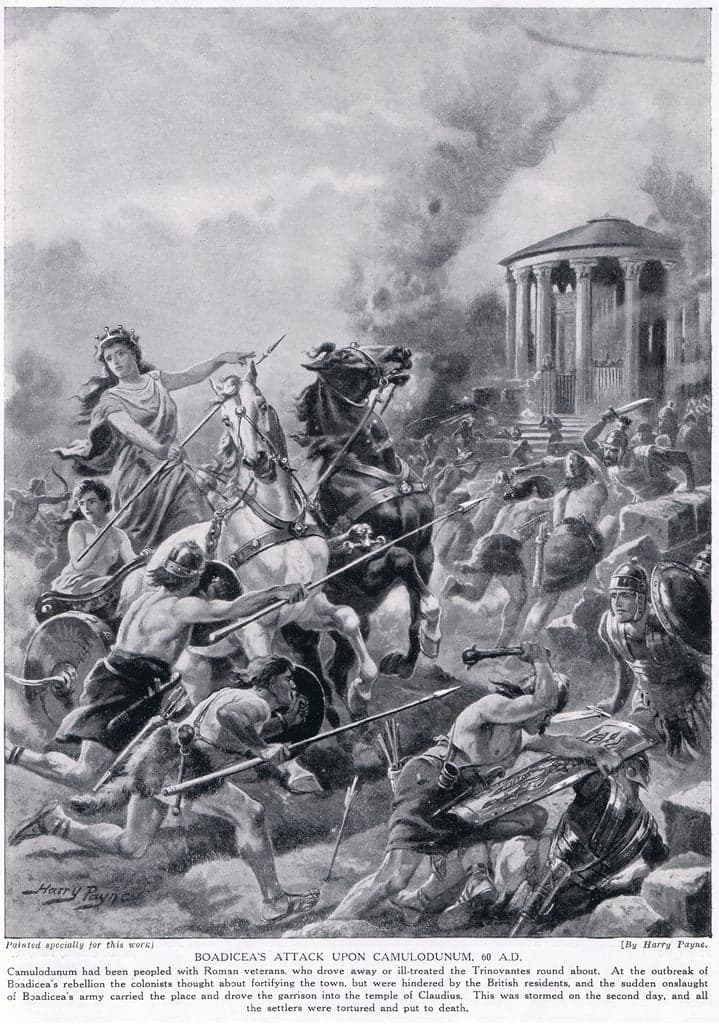
Night falls on the British camp, somewhere on the road leading west. Fires crackle, the wagons form a vast arc where women and children await dawn. In front of her large tent, a tall woman, her red hair loose, a golden torc around her neck, agrees to speak before the battle that will decide everything.
—What happened after the death of your husband Prasutagus?
My husband was a cautious man, too cautious perhaps. Prasutagus ruled the Iceni as a rex socius, a friend-king of Rome, and he believed his caution would save us. At his death, he bequeathed his kingdom by will: half to the daughters I bore him, the other half to the emperor, to appease the wolf. The wolf took both halves. The procurator Catus Decianus came with his scribes and soldiers, as one comes to a conquered foe, not an ally. I was bound. I was flogged before my people, I, the queen. And my two daughters, still children, were handed over to the hands of the legionaries. That is what Rome's word was worth. A kingdom promised to women weighed no more than a grain of barley under the millstone.
A kingdom promised to women weighed no more than a grain of barley under the millstone.
—Why did this outrage ignite such a vast revolt?
Because I was not the only one bleeding. The Trinovantes, our neighbors, had seen Rome plant among them a colonia of veterans who took their lands, their herds, their sons. At Camulodunum, these old soldiers lived as masters and built a temple to the dead emperor they called a god — and it was we, the conquered, who were taxed to pay for it. When I raised my spear, I did not have to convince: each tribe bore its own wound. The iron heated in a thousand hearths awaited only a breath. My lacerated back and the cry of my daughters were merely the spark thrown onto dry straw. The druids had long said: a people humiliated deeply enough has nothing left to lose, and that is when it becomes most formidable.
—Do you remember the day Camulodunum fell?
I remember it like a harvest. Camulodunum had neither wall nor ditch; only its arrogance served as rampart. Its colonists had so despised our numbers that they had fortified nothing. We fell upon them like hail. They took refuge in the great temple of Claudius, that stone god they had imposed on us, and the temple burned with them after two days. Then I was told that a legion was coming to meet us from the north — the Legio IX. My warriors caught it in a defile, and the infantry never returned. That day, I understood that Rome bleeds like an ordinary man when struck by surprise, and that its eagles were only bronze on a stick.
I understood that Rome bleeds like an ordinary man when struck by surprise.
—How do you explain that Londinium was given up without a fight?
The governor Paulinus was far away, at the other end of the island, busy slaughtering the druids on the sacred island of Mona. When he learned of our march, he hurried to Londinium with his cavalry, judged the city indefensible, and abandoned it to its fate. He chose his soldiers over his merchants. So we took that great trading post on the river — its warehouses, its taverns, everything that reeked of Roman gold — and gave it to the fire. Then Verulamium followed, the former oppidum turned town of collaborators. Three cities in a few moons. They say the ash of those fires will sleep long under the earth; let it stay there, as the mark of a people who said no.
—How did you present yourself before your warriors before battle?
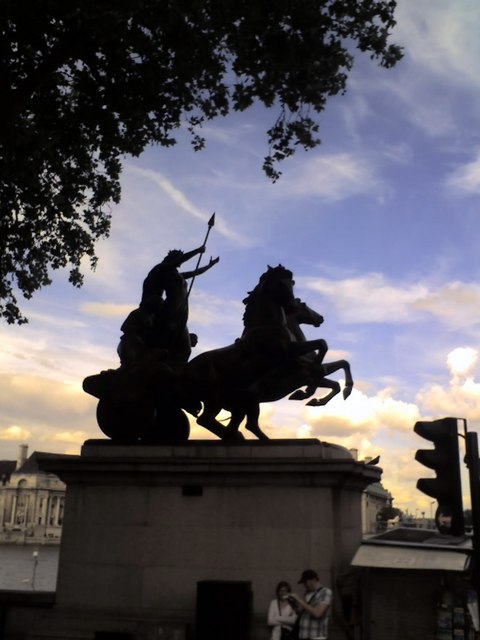
I mounted my chariot myself, my esseda, my two daughters at my side, so that all could see what had been done to them and to whom vengeance was owed. I wore the golden torc around my neck, that twisted ring that speaks rank better than a thousand words, and over my checked tunic the great bright cloak that the wind swelled. I rode along the lines from end to end, my voice thrown over the clash of shields. Among us, a woman can lead war like a man; the Romans marveled at it, but our ancestors saw nothing strange in it. I did not harangue from a stone platform: I rode among my men, in the dust and the smell of horses, a queen made of the same earth as they.
Among us, a woman can lead war like a man; our ancestors saw nothing strange in it.
—What place did the goddess Andraste hold in your decisions?
No battle is launched without consulting the gods — to believe otherwise would be the folly of pride. Before combat, I released a hare I kept hidden in the folds of my cloak, and I read its course: the side toward which it fled announced the favor or anger of the powers. Then I raised my hands to Andraste, our goddess of victory, she who loves blood spilled on her altars. The Romans mock our omens, they who slaughter chickens to read their entrails; every people has its signs. For us, war is not a matter of accounts and machines: it is a pact with the invisible. The iron cuts, but it is the goddess who decides where it falls.
—If you could imagine how Rome will tell your story in a century, what would you say?
Rome's scribes will write, for it is they who hold the pen, never the vanquished. They will no doubt make me larger than life: a giantess with a harsh voice, hair of fire falling to the waist, a fury from the northern forests. They will count my warriors in the hundreds of thousands so that my defeat better honors their legions — for a huge monster is needed to magnify the one who slays it. Perhaps they will even lend me a fine speech before the battle, crafted in their Latin, as they like to put into the mouths of kings they kill. Let them write what they will: a queen told by her enemies will remain alive, and that is already to defeat them a little.
A huge monster is needed to magnify the one who slays it.
—It is said that your stature and voice struck all who approached you. What do you think of that?
I am told I am tall, my voice harsh, my gaze that does not like to lower — I will not deny it. A queen of the Iceni does not whisper; she must make herself heard over a thousand horses and the wind of the plain. This body, the Romans find frightening because it is not that of their matrons shut up in their brick houses. But my red hair and harsh voice are not weapons: my weapons are my allied tribes, my anger, and the memory of the rods on my back. Let them tremble at my stature, so be it. They would do better to tremble at what an entire people is capable of when even their queen has been trampled.
—On the eve of facing Paulinus, what do you fear most?
I fear our numbers. That may surprise, but listen: Paulinus has chosen his ground, a narrow defile, the forest behind him, barely ten thousand legionaries packed like a wall. In that bottleneck, our multitude cannot deploy; it tramples itself. And I have committed a fault of pride — I let the wagons, the women, the children, all our impedimenta, form an arc behind our lines to witness the victory. If the battle turns badly, that wall of wagons will become a trap closing off our escape. The Romans are few, but they are a closed fist, while we are an open hand. That is what keeps me awake this night, not death, but the geometry of death.
The Romans are few, but they are a closed fist, while we are an open hand.
—And if, despite everything, victory eludes you tomorrow?
Then I will not surrender alive. I have seen what Rome does with captured queens: they drag them in chains through their streets, parade them before the crowd, make them an ornament of triumph before strangling them in the shadow of a prison. That spectacle, they will not have from me. There is always a cup, a discreet poison, an exit no jailer can confiscate. I began this war free; I will end it free, one way or another. Whether the iron of the legions takes me in the melee, or I choose the hour of departure myself, it matters not: Rome may burn our roundhouses and raze our fields, it will never enter the last stronghold of a soul that has decided not to bend.
I began this war free; I will end it free, one way or another.
This imaginary interview was generated by artificial intelligence from sources documented in Boudicca's profile. It dramatises what the figure might have said based on what we know about them, but does not constitute attested historical testimony. For primary sources and factual documentation, refer to the full profile.