Kids interview Calamity Jane
by Charactorium · Calamity Jane (1852 — 1903) · Exploration · Performing Arts · Society · 5 min read
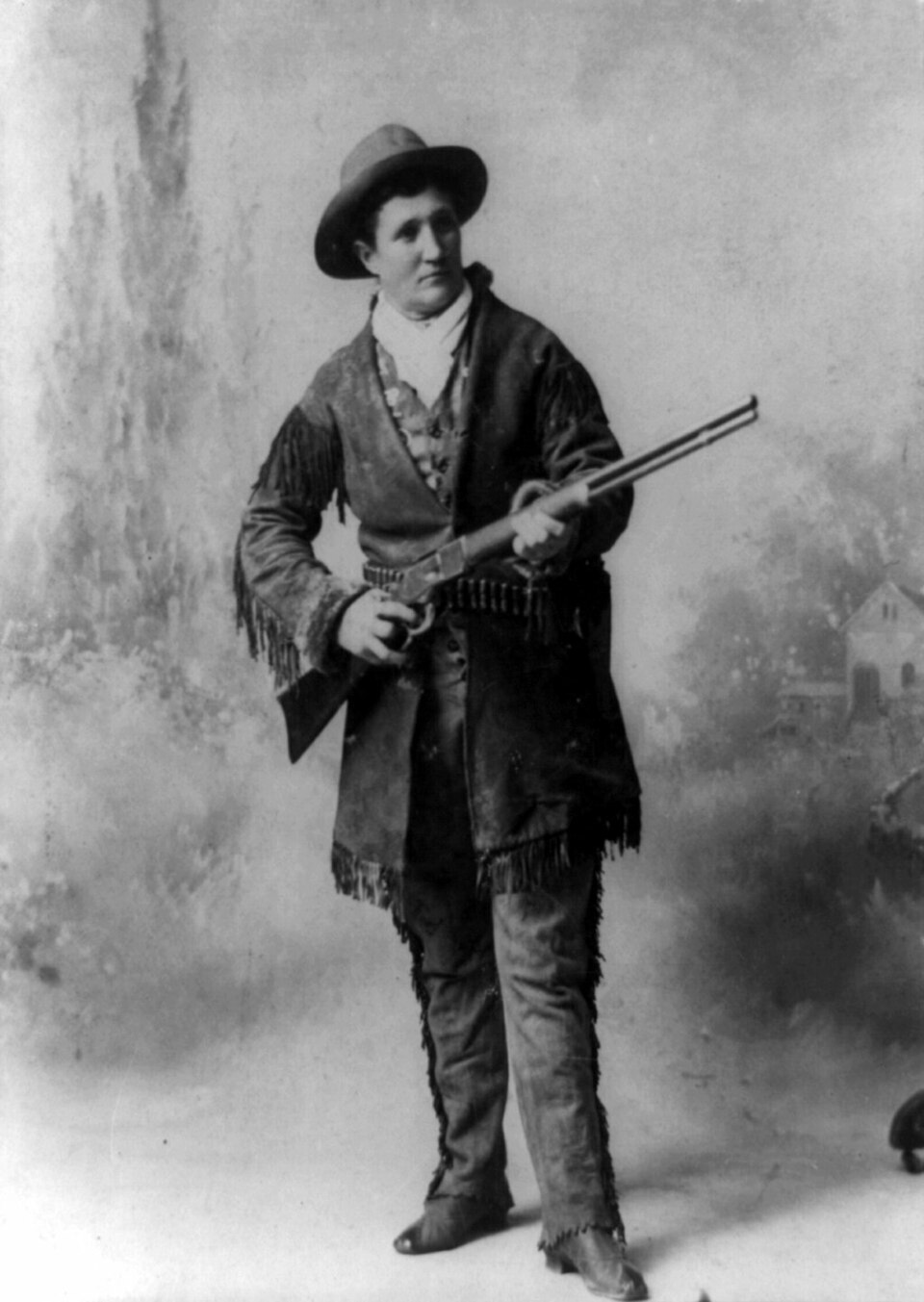
Two young visitors, on a school trip, push open the door of a wooden cabin somewhere in the Black Hills. A woman in a fringed leather jacket waits for them, a rifle propped against the wall. She smiles: it amuses and touches her that children come to listen.
—What was it like, a girl dressed as a man among soldiers?
You know, my child, imagine a long column of soldiers and mule drivers advancing toward Sioux territory, in the dust. And there, in the middle, is me, in the 1870s, in trousers and a leather jacket. A woman dressed like that, in my time, was rare, and it set tongues wagging. But the job of a scout means spotting trails, guiding convoys, warning of dangers. You don't do that in a long dress! I also drove the team, with the big whip in hand. Dressed as a man, I was listened to more. And above all, I could follow the columns that left Fort Laramie.
A scout doesn't guide convoys in a long dress.
—Did you really drive those big horse-drawn wagons all by yourself?
Yes, my little one, the stagecoach! Imagine a heavy wooden vehicle, pulled by several horses or mules, carrying passengers and mail between camps. The trails of the Black Hills were dangerous: rocks, ravines, and sometimes bandits. It took a strong arm and a long whip to handle the whole team. I boasted that I could do it, and I liked being believed. It was a man's job, you see, but I managed. At night, my hands burned from holding the reins. But bringing in a full load without tipping into a ditch—that made me proud.
—Weren't you afraid of catching the disease while nursing people?
Yes, a little, I won't lie to you. Smallpox is a terrible disease that covers the skin with scabs and kills many. Around 1878, in Deadwood, it struck the mining camp. Many fled the sick, fearing they would be contaminated too. I stayed. I gave them water, cooled their foreheads, kept watch at night beside them. I wasn't a doctor, just a pair of hands that didn't run away. People said I was a drinker and a brawler. And yet, it was that gesture that earned me the camp's affection.
I was just a pair of hands that refused to run away.
—Why did people like you even though you caused trouble?
Ah, you remember well! It's true, my child, I had a bad reputation. In the evenings, I was a regular at the saloons—you know, those drinking places where people played cards and drank. I loved whiskey and the stories told there, often a bit exaggerated. So, naturally, I was considered rowdy. But in a mining camp, what matters isn't being well-behaved. It's being there when things go wrong. When sickness came, I stayed. People don't forget that. You can be loud on Saturday night and good on Monday at a sick person's bedside.
—Is your book where you tell your whole life true?
Partly true, partly embellished, my little one! Around 1896, I had a small eight-page pamphlet printed: Life and Adventures of Calamity Jane, By Herself. I sold it for a few cents when I appeared before the public. It began like this: 'My maiden name was Marthy Cannary. I was born in Princeton County, Missouri, on May 1, 1852.' The rest? In it, I am an intrepid scout facing a thousand dangers. Some things are true, others I made more beautiful. That's how you become a legend in your own lifetime.
Some things were true, the others I made more beautiful.
—And your funny nickname, 'Calamity', where does it come from?
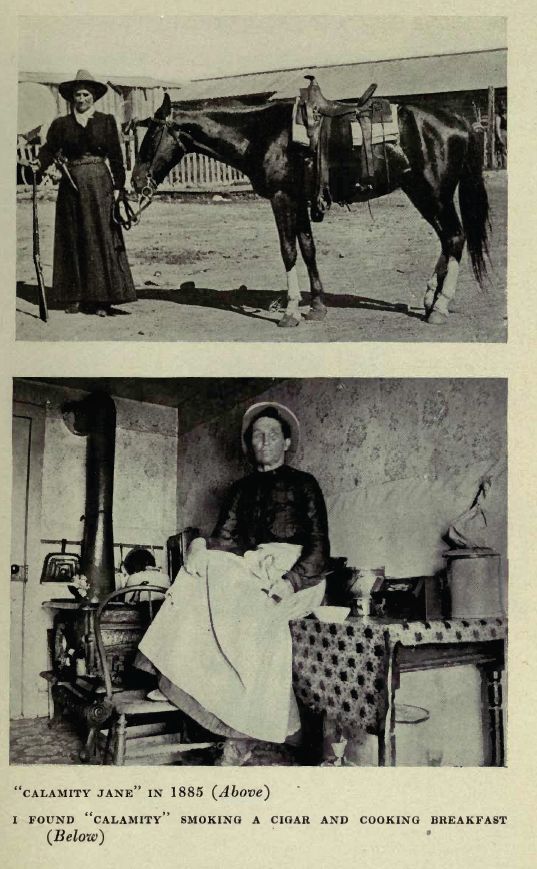
Ah, everyone asks me that! I used to tell a nice story: an officer I supposedly saved from an ambush gave me that name, saying that defying this woman brought 'calamity'—that is, misfortune, disaster. Pretty, isn't it? But I'll be honest with you: no one was ever able to prove it. The truth is surely simpler. I had a terrible temper, I was boisterous, I made noise everywhere I went. So the nickname stuck. You see, a good story is sometimes better than the truth for people to remember you.
—Did you really go on stage for people to watch you?
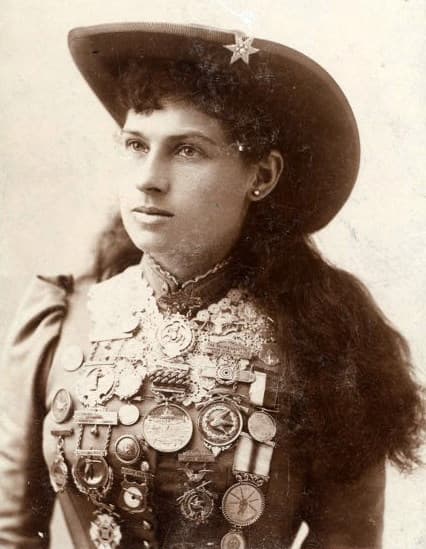
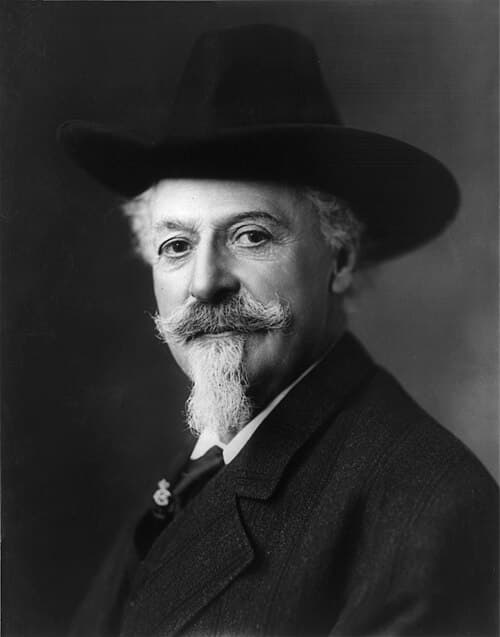
Yes, my child, at the end of my life, in the 1880s and 1890s. Imagine a big tent, or a fair booth like those of Kohl & Middleton, where curious things were shown. The public paid to see 'the real Calamity Jane'. I posed in leather costume, my Colt revolver at my belt, like a figure straight out of the frontier. They called it a Wild West show, a performance reenacting Western life. In 1883, Buffalo Bill had launched his own, enormous. As for me, I had become a living attraction. A bit sad, when you think about it: I was the memory of my own youth.
I had become a living attraction: the memory of my own youth.
—How do you become a book character while still alive?
It's strange, isn't it? In my time, there were what they called dime novels—cheap little novels sold for ten cents. They told adventures of the West, full of duels and rides. Writers who had never met me put me in them, with my weapons and exaggerated courage. So there were two Calamity Janes: the real one, me, tired and often penniless; and the one in the books, intrepid and flamboyant. People came looking for the one in the books. And sometimes, in my shows, I played that character that had been invented from me.
—Who was this Wild Bill that people always talk about with you?
Wild Bill Hickok was a pistolero—you know, a man known for his skill with a revolver and his duels. A true figure of the West. He was murdered in Deadwood on August 2, 1876, shot from behind in a saloon during a card game. I always let it be understood that we were very close, him and me. Was it entirely true? Let's say I helped the legend grow. Our two names sound good together, don't you think? Stories of friendship and love in the West are told around the campfire. And I liked having mine told.
—Is it true that you are buried right next to him?
Yes, my child, and that's the whole end of the story. I died in 1903, sick and with little to my name, near Deadwood. I was buried in Mount Moriah cemetery, right next to Wild Bill Hickok's grave. They say it was my last wish. You see, during my lifetime, I had done everything to make people believe in our great closeness. And this neighboring grave, forever, sealed it in legend. Perhaps it's my greatest staging: even dead, I remain linked to him. No one will ever be able to tell his story without a bit of mine.
Even dead, I remain in history next to him.
This imaginary interview was generated by artificial intelligence from sources documented in Calamity Jane's profile. It dramatises what the figure might have said based on what we know about them, but does not constitute attested historical testimony. For primary sources and factual documentation, refer to the full profile.