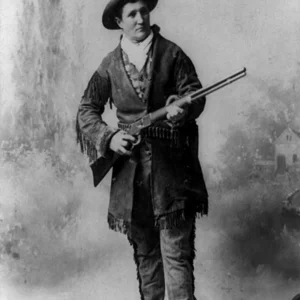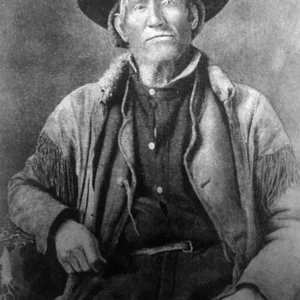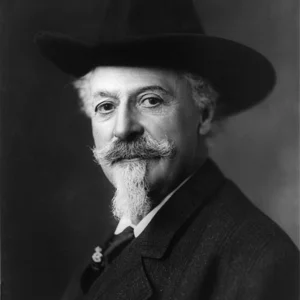

William Cody (1846-1917), known as Buffalo Bill, was a scout for the U.S. Army and a bison hunter before becoming a worldwide showman. His Wild West Show staged the conquest of the West before millions of spectators in America and Europe.
Buffalo Bill(1846 — 1917)
Buffalo Bill
États-Unis
6 min read
Frequently asked questions
Key Facts
- Born in 1846 in Iowa, he became a rider for the Pony Express and then a scout for the U.S. Army
- Nicknamed Buffalo Bill after killing thousands of bison to feed the railroad workers (around 1867-1868)
- Received the Medal of Honor in 1872 for his services as a scout (revoked, then reinstated in 1989)
- Founded Buffalo Bill's Wild West Show in 1883, a touring spectacle that became a worldwide success
- Triumphant tours in Europe (1887, 1889) featuring the likes of Sitting Bull and Annie Oakley; died in 1917
Works & Achievements
A traveling show combining horse riders, sharpshooters and Native Americans, which invented a lasting dramatization of the conquest of the West.
A section added to the show bringing together horsemen from many countries, which turned it into an international attraction.
Several tours through England, France, Italy and Germany that spread the imagery of the Wild West to millions of Europeans.
A heavily fictionalized autobiography that helped forge his own legend as a hero of the Frontier.
The creation of a town in Wyoming, intended to benefit from tourism and its proximity to Yellowstone.
Anecdotes
Recruited as a rider at a very young age, William Cody is said to have worked around 1860 for the Pony Express, the horseback mail service that connected Missouri to California. This network of relay stations could carry mail in about ten days, but it was made obsolete in less than two years by the transcontinental telegraph.
His nickname “Buffalo Bill” came from his contract with the Kansas Pacific railroad company around 1867-1868: tasked with feeding the workers, he reportedly killed more than 4,000 bison in eighteen months. This industrial-scale hunting illustrates the massive destruction of the herds that reduced the bison to just a few hundred individuals by the end of the century.
In 1872, the U.S. Army awarded him the Medal of Honor for his role as a scout, even though he was a civilian. Decades later, in 1917, the medal was revoked because the law reserved it for military personnel; it was not officially restored to him until 1989.
Starting in 1883, his show “Buffalo Bill's Wild West” toured America and then Europe. In 1887, he performed in London for Queen Victoria's Jubilee, and in 1889 in Paris during the World's Fair, before enormous crowds who were discovering a spectacular image of the American West.
The Sioux chief Sitting Bull, victor at Little Bighorn in 1876, joined Buffalo Bill's show in 1885 for one season. The two men respected each other: it is said that Cody gave him a show horse, and that Sitting Bull bestowed an honorary name upon him.
Primary Sources
“I was born on the 26th of February, 1846, in Scott County, in the State of Iowa.” In it, Cody recounts—embellishing it—his youth as a horseman and scout on the Frontier.
The program presents the show as a “realistic scene of life on the Frontier,” staging stagecoach attacks, horse races, and reenactments of battles.
The monumental posters proclaim “Buffalo Bill's Wild West and Congress of Rough Riders of the World,” boasting hundreds of riders, Indians, and bison.
Key Places
Rural region of Iowa where William Cody was born in 1846.
Territories where Cody hunted bison for the Kansas Pacific Railroad in the late 1860s.
The Wild West Show performed here in 1887 for Queen Victoria's Jubilee, before enormous crowds.
The show triumphed here in 1889 during the World's Fair, at the foot of the newly built Eiffel Tower.
Town founded at his initiative in 1896 and bearing his name, at the gateway to Yellowstone National Park.
City where Buffalo Bill died in 1917; he was buried not far away, on Lookout Mountain.
Typical Objects
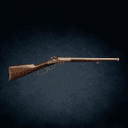
Single-shot carbine used by scouts and hunters of the U.S. Army. Cody made it one of the emblems of his legend as a marksman.
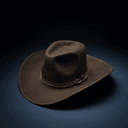
Felt headwear protecting against the sun and dust of the plains. It became a distinctive feature of Buffalo Bill's silhouette.
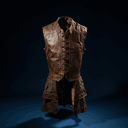
Buckskin garment adorned with fringes, inspired by the outfits of trappers and Native Americans. Cody turned it into a spectacular stage costume.
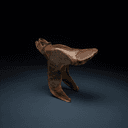
Sturdy saddle with a high pommel, suited to long rides and cattle work. It equipped the riders of the Wild West Show.
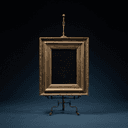
Large color lithograph announcing the performances in the towns. These posters played a part in the birth of mass advertising.
Horse-drawn carriage used to transport travelers and mail, presented as a genuine historic stagecoach in the show.
School Curriculum
Vocabulary & Tags
Key Vocabulary
Tags
Daily Life
Morning
During his years as a scout, the day began at dawn: saddling his horse, examining trails, and reporting to the officers. In the era of the show, the morning was devoted to setting up the camp and rehearsing.
Afternoon
The afternoon might be filled with long scouting rides across the plains, or, later on, with performances before the public and welcoming the spectators around the tents.
Evening
In the evening, around the campfire, the men shared a meal and stories. While on tour, the evening was spent counting the takings, organizing the move to the next town, and tending to the horses.
Food
On the Frontier, people lived mainly on bison meat or game, beans, flour cakes, and strong coffee. During the tours, the quartermasters had to feed hundreds of performers and animals every day.
Clothing
Cody wore fringed leather outfits, high boots, and a wide-brimmed hat. For the stage, he took great care with his appearance: a goatee, long hair, and a theatrical costume to play the hero of the West.
Housing
As a scout, he lived under canvas or beneath the open sky near the military forts. Once he had grown wealthy, he owned a large ranch in Nebraska, then had hotels and a house built in the town of Cody.
Historical Timeline
Period Vocabulary
Liens externes & ressources
Références
Œuvres
Buffalo Bill's Wild West
1883
Congress of Rough Riders of the World
1893
Tournée européenne triomphale
1887-1906
The Life of Hon. William F. Cody
1879
Fondation de la ville de Cody
1896