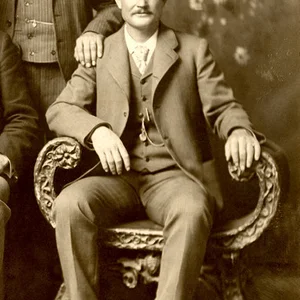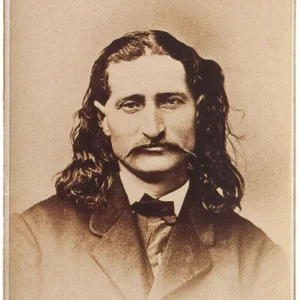

An iconic figure of the American West, James Butler Hickok was in turn a Union scout, a Kansas lawman, a professional gambler, and a stage performer. A renowned gunfighter, he became a living legend before being shot in the back in 1876.
Wild Bill Hickok(1837 — 1876)
Wild Bill Hickok
États-Unis
6 min read
Frequently asked questions
Key Facts
- Born on May 27, 1837, in Homer, Illinois, under the name James Butler Hickok.
- Scout and spy for the Union Army during the Civil War (1861-1865).
- A Kansas lawman, notably marshal of Abilene in 1871, a cattle and cowboy town.
- Performed in 1873 with Buffalo Bill Cody's theatrical troupe, popularizing the image of the gunfighter.
- Murdered with a shot to the back on August 2, 1876, in Deadwood during a poker game; his hand of cards became known as the “dead man's hand.”
Works & Achievements
During the Civil War, Hickok worked as a teamster, scout, and intelligence agent, earning his reputation as a plainsman.
A face-to-face showdown in Springfield often described as the first quick-draw gunfight of the West, the template for the myth of the fast shooter.
As a lawman in the Kansas frontier towns, Hickok tried to keep order among cowboys and gamblers.
Hickok appeared on stage alongside Buffalo Bill Cody, taking part in the birth of the Wild West Show.
The Harper's article and later the popular novels made “Wild Bill” one of the founding heroes of the mythology of the American Frontier.
Anecdotes
On 21 July 1865, in the public square of Springfield (Missouri), Hickok faced the gambler Davis Tutt in a face-to-face duel. From about 75 meters, the two men fired almost together: Tutt missed, while Hickok struck him right through the heart. This confrontation is often described as the first true “gun duel” of the West, the origin of the myth of the quick draw.
In February 1867, Harper's magazine published an article by Colonel George Ward Nichols that turned Hickok into a national celebrity. The author credited him with hundreds of kills and improbable feats. Many of these accounts were exaggerated, but they laid the foundation of the legend of “Wild Bill.”
As Marshal of Abilene in October 1871, Hickok exchanged gunfire with the gambler Phil Coe. Hearing footsteps rushing up behind him, he fired by reflex and accidentally killed his own deputy and friend, Mike Williams. Devastated, he never served as a lawman again after this episode.
In 1873, Hickok joined Buffalo Bill Cody's theatrical show “Scouts of the Plains.” A poor actor, bothered by the footlights that hurt his eyes, he sometimes fired too close to the extras' legs to make them jump and eventually left the troupe.
On 2 August 1876, in a Deadwood saloon, Hickok was playing poker with his back to the door — he who always took care to sit with his back to the wall. Jack McCall walked in and shot him in the back of the head. According to legend, Hickok was then holding a pair of aces and a pair of eights, since nicknamed the “dead man's hand.”
Primary Sources
“I suppose I have killed considerably over a hundred men.” This statement attributed to Hickok by Nichols is one of the exaggerations that launched his legend.
The local newspaper recounts the confrontation in the public square: Hickok, accused of shooting Davis Tutt, was arrested for murder and then acquitted on grounds of self-defense.
In his family correspondence, Hickok describes his life as a scout and traveler on the plains, far removed from the killer's image the newspapers gave him.
The minutes of the second trial establish that McCall shot a bullet into the back of Hickok's head during a card game in Deadwood; he was convicted and hanged in 1877.
Key Places
Birthplace of James Butler Hickok, in northern Illinois, where he grew up in an abolitionist family.
Setting of the famous face-to-face duel against Davis Tutt in 1865, considered the first true gunfight of the West.
Frontier town where Hickok served as acting sheriff in 1869, in a turbulent railroad city.
Texas cattle terminus where Hickok was marshal in 1871; there he accidentally killed his deputy Mike Williams.
Mining town of the Black Hills gold rush where Hickok was murdered in 1876; he is buried there in Mount Moriah Cemetery.
Typical Objects

Hickok wore a pair of .36 caliber Colt Navy revolvers tucked into a sash, with the grips turned forward for a cross-draw. They were his favorite dueling weapons.

A metal badge worn by the lawmen of the West. Hickok wore it in Hays City and then in Abilene as a symbol of his authority.

A professional gambler, Hickok made his living at poker tables. The pair of aces and eights he is said to have held when he died became the legendary “dead man's hand.”

A single-shot rifle of great accuracy, used by the scouts and buffalo hunters of the plains. Hickok used one as an army scout.

A supple, fringed leather garment worn by the scouts of the Frontier. On stage, Hickok played it up to embody the man of the West.

A wide band of cloth knotted at the waist, into which Hickok tucked his revolvers rather than using holsters. This detail made his quick draw easier.

A large fighting knife and versatile tool, emblematic of the American Frontier. A common backup weapon among the men of the West.
School Curriculum
Vocabulary & Tags
Key Vocabulary
Tags
Daily Life
Morning
Hickok often woke up late, since his nights were spent at the gambling tables. He took great care with his appearance: he combed his long hair and his moustache, and was renowned for his polished elegance.
Afternoon
As a lawman, he patrolled the dusty streets of the cattle towns, keeping watch over saloons and gamblers. During show season, he rehearsed the scenes of the Wild West Show, which he hated performing.
Evening
Evening was his favorite time of day: he would settle into a saloon to play poker or faro. Cautious by nature, he always chose a seat with his back to the wall, facing the door.
Food
On the Frontier, the diet relied on bison or beef, strong coffee, beans, cornbread, and whiskey served at the saloon. Fresh fruits and vegetables were scarce in these isolated towns.
Clothing
Hickok took care with his appearance: he often wore a frock coat, a waistcoat, fine shirts, and sometimes a fringed buckskin jacket. A sash belt at his waist held his two revolvers.
Housing
His nomadic life led him to lodge in hotel rooms, boarding houses, and saloons of the frontier towns. He never owned a real home and slept wherever his travels took him.
Historical Timeline
Period Vocabulary
Liens externes & ressources
Références
Œuvres
Service d'éclaireur et d'espion pour l'Union
1861-1865
Duel contre Davis Tutt
1865
Charge de marshal de Hays City et d'Abilene
1869-1871
Tournée théâtrale « Scouts of the Plains »
1873-1874
Légende des dime novels et de la presse
à partir de 1867