Kids interview Caracalla
by Charactorium · Caracalla (188 — 217) · Politics · 5 min read
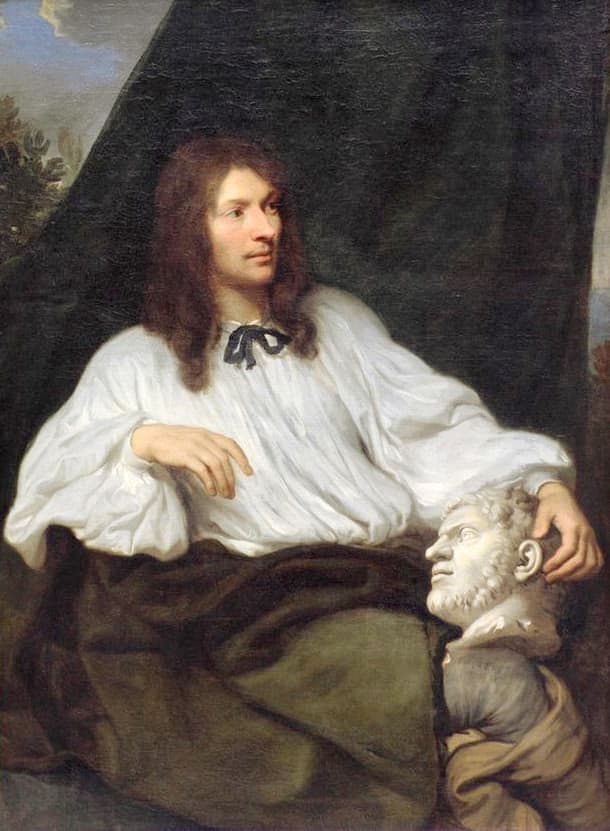
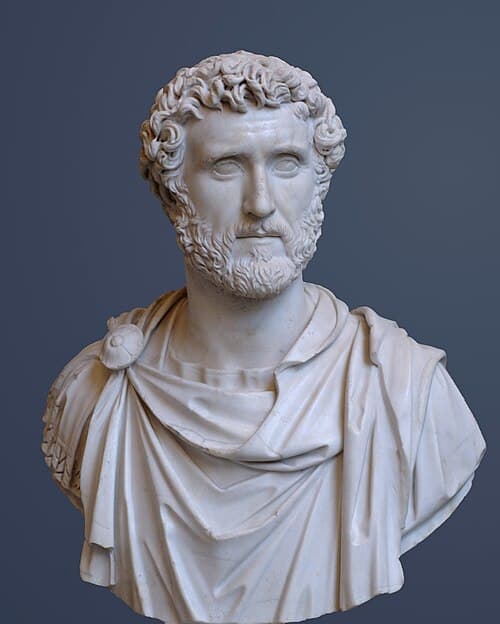
That morning, two students from a school trip pushed open the door of a great marble hall. Before them stood a stern-faced man wrapped in a long hooded cloak. It was Caracalla, Emperor of Rome, and he had agreed to answer all their questions.
—Why are you called Caracalla? That's a funny name!
You know, it's not even my real birth name. But I always wore a long hooded cloak from Gaul called a caracallus. Picture a big woolen garment that reaches down to your feet, with a hood for the rain. It was the clothing of ordinary people, not emperors! But my soldiers loved it, so I kept it on my shoulders from morning till night. On my feet, I wore caligae, the heavy nailed sandals of legionaries. Little by little, my name was forgotten, and everyone started calling me after my cloak. An emperor nicknamed after his clothes — you have to admit, that's rare!
—Is it true you killed your brother? How is that possible?
Yes, my child. And I won't lie to you: this is the darkest part of my life. When our father Septimius Severus died in 211, my brother Geta and I were supposed to rule together. But we hated each other. The palace on the Palatine Hill in Rome was not big enough for the two of us. One day, I sent men to kill him. He ran to our mother Julia Domna and died in her arms. Then I ordered his name erased everywhere: on walls, coins, statues. It was called damnatio memoriae — the condemnation of memory. As if Geta had never existed.
Power sometimes makes men monstrous.
—What is that great law everyone talks about?
Ah, that is what I am most proud of! In 212, I signed an edict called the Constitutio Antoniniana. A complicated word for a very simple idea: I made almost all free men in the Empire Roman citizens. Before me, being cives Romani, a Roman citizen, was a privilege reserved for a few. Imagine a closed club where only some are allowed in. Suddenly, I opened the doors to millions of people, from Egypt to Gaul. An Egyptian, a Gaul, a Syrian: all Romans, all equal before the law. A fragment of my edict was even found on an old papyrus, the Papyrus of Giessen.
—Did everyone become Roman, even at the ends of the earth?
Almost everyone, yes! Imagine a city at the very edge of the Empire: Volubilis, in what is now Morocco. There, so far from Rome, they erected a stone arch in my honor, because even those inhabitants had become citizens. That shows how far my law traveled! But I must be honest with you: not everyone was included. The dediticii, those peoples conquered in war and forcibly subdued, were probably left out. Citizenship was a huge gift, but not for absolutely everyone. An empire, you see, is never as simple as we would like.
—Is it true you admired Alexander the Great?
Oh yes, he was my hero! Alexander the Great had conquered almost the entire world centuries before me, and I dreamed of being like him. When I went to Alexandria, the great city of Egypt that bears his name, I visited his tomb. I laid my own cuirass and jewels there as an offering. Can you imagine? An emperor placing his treasures before a dead man! I even went further: I organized my soldiers into phalanxes, those tight blocks of spearmen that Alexander used to win his battles. Some people mocked me in secret. But I felt I was walking in the footsteps of a giant.
—And then, in Alexandria, something terrible happened, didn't it?
Yes... and here again, I won't hide behind pretty words. The people of Alexandria were mocking. They had invented cruel songs and jokes about me, about my brother's death. It drove me mad with rage. In 215, I unleashed my legionaries on the city. Many young men died that day. It is called the Massacre of Alexandria. You see, I loved that city for Alexander's tomb, and yet I stained it with blood. A man with too much power and too much anger becomes dangerous. Remember this lesson well, my child.
—They say you built giant baths. What were they like?
Ah, my Baths! If you came to Rome, that is surely what you would notice first. Picture an enormous building, as large as several temples put together, where more than 1,600 people could bathe at once! The thermae were public baths: people washed there, but also chatted, exercised, and read in libraries. After exertion, they scraped their skin with a strigile, a small bronze scraper, to remove sweat and oil. Rich and poor mingled there. I liked to go myself, like an ordinary Roman. An emperor naked in the water — surprising, isn't it?
—And is it true you had money problems?
Alas, yes. Waging war and paying soldiers costs a fortune! So in 215, I invented a new silver coin, the antoninianus. The problem was that I cheated a little. The coin was supposedly worth two denarii, but it contained less actual silver. Imagine being given a coin that is said to be worth two apples, but it can only buy one and a half. Eventually, people notice, and everything becomes more expensive: that is called inflation. Without meaning to, I helped trigger a long crisis for the Empire.
Money is like trust: if you cheat, it eventually shows.
—What did you eat, as an emperor? Fancy things?
You would be surprised! Many emperors loved grand banquets. I wanted to be a soldier-emperor, close to my men. So in the morning, I ate simply: bread and cheese, nothing more. On military campaign, I shared my legionaries' mess: bacon, lentils, that hard bread called panis militaris. I drank my wine mixed with water, just like them. I even slept in a tent with my soldiers, while the generals had fine rooms! Why? Because a leader who eats the same bread as his men — his men will follow him to the end.
—How did you die? And what is remembered about you?
I died far from Rome, my child. In 217, I was in the East, near a city called Carrhae in Mesopotamia, preparing a war against the Parthians. One day, I stepped off the road to relieve myself... and one of my own soldiers stabbed me. He had been put up to it by Macrin, the commander of my guard, who wanted my position — and he got it. That is how emperors often end: through betrayal. But you know, what is remembered about me is not my death. It is my edict of 212, which made so many people Roman citizens.
How a man dies is forgotten; what he changed is remembered.
This imaginary interview was generated by artificial intelligence from sources documented in Caracalla's profile. It dramatises what the figure might have said based on what we know about them, but does not constitute attested historical testimony. For primary sources and factual documentation, refer to the full profile.