Imaginary dialogue between Raymond de Capoue (Raimondo da Capua) and Catherine of Siena
by Charactorium · Catherine of Siena (1347 — 1380) · Literature · Politics · Philosophy · 6 min read
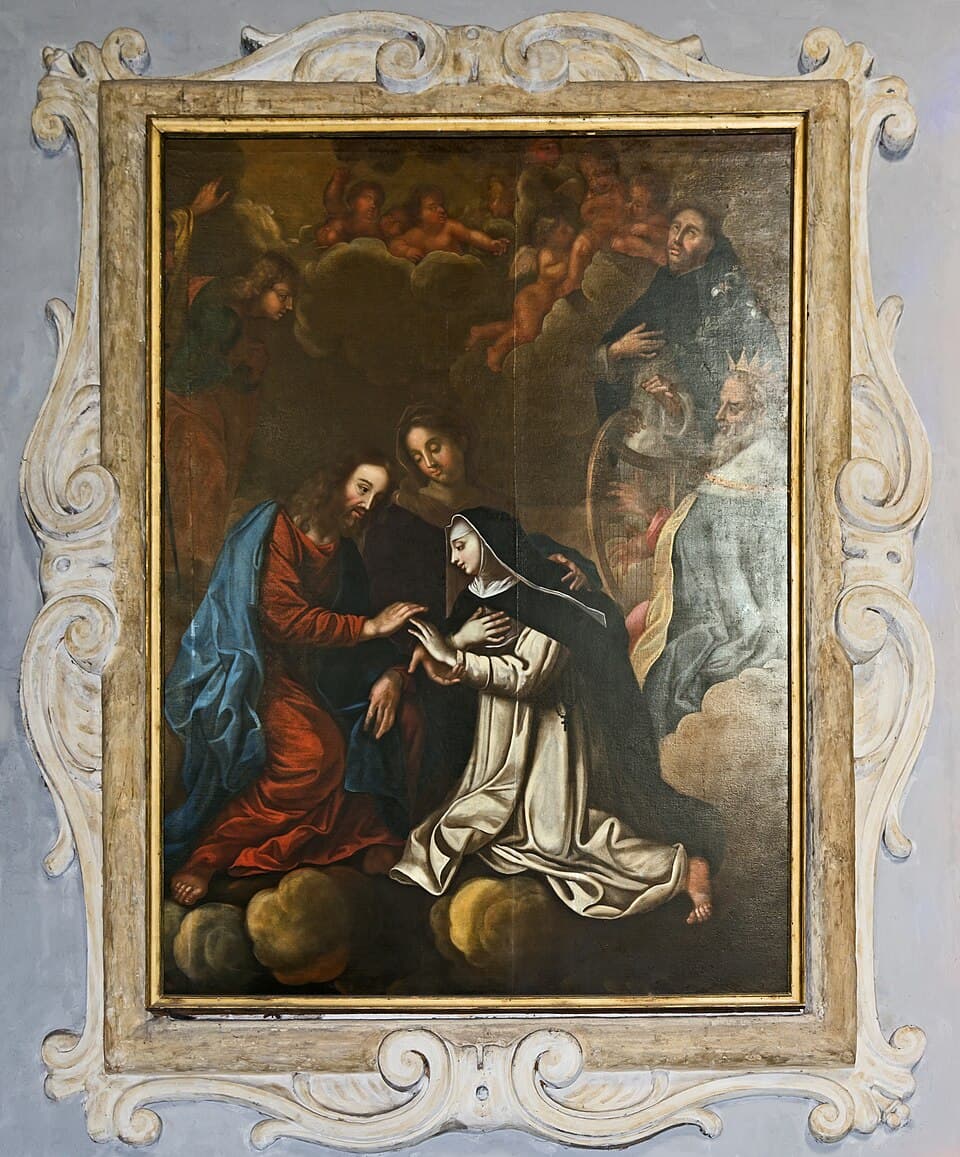
It is in a bare cell near Santa Maria sopra Minerva, in Rome, that I find Catherine in this winter of 1379. A single candle lights the table where our brothers are still transcribing her letters; outside, the city rumbles with the quarrels of the Schism. I, who have been her confessor since Siena, see her paler than ever, emaciated by her fasts. I come to gather, before it is too late, what I have so often sensed without daring to ask.
—Catherine, do you remember when we were in Avignon, in 1376: where did you get the audacity to rebuke the Holy Father like that?
Father Raymond, you who accompanied me in those audiences, you know it was not my audacity but that of the crucified Christ speaking through my mouth. I called him sweet Christ on earth, for I venerated him as vicar; but true love does not flatter. I begged him to come fight the enemies of God, to fear no more, to be courageous and not cowardly. A poor dyer from Siena has nothing to lose before a pope, except guilty silence. When Gregory XI finally returned to Rome in 1377, after sixty-eight years of Avignon exile, I understood that God uses the smallest to straighten the greatest. You saw me tremble before each interview, and yet the words came.
A poor dyer from Siena has nothing to lose before a pope, except guilty silence.
—You who held the pen for me, tell me: how is the Dialogue born in you, when you dictate thus with your eyes closed?
Raymond, you yourself wrote under my word, so you are well placed to witness it. When ecstasy seizes me, my body withdraws and my soul converses with eternal Truth. What God shows me, I repeat to my secretaries, who gather phrase after phrase — for long I could not form my own letters, and it was considered a gift from Heaven that I learned to read alone. The Dialogue of Divine Providence is not my work: it is a conversation where the soul questions and God answers, inviting me to open the eyes of the intellect to contemplate the beauty of his rational creature. I am only the pen, or rather the parchment on which a higher hand writes.
I am only the pen, or rather the parchment on which a higher hand writes.
—My child, I see you refuse almost all food. How does your body hold up, when you take only the host?
You worry like a father, and I know you well enough to know that you have often urged me to eat more. But my body has unlearned the hunger of men. I sometimes put a few bitter herbs to my mouth, and I spit them out; the little I swallow weighs on me like a stone. My true food is the Body of Christ received at the altar — from him alone I live, and you have gathered under oath what so many witnesses saw in Siena. I have been reproached for this abstinence, judged as pride or illness. But I did not choose this fast as a feat: it imposed itself on me. Earthly bread left me as heavenly bread filled me.
My true food is the Body of Christ received at the altar — from him alone I live.
—Before Avignon, at Fontebranda, why did you choose the streets and hospitals rather than the cloister where you would have been thought safe?
You remember our first meetings, Raymond, when I returned from the wards of Santa Maria della Scala with my hands still soiled. I took the white habit and black mantle of the Mantellate, those sisters of the Third Order who remain in the world, precisely not to be enclosed. Christ did not hide behind walls: he touched lepers. I cared for the sick that others fled, watched over prisoners led to execution, held the hands of the condemned up to the scaffold. A common woman could thus serve without leaving her cell in Fontebranda and without renouncing her city. The cloister guards the body; the streets of Siena taught me to love those God places on my path.
Christ did not hide behind walls: he touched lepers.
—Here we are in Rome, in the midst of rupture. Why support Urban VI with such force, at the risk of consuming yourself?
Father, you see as I do the Church breaking apart since the death of Gregory XI, this year 1378 when a second pope was set up against the first. I do not judge souls, but I hold that there is only one legitimate vicar, and that is Urban, elected before any schism. I write day and night to cardinals, princes, cities, begging them to return to unity. My health? It no longer belongs to me. I offer myself for this bark of Peter tossed by the storm, and if my body must break from praying and fasting, let it break. The Great Schism is an open wound in Christ's side; I want to die pressing it with my hands.
The Great Schism is an open wound in Christ's side; I want to die pressing it with my hands.
—Many are astonished that an unlettered woman writes to kings and condottieri. Do you never fear being reproached for this freedom?
I have been reproached, and you have sometimes had to defend me, Raymond. No matter if they are astonished: the fire that presses me does not ask permission of scholars. I address my letters, sealed with wax, to popes as to mercenary captains, not to appear but to tear them away from their wars. To those condottieri who ravage Italy, I cry out to turn their arms toward crusade rather than against Christians. A woman has no pulpit or council; she has the written word and burning love. If I am objected to for my sex and ignorance, I reply that God readily confounds the strong by the weak. My only authority is the blood of Christ that I never cease to invoke.
The fire that presses me does not ask permission of scholars.
—In Pisa, in 1375, you spoke to me in veiled terms of what you had received. What really happened to you that day?
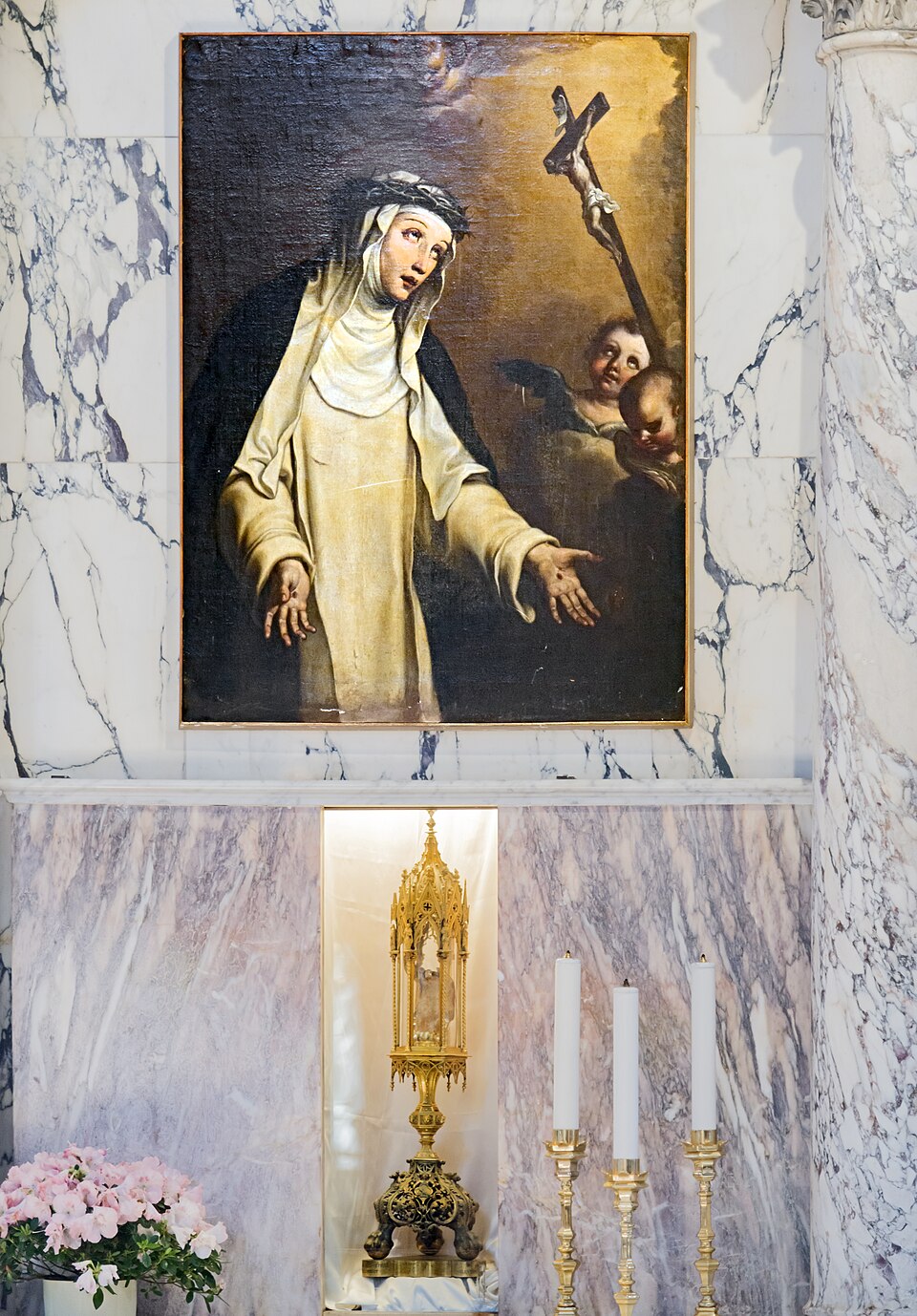
You are one of the few to whom I have dared to confide it, and I beg you to keep it to yourself as long as I live. In the church of Santa Cristina, in full ecstasy before the crucifix, I felt the five wounds of Christ penetrate my body like shafts of light. I begged the Lord that these marks remain invisible to the eyes of men, for I fear above all vanity and admiration. The pain, however, has never left me: it burns within me like a hidden fire. This was not an honor but a burden, a way to bear in my flesh what I preach with my lips. Do not think, Raymond, that God thus distinguished me for my holiness: he did it to unite me to his Passion.
I begged that these marks remain invisible: I fear above all vanity.
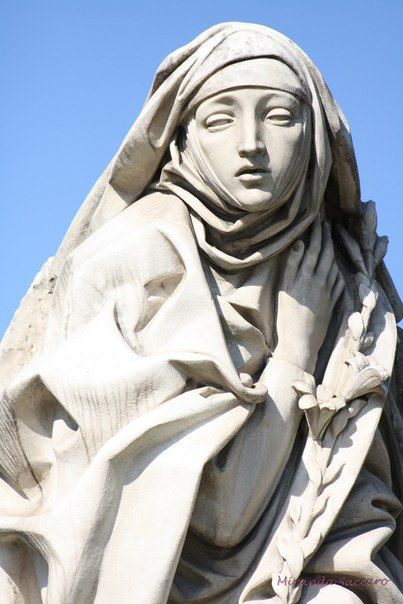
—I see you rise before dawn and hardly sleep. How do you keep this pace, between prayer, the sick, and dictations?
You have shared enough of our Sienese days to know, Raymond. I rise before daybreak for prayer, often rapt until sunrise, then I receive the Body of Christ at mass. In the morning, our secretaries transcribe my letters; in the afternoon, I go to the sick and to those about to be hanged; in the evening, I resume dictation surrounded by my famiglia, those disciples God has given me. I sleep little, sometimes two hours on a plank, for the night is short when so many souls call. It is not my strength that holds — my body should have been on the ground long ago. It is love that carries me, and it knows no fatigue that the flesh knows.
It is not my strength that holds: it is love that carries me.
—You who take my words under oath to witness them: what do you want to remain of what God made you say?
Strange question, Raymond, coming from one who will keep my writings better than I myself. I do not think about what will remain: I am only a passing voice. If my Letters and my Dialogue serve a single soul to open the eyes of its intellect toward God, I will have received a hundredfold. What I fear is not oblivion, but that the messenger be remembered and not the message, that one look at my fasting or ecstasies instead of the blood of Christ. Keep my words, then, but keep them as a finger pointing to the sun, not as the sun. The rest belongs to Providence, which writes in history lines we do not know how to read.
Keep my words as a finger pointing to the sun, not as the sun.
—Catherine, your health declines before my eyes. Are you afraid, in these days of Schism, of what is coming?
Afraid? No, my father. This exhausted body is but a worn garment I will soon return. What torments me is not my death but the tearing of the Church, this ship beaten by the waves while its pilots quarrel over the helm. I spend my days on my knees begging for unity, here in Rome itself, at the heart of the storm. I have offered my life for this purpose, and I feel it will not be refused me long. When I appear before the Spouse, I will present neither works nor fasts, but this sole desire: that his bride be one. Remain faithful after me, Raymond, and do not let the fire we carried together go out.
I will present neither works nor fasts, but this sole desire: that his bride be one.
This imaginary interview was generated by artificial intelligence from sources documented in Catherine of Siena's profile. It dramatises what the figure might have said based on what we know about them, but does not constitute attested historical testimony. For primary sources and factual documentation, refer to the full profile.