Imaginary interview with Chantal Akerman
by Charactorium · Chantal Akerman (1950 — 2015) · Performing Arts · Visual Arts · 6 min read
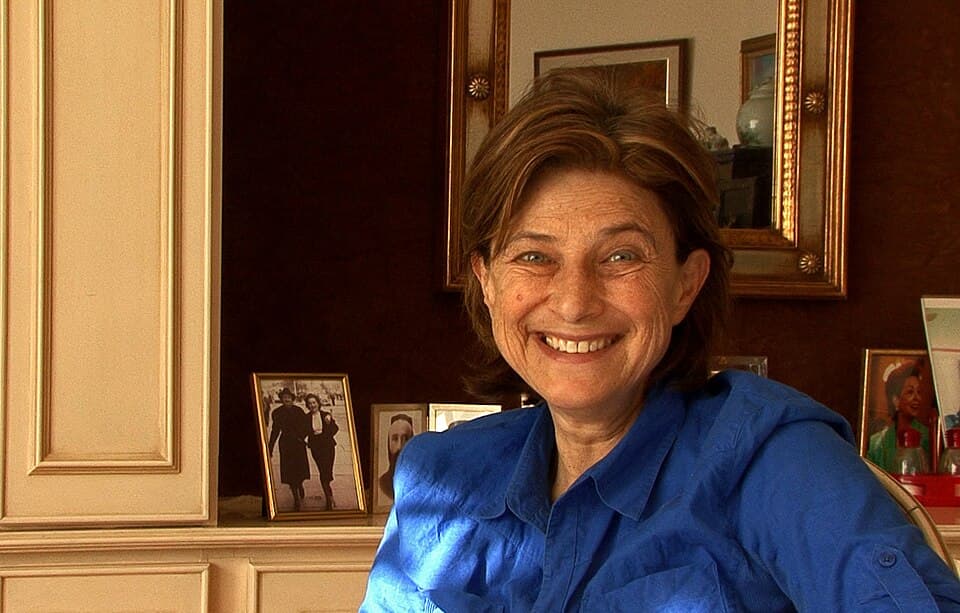
Brussels, a gray late-autumn afternoon. Chantal Akerman receives us in an apartment cluttered with books, videotapes, and 16 mm reels, a cigarette never far from her hand. Through the window, rain falls on the rooftops — the same low sky as in her films. She speaks slowly, often interrupting herself, as if each sentence had to last its exact duration.
—Do you remember the exact moment you decided to make films?
I was fifteen, in a theater in Brussels, and they were showing Godard's Pierrot le fou. I didn't understand everything, but something tore open. I understood that a film could be as free as a poem, that you didn't have to tell well-behaved stories. When I came out, I knew. I borrowed my father's camera — he hardly ever used it — and at eighteen I shot Saute ma ville, that little film where I play a girl who trashes her kitchen before blowing everything up. It was black humor, rage, clumsiness, all at once. I had no theory. I just had this urgent need to tear domestic life apart, literally, on film.
A film could be as free as a poem, that you didn't have to tell well-behaved stories.
—Why did you leave for New York in the early 1970s?
Because school wasn't enough. I barely set foot inside the INSAS before I understood that I would learn more by filming than by listening. New York seized me. I lived in miserable hotel rooms, and it was there, in those endless hallways, that I shot Hôtel Monterey: fixed shots, silent, of people waiting, of closed doors. At Jonas Mekas's Anthology Film Archives, I discovered Michael Snow, Brakhage — what was called structural film. Those people filmed duration itself, the frame, the light, without anecdote. It gave me permission: I could set down my camera and not move it, let real time enter the image as a character in its own right.
Those people filmed duration itself, without anecdote. It gave me permission.
—How did you conceive the structure of Jeanne Dielman, that film over three hours long?
I wanted to show the gestures that are never shown. A widow, three days, an apartment on the Quai du Commerce in Brussels. She peels potatoes, does the dishes, sets the table — and I don't cut. The peeling scene lasts its full four minutes, as in life. People asked me why I didn't 'shorten' it. But cutting is lying about the time this work really takes. As I told the Cahiers du cinéma in 1975: “The long, fixed shot is not a filmmaker's laziness. It is a gaze that respects the real time of life, that does not cheat with the duration of what is shown on screen.” I was twenty-four and had an almost entirely female crew. We knew what we were doing.
Cutting is lying about the time this work really takes.
—What do these everyday objects — the potatoes, the kitchen table — that take up so much screen space represent for you?
They are not props; they are soft prisons. A potato peeled in real time suddenly becomes political: you see the weight of all those hours that millions of women give without anyone watching. Classical cinema skips that with editing: cut, and dinner is served. I stay. I film the gesture to the end, on the same Steenbeck editing table where I discussed every second with my editor. The domestic space, for me, is always a cage — already in Saute ma ville, the kitchen was a place of confinement. When you let it last, banality begins to tremble, and you understand that a dinner prepared every evening can contain a whole life, or the collapse of a life.
They are not props; they are soft prisons.
—You have been labeled a feminist filmmaker. How do you receive that label?
With some mistrust. I was placed under a banner before I had even finished speaking. I said it to the journal Camera Obscura in 1977: “I did not want to make a feminist film in the militant sense. I wanted to show domestic work in its exact duration, without accelerating or dramatizing it, so that the spectator would feel it in its true reality.” The difference is crucial. I don't make pamphlets. I set up a camera and let it be seen. Of course, the era ran through me — the second-wave feminist movement was raising the question of women's representation everywhere. But my work is not a thesis. If Jeanne Dielman says something about women's condition, it is through duration, through silence, not through a slogan.
I don't make pamphlets. I set up a camera and let it be seen.
—There is this idea of the male gaze in cinema, which makes women objects of desire. Where do you stand?
Opposite, probably, but not as a soldier. In my time, people were theorizing this male gaze — this way of filming women as something offered to the spectator's eye. In Jeanne Dielman, the camera never towers over my heroine, never cuts her into desirable pieces; it is at table height, patient, almost in her place. It is not an aggressive reversal, it is a displacement. I refuse the point of view that possesses. Already in Je, tu, il, elle, where I played myself, it was about filming female desire and the female body from the inside, without delivering them. Perhaps my entire cinema consists of giving women the place of the gaze, not just that of the image being looked at.
I refuse the point of view that possesses.
—Your mother, Natalia, recurs throughout your work. What does she represent for you?
She is the ground beneath my films, even when she does not appear in them. Natalia survived Auschwitz, and she almost never spoke of that experience. That silence, that way of being together without words, is perhaps what I have spent my whole life trying to film. I wrote it in Ma mère rit: “My mother and I didn't say much to each other, but we were there, together. And maybe that's what I've spent my life filming: being there together.” The Holocaust is never named head-on in my work, but it is everywhere — in exile, in suitcases, in those apartments where one stays without truly being able to inhabit them. My mother is my deepest hors-champ.
She is the ground beneath my films, even when she does not appear in them.
—How did No Home Movie, this last portrait of your mother, come about?
Almost without intention, with a small digital camera, in her apartment in Brussels. I filmed her because she was aging and I felt time tightening. We talked about nothing — about soup, the weather, my trip — sometimes through a computer screen when I was far away. These are not scenes; they are presences. The film came out a few months after her death. While editing those images, I did not yet know how much of a farewell it would be — hers, and perhaps mine. All my life I have filmed empty spaces and waiting women; in the end, there was only her, and the apartment around her, and that ordinary light that becomes unbearable when you know it is about to go out.
These are not scenes; they are presences.
—From the 1990s onward, you left the movie theater for the museum. What were you looking for there?
Another time, another spectator. With D'Est, shot in Eastern Europe after the fall of the Wall, I filmed lines of people waiting in the cold, faces, roads. In a theater, you sit and endure the film's duration. In a video installation, on several monitors at once, the visitor moves around, chooses their time, enters and exits the image. That fascinated me: making space itself perceptible, turning the museum into a cinema without seats. Deep down, as I confided to the Centre Pompidou in 2004, “filming, for me, is always a way of seeking something I do not yet know how to name” — and these installations were a new way of seeking.
Making space itself perceptible, turning the museum into a cinema without seats.
—If you could imagine that Jeanne Dielman would one day be voted the greatest film of all time, what would that inspire in you?
You are making me dream out loud, so allow me the recklessness. If I could imagine that one day this slow film, this housewife film, would be raised above Citizen Kane or Hitchcock, I think I would first laugh — a slightly incredulous laugh. Then I would think of all those women who never had access to the camera. That a shot of peeled potatoes could count as much as a studio masterpiece would mean that women's time, that time we considered invisible, finally deserves to be looked at. It would not be my victory; it would be that of duration over triumphant editing, of waiting over spectacle. But I only half believe it — the film world has a short memory for this kind of film.
Women's time, that time we considered invisible, finally deserves to be looked at.
This imaginary interview was generated by artificial intelligence from sources documented in Chantal Akerman's profile. It dramatises what the figure might have said based on what we know about them, but does not constitute attested historical testimony. For primary sources and factual documentation, refer to the full profile.