Imaginary interview with Charles de Gaulle
by Charactorium · Charles de Gaulle (1890 — 1970) · Politics · 6 min read

Autumn 1969. At La Boisserie, in the silence of the Haute-Marne prairies, a seventy-nine-year-old man has just left power for the last time. General Charles de Gaulle receives in his study overlooking the Champagne countryside, his step slow, his gaze still sharp. That day, he agrees to look back on a life in which he constantly merged his destiny with that of France.
—Do you remember that precise moment, in front of the microphone in London, on June 18, 1940?
London, June 18, 1940. I was led into a narrow studio at the BBC, a metal microphone in front of me, and across the Channel an army in disarray. I had no government, no troops, no mandate — nothing but a voice and a certain idea of what France must remain. I said what I believed to be true: “France is not alone! She is not alone! She has a vast Empire behind her.” Very few French people heard me that evening, I already knew that. But a right word has no need of an immediate audience: it bides its time. The very next day, the newspapers picked it up. And that microphone, that humble object, became the first free soil of the homeland.
A right word has no need of an immediate audience: it bides its time.
—Why did you choose the Cross of Lorraine as the emblem of Free France?
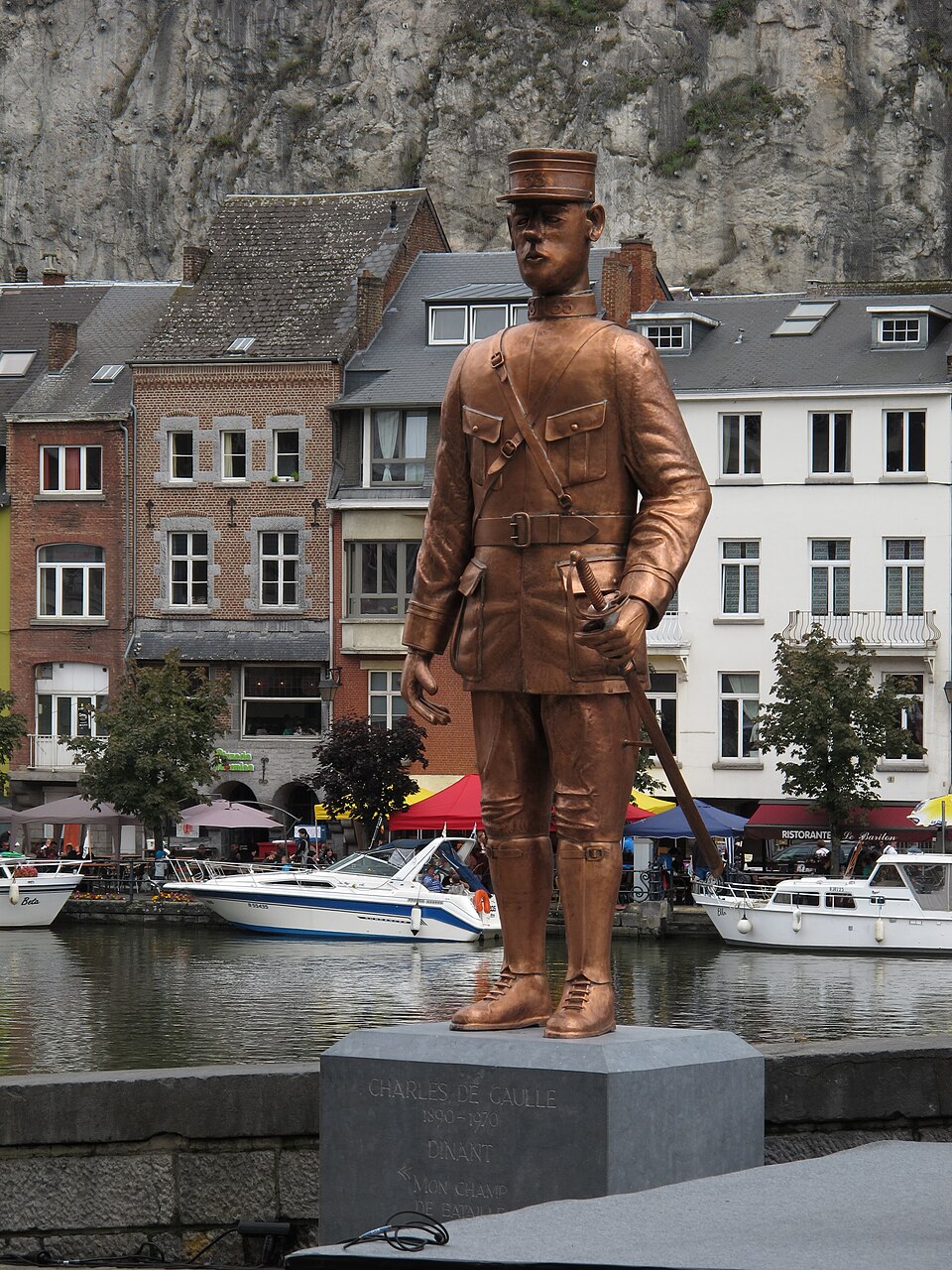
When you raise an army without a country, you need a sign under which men recognize each other. The enemy had his swastika, that twisted cross turned against the spirit. I wanted to oppose it with the Cross of Lorraine, Joan's cross, straight and clear. It was to assert in one image that the real France was not in Vichy, bowed under the armistice, but wherever French people refused defeat. My képi on my head, that cross on our flags: that was all that Free France possessed at the start, and it was already a great deal. A defeated people sometimes have nothing left but symbols; still they must be noble enough for one to accept dying for them. Greatness always begins with an emblem one refuses to lower.
—How did you experience the fact that your ideas on armored divisions were ignored in France and studied in Germany?
As early as 1934, in Vers l'armée de métier, I wrote that a modern war would be won by movement: autonomous armored divisions striking deep, not that concrete line where one waited for the enemy as one waits for a storm. The general staff listened politely, then shelved the work. In Berlin, it was read quite differently — Guderian and his men found in it what our own generals disdained. In May 1940, I saw my ideas come back against us, under the German helmet, through our ravaged countryside. Being right too early is a form of solitude. They call you a theorist as long as the facts have not proved you right in blood.
Being right too early is a form of solitude.
—What would you say about what forges a true leader, a theme that runs through Le Fil de l'épée?
Before writing about war, I had learned what a leader is in the worst school: captivity. Wounded at Verdun, left for dead, taken prisoner, I tried to escape five times, up to that fortress of Ingolstadt where they locked up the unyielding. There I understood that a man is defined less by what he suffers than by what he refuses. Le Fil de l'épée, in 1932, was born of this conviction: the leader is recognized by character, by composure, by that element of mystery he keeps to himself. One does not command by explaining everything; one commands by deciding when others hesitate. Prestige is a distance, and that distance is cultivated like a secret garden.
—In Bayeux, in 1946, you gave a speech that remains foundational. What were you trying to say?
June 16, 1946, in Bayeux, the first liberated town I had found again two years earlier. I returned not to celebrate, but to warn. I recalled that on the soil of our ancestors “the State reappeared; the legitimate State, because it rested on the interest and sentiment of the nation.” The Fourth Republic was about to reconstitute the party system, that perpetual effervescence where governments fall like autumn leaves. I warned that there must be an arbiter above factions, a head of state guaranteeing continuity. I was hardly followed. It took twelve years and a crisis for this speech to be reread and for them to discover in it, already drawn, the plan of what I would build.
—In 1958, you founded the Fifth Republic. Why were you so insistent on a president elected by the people?
In 1958, called back by the Algerian crisis, I was finally able to give France the institutions it had been waiting for since Bayeux. With Michel Debré, we drafted a constitution where the executive ceases to be the hostage of assemblies: a president guaranteeing institutions, capable of deciding. But I wanted more — that this president should derive his legitimacy from the people themselves. In 1962, by referendum, I had his election by direct universal suffrage instituted. There were cries of violation, of personal power. I replied that a head of state must be able to look the nation in the eye without passing through the screen of parties. The referendum was always my recourse: to question the people directly, and to bow if they said no. Which they did, one day.
—“I have understood you”: that phrase from Algiers has been much criticized. What did you really mean?
June 4, 1958, in Algiers, on the forum black with people. I raised my arms and declared: “I have understood you!” The crowd believed I was promising them French Algeria forever. But I had promised nothing of the sort — understanding is not approving. I saw a war bogging down, an exhausted France, a world where empires were fading one by one. We had to break the deadlock through self-determination, let the peoples decide their fate. That phrase, so often reproached to me, was not a lie: it was the necessary art of the leader, who must lead without revealing everything. The fraternity I evoked that day, History translated it, four years later, into separation.
—You survived the Petit-Clamart assassination attempt in 1962. How did you get through that danger?
August 22, 1962, at Petit-Clamart. My Citroën DS was driving through the twilight when the bullets of the OAS riddled it — starred windshield, punctured tires, and we sped on nonetheless. Yvonne, my wife, was by my side. It is reported that I muttered, brushing off my suit: “These people shoot like pigs.” Bravado, perhaps; but I was not going to offer those fanatics the spectacle of my fear. They resented me for having consented to Algerian independence; they imagined that by killing me they would stop the course of events. You do not stop History with a rifle in a thicket. I had survived two wars and five escapes: no suburban ambush would make me back down.
You do not stop History with a rifle in a thicket.
—Why did you provide France with nuclear weapons, despite the cost and criticism?
1960, in the desert of Reggane, France exploded its first atomic bomb, becoming the world's fourth nuclear power. Many deemed it ruinous, arrogant. But understand: in a world divided between Washington and Moscow, a country without a deterrent force is merely a protégé, and a protégé is never entirely free. I did not want France's survival to depend on the goodwill of a foreign president, however friendly. Our bomb was modest next to theirs, but it sufficed to warn: whoever strikes us will pay a price he will not want to pay. Independence is not begged; it is founded — even if in sand and fire.
—As you retired to Colombey, what idea of France do you carry with you?
In 1966, I withdrew France from NATO's integrated command. Not out of hostility toward our allies, but because a great nation does not place its sword under a foreign hand. It was my third way: neither vassal to America, nor subject to the USSR, France speaking in its own name. They called this Gaullism, as if it were a doctrine; it was only fidelity. For “all my life, I have formed a certain idea of France.” I envision her like the princess of fairy tales, destined for an eminent fate. A France that would be content to be mediocre would betray her genius. At Colombey, as evening falls, I reread History and tell myself that a country truly exists only through the idea it has of itself.
A France that would be content to be mediocre would betray her genius.
This imaginary interview was generated by artificial intelligence from sources documented in Charles de Gaulle's profile. It dramatises what the figure might have said based on what we know about them, but does not constitute attested historical testimony. For primary sources and factual documentation, refer to the full profile.