Kids interview Cicero
by Charactorium · Cicero (106 av. J.-C. — 42 av. J.-C.) · Philosophy · Politics · 5 min read
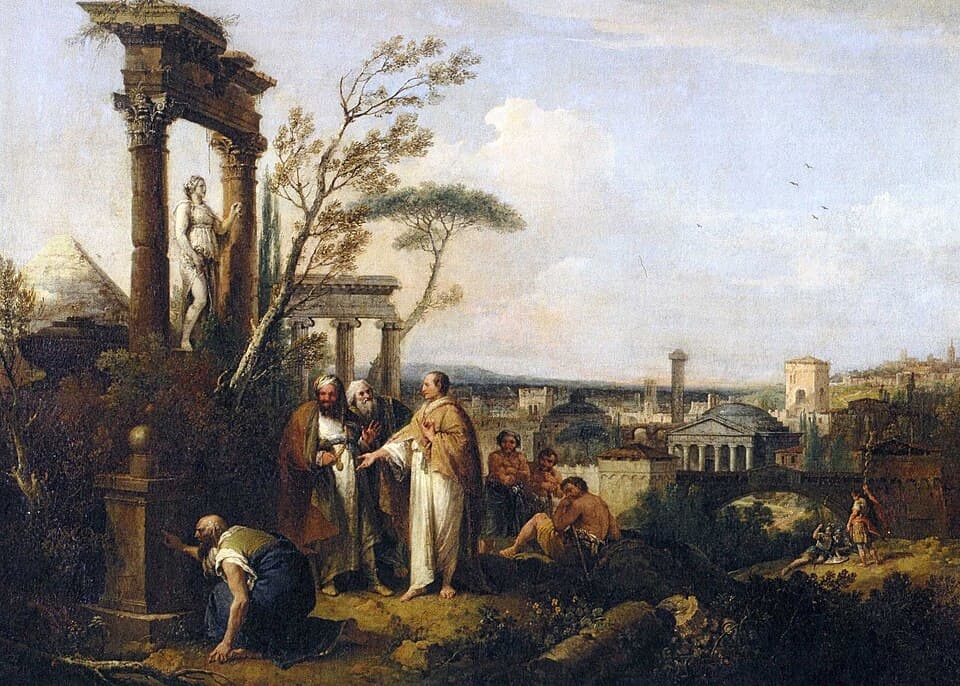
Two young visitors, on a field trip, push open the door of a Roman villa full of scrolls. An old man in a toga greets them, surprised and touched that someone still takes an interest in him. He invites them to sit down and begins to speak.
—Where were you born, and was it a great wealthy and famous family?
No, my child, not at all! I was born in Arpinum, a small hill town three days' walk from Rome. My family belonged to the equestrian order — well-off people, but without any famous ancestors. In Rome, I was called a homo novus, a 'new man.' That means the first in one's lineage to aim for the top. Imagine arriving in a courtyard where everyone has known each other for a hundred years, and you, no one knows your name. That was my youth. But I had a weapon: my voice. And I have always kept great pride in my small-town origins.
No one knew my name — so I made it known through my voice.
—What was your very first major trial like? Were you afraid?
Yes, I was afraid, and for good reason. I was barely twenty-six years old, in 80 BC. I was defending a man, Sextus Roscius, accused of killing his father. The problem? His accusers were protected by Sulla, the all-powerful master of Rome at that time. Imagine defending a stranger against the friends of the most feared leader in the land. Many lawyers had refused. I dared. And I won. Overnight, all Rome knew my name. I understood one thing: courage, in a courtroom, stands out as much as talent.
Courage, in a courtroom, stands out as much as talent.
—How did a normal day begin for you?
Before sunrise! I would get up in the dark and light a small bronze oil lamp to write. In Rome, we had a word, lucubrare: to work by lamplight. That was me entirely. Then, at first light, my house would fill with people. It was called the salutatio: people came to greet me, ask for advice or help. Imagine your door opening and thirty people already waiting to speak to you. After that, I would head to the Forum, the great heart of Rome, to plead or debate. My days were packed full, from the dark of morning to the dark of evening.
I worked by lamplight before the sun — and often after it too.
—Did you write all that by yourself? That must have taken forever!
Ah, I had a secret, or rather a precious friend: Tiro. He was my secretary, a very intelligent man. While I spoke, he wrote at full speed using little quick signs, a kind of shorthand he had perfected. Imagine being able to note a sentence as fast as it is spoken! We wrote on wax tablets with a stylus, a pointed tool, then copied onto papyrus scrolls, the volumina. My works filled hundreds of them. I also wrote over nine hundred letters, many to my best friend Atticus. Without Tiro, half my thoughts would have vanished into thin air.
Without my friend Tiro, half my thoughts would have vanished into thin air.
—Is it true that you saved Rome one night? Tell us!
That was the most intense year of my life, 63 BC. I was consul, the highest magistrate of Rome, elected for one year. An ambitious and dangerous man, Catiline, was plotting to overthrow the state by violence. I discovered it. So, before the entire assembled Senate, I rose and thundered: Quo usque tandem abutere, Catilina, patientia nostra? — 'How long, Catiline, will you abuse our patience?' Imagine the silence, then Catiline, exposed, leaving the chamber. My words had driven him from Rome without a single sword being drawn. That day I understood the true power of speech.
My words drove him from Rome without a single sword being drawn.
—And afterwards, were you given a reward or a title?
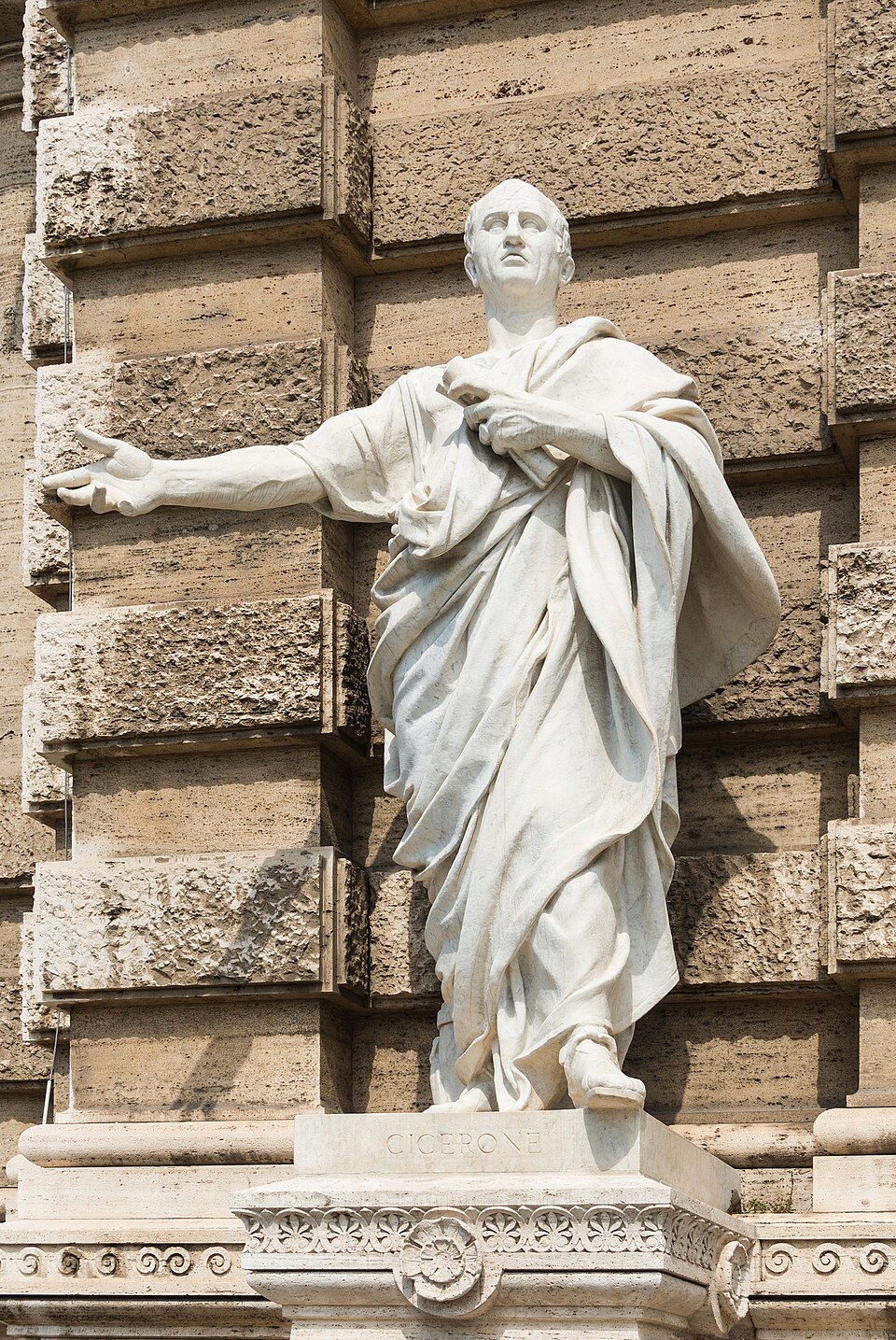
Yes, and that is the honor I was most proud of. The Senate proclaimed me Pater Patriae — 'Father of the Fatherland.' Can you imagine? They said I had saved Rome like a father saves his home. And the best part is that I did it without war, without battle, just with speeches, the Catilinarian Orations. But, my child, I will confide something sad: this glory also brought me enemies. A few years later, I was reproached for having executed conspirators without a trial, and I had to go into exile. Glory and downfall sometimes go hand in hand.
They named me Father of the Fatherland — and glory also brought me my worst enemies.
—Is it true that you invented words that we still use?
Yes! And that is perhaps my greatest secret pride. In my time, all philosophy was thought in Greek. I wanted people to be able to think in Latin, my language. The problem: many ideas had no Latin word. So I made them up. Words like qualitas, quality, or moralis, pertaining to morals, or humanitas. Imagine having to invent the name of a color that no one had ever named. That is the work I did for ideas. And humanitas, that word, later gave rise to 'humanism.' A part of the language in which you think, you owe a little to me.
Inventing a word for an idea is like naming a color no one had seen.
—Did you write your philosophy books when you were sad?
You hit the mark, my child. Philosophy was my refuge in the deepest sorrow. I had a beloved daughter, Tullia, and she died young. I was shattered. I withdrew to my favorite villa at Tusculum, in the hills south of Rome. And there, to keep from sinking, I wrote the Tusculan Disputations: five books that ask how to bear pain, fear, death. Writing about grief was my way of not drowning in it. The Romans had a word, otium: leisure devoted to study. That leisure, that day, saved my life.
Writing about grief was my way of not drowning in it.
—Why did you keep fighting, even as an old man, against Antony?
Because I could not stay silent, my child. Caesar had just been assassinated, and a powerful man, Mark Antony, was in turn threatening the Republic I loved so much. I was old, tired, and it would have been far more prudent to retire to my villas. But I rose one last time. I delivered fourteen fiery speeches against him, the Philippics — I gave them that name thinking of a Greek orator, Demosthenes, who had done the same centuries before. I knew it was risky. But what use is a voice if it falls silent at the most important moment?
What use is a voice if it falls silent at the most important moment?
—And what happened to you in the end? Is it sad?
Yes, it is sad, but you are old enough to hear it, and I will tell you gently. My speeches against Antony had marked me as his enemy. In 43 BC, his supporters caught up with me near my villa at Formiae, on the coast. There, my life ended. They say my hands and head were displayed on the rostra of the Forum, at the very spot from which I had so often spoken. It was cruel, I will not hide it. But do you know what survived? Not those who silenced me — they have been forgotten. My words, however, have reached you.
Those who silenced me have been forgotten; my words have reached you.
—If we had to remember one thing about you, what would it be?
What a beautiful question to end on! Remember this: we are not made only for ourselves. In a book I wrote for my son, De Officiis, 'On Duties,' I explained that our country and our friends have a claim to a part of our life. Imagine your life as a loaf of bread: you keep a piece for yourself, but you also share it with others. I was an orator, consul, writer, exile, and I ended up dying for my ideas. But if you learn to speak well, to defend what is right, and to think for yourself, then a small flame of me continues to burn in you.
We are not made only for ourselves.

This imaginary interview was generated by artificial intelligence from sources documented in Cicero's profile. It dramatises what the figure might have said based on what we know about them, but does not constitute attested historical testimony. For primary sources and factual documentation, refer to the full profile.