Imaginary dialogue between Titus Pomponius Atticus and Cicero
by Charactorium · Cicero (106 av. J.-C. — 42 av. J.-C.) · Philosophy · Politics · 6 min read
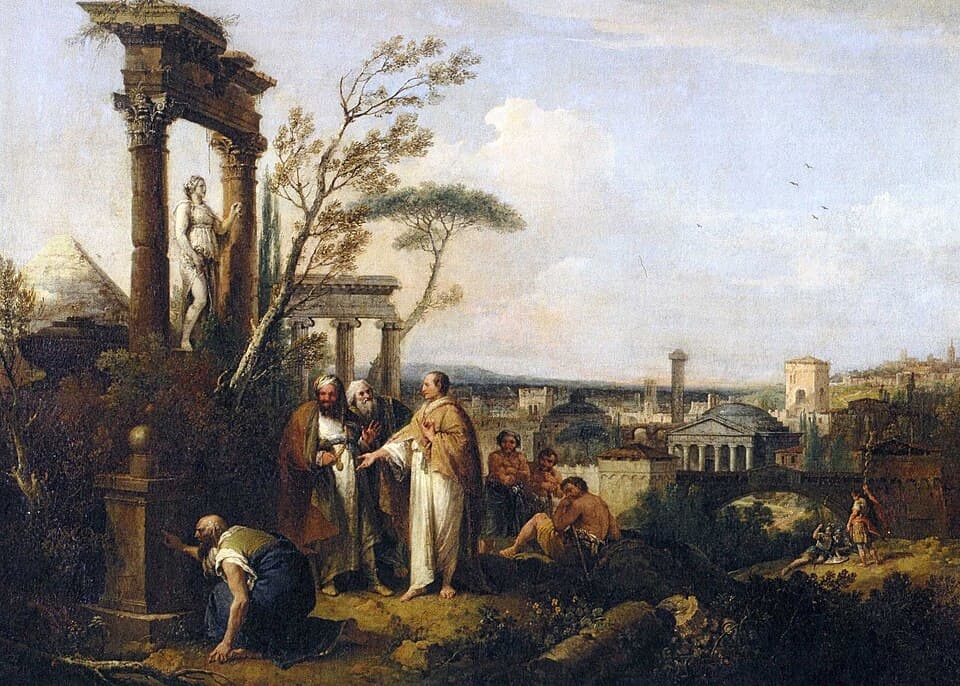
It is in the villa at Tusculum, among the Alban hills where Cicero loves to take refuge, that Atticus arrives at the beginning of the year 43 BC. On the table, half-unrolled papyrus scrolls and an oil lamp still lit despite the daylight: Cicero is preparing new speeches against Antony. The two men have been friends since their youth, bound by a correspondence in which Cicero has confided without a mask. Atticus, worried for the man he loves, comes this morning to find the man behind the orator.
—Marcus, you and I grew up far from the great nobility of Rome. You, son of Arpinum — how did you dare aim for the consulship?
You know better than anyone, Atticus: none of my ancestors had ever worn the consul's toga. Born in Arpinum into the equestrian order, I was what the nobility disdainfully call a homo novus, a new man. But I possessed a weapon that heredity does not give: speech. I climbed the entire cursus honorum — quaestor, aedile, praetor — each magistracy suo anno, at the earliest age the law allowed. When I reached the consulship in 63 BC, I was the first of my line to sit in the sella curulis. The great families tolerated me without liking me. But Rome does not belong only to those who inherit a name: it belongs to those who serve it.
Rome does not belong only to those who inherit a name: it belongs to those who serve it.
—Do you remember your defense of young Roscius in 80, when Sulla still ruled? They thought you were crazy to confront his protégé.
How could I forget? Sextus Roscius was accused of killing his own father, and behind the accusation lurked Chrysogonus, a powerful freedman of the dictator Sulla, who coveted the dead man's inheritance. All the experienced lawyers had recused themselves out of caution. I was barely twenty-six, and I had nothing to lose but my fear. I argued that the real parricide was not the accused but those who gorged themselves on the property of the proscribed. I won, and I survived — which was not a given. Overnight, my name became known in Rome. I had learned one thing: a well-armed speech can stand up to a man whom weapons themselves dare not confront.
—And that night when you unmasked Catiline before the Senate? Your first words are still whispered, in the Temple of Jupiter Stator.
Ah, that night! The Senate was meeting, under heavy guard, in the Temple of Jupiter Stator, and Catiline had the audacity to appear, he who was plotting to cut my throat and burn Rome. I rose and hurled in his face: Quo usque tandem abutere, Catilina, patientia nostra? — How long, Catiline, will you abuse our patience? My words became four speeches, and they did what no army had done: they drove him from the city without a sword being drawn. The Senate had entrusted me with the senatus consultum ultimum, that extreme power to save the state. I exercised it. And I was awarded the title of Father of the Fatherland — the honor of which I remain, I confess, the proudest.
—But having the conspirators executed without trial, Marcus — didn't that later cost you exile and your razed house?
You touch my wound there, Atticus, and you know I don't hide it from you. Yes: to save the Republic, I had Roman citizens put to death without the trial the law entitled them to. I believed — I still believe — that urgency demanded it. But my enemies were only waiting for that. Five years later, Clodius had my banishment voted; my domus on the Palatine was razed, my possessions scattered. I knew exile in Thessalonica, and those were the darkest months of my life. Then the Senate recalled me triumphantly and voted to rebuild my house at public expense. I saved the state, and the state nearly crushed me: such is the price of those who serve without sparing themselves.
—Marcus, when we were young and you studied in Athens with Antiochus, did you foresee that you would give Rome a language for philosophy?
Not in the least! In Athens, in those years 79 and 77, I only wanted to strengthen my voice and nourish my mind with Antiochus of Ascalon. But on returning, I measured our poverty: the Greeks had words for every nuance of thought, and Latin remained mute on essentials. So I forged them. Qualitas to translate their idea of quality, moralis for what concerns morals, humanitas for what elevates man above the brute. I wanted a Roman to finally read wisdom in his own language, without bowing to Greek. My Tusculanae Disputationes, my De Officiis were born from this ambition. Giving words to a people, you see, is giving them thoughts they did not yet know they had.
Giving words to a people is giving them thoughts they did not yet know they had.
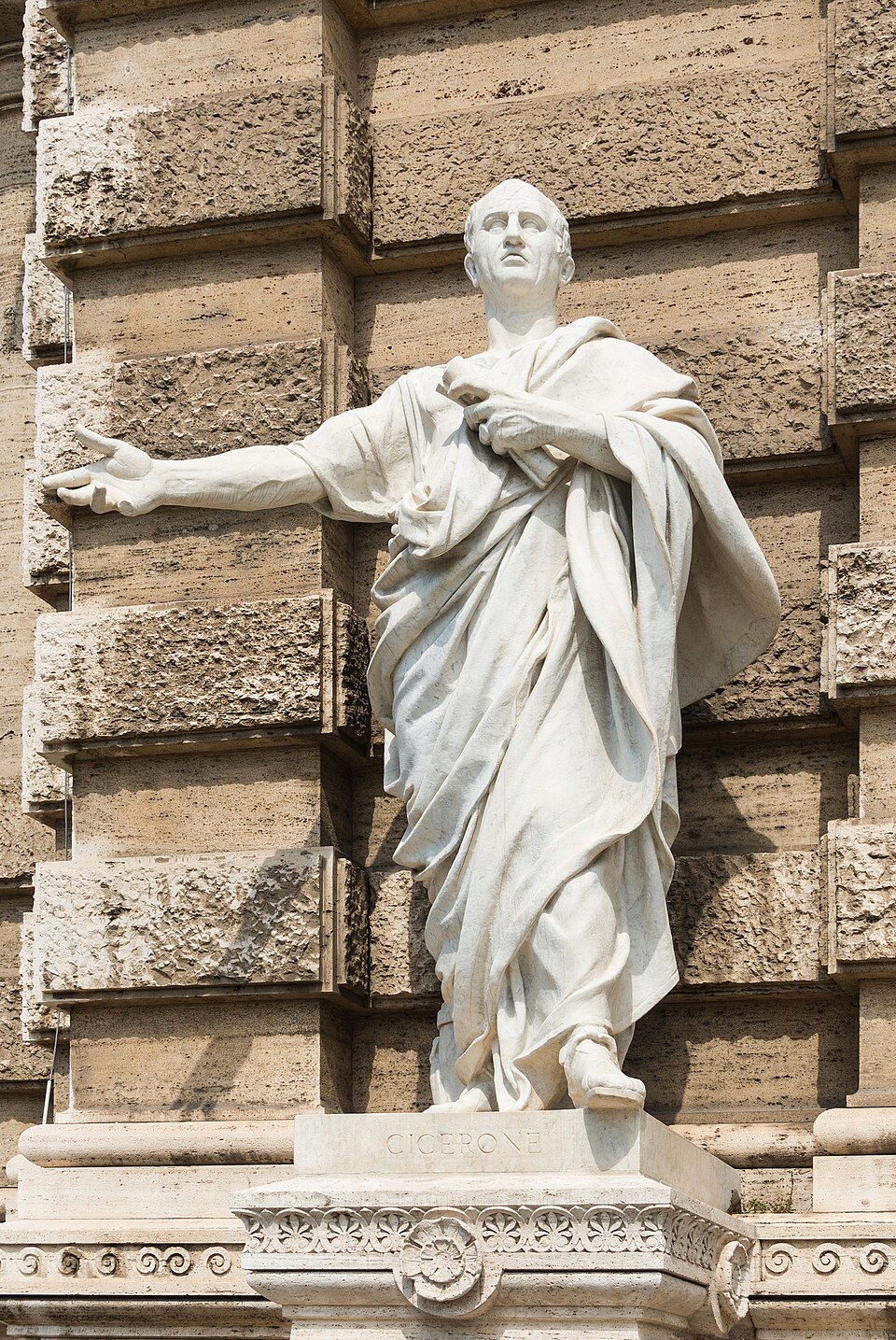
—That treatise you are writing for your son, on duties — what do you hope to pass on to him that rhetoric alone cannot give?
My De Officiis, yes. My son Marcus is studying in Athens, and I fear he is acquiring more taste for wine than for wisdom. So I am writing to him what every public man should ponder: how to resolve the conflict between the expedient and the honorable. For the vulgar think one must choose advantage; I maintain that what is truly honorable is always expedient, and no profit is worth a wrong. I also remind him of this truth I carry within me: Non nobis solum nati sumus — we are not born for ourselves alone; our country claims a part of our existence, our friends another. Rhetoric teaches how to persuade. Philosophy teaches what is worth persuading about.
—When Tullia left us, you shut yourself away at Tusculum. Your letters from then tore me apart, Marcus. How did writing keep you standing?
You were, in those days, the only wall I could lean against. The death of my daughter Tullia took away all desire to live; the Forum, the Senate, everything seemed like ashes. I withdrew to this villa where we are, and I began to write about grief, about death, about the passions — these became my Tusculanae Disputationes. Writing was converting my wound into thought, so that it would stop devouring me in silence. You remember what I confided to you, years earlier, in one of my letters: these hours of leisure when I write to you are the only ones where I feel alive. That was never truer than after Tullia. Philosophy did not console me. But it kept me from sinking.
Writing was converting my wound into thought, so that it would stop devouring me in silence.
—You who have served the state so much, have you ended up preferring the otium of your villas to the tumult of the Forum?
Don't set that trap for me, my friend! I have always defended otium cum dignitate, dignified leisure devoted to study — not the idleness of the lazy, but the fruitful rest of the mind. When negotium, public affairs, drives me from the Forum, I take refuge in my books; when the Republic calls, I leave my books without hesitation. For I wrote in my De Republica that res publica res populi — the public thing is the people's thing, a society founded on law and common interest. How could I turn my back on it? My treatises I wrote in retirement; but I wrote them for the city. Otium is legitimate, in my eyes, only if it makes a man more capable of serving.
—These speeches you are launching against Antony, your Philippics — do you measure the danger you run by attacking him so directly?
I measure it better than anyone, Atticus, and that is precisely why I must speak. Since the assassination of Caesar, Mark Antony behaves like a master, as if the Republic belonged to him. I have taken as my model Demosthenes, who once roused Athens against Philip of Macedon; I have named my speeches after his, my Philippics. Fourteen times already I have denounced this man's ambition before the Senate. Yes, I know he has force, legions, veterans. And I have only my voice and my old body. But if I fall silent, who will remain to remind Rome that she was once free? I have lived too long to fear death; I fear only dying mute.
I have lived too long to fear death; I fear only dying mute.
—Marcus, you are no longer young. Why not fall silent and end in peace in this villa, rather than offer your throat to that triumvir?
Because the peace you propose would be that of a slave, and I prefer the peril of a free man. See where we are: three men are dividing the state like spoils, and drawing up lists — those proscriptions whose horror we remember from Sulla. My name may appear on them; I have few illusions. But consider this: I defended Roscius against Sulla, unmasked Catiline, stood up to Antony. To retreat now would belie my entire life. If my speech must cost me my head and these hands that have written so much for the Republic, so be it. A man does not survive in silence, Atticus — he survives in what he dared to say when it was dangerous to say it.

This imaginary interview was generated by artificial intelligence from sources documented in Cicero's profile. It dramatises what the figure might have said based on what we know about them, but does not constitute attested historical testimony. For primary sources and factual documentation, refer to the full profile.