Imaginary interview with Cicero
by Charactorium · Cicero (106 av. J.-C. — 42 av. J.-C.) · Philosophy · Politics · 6 min read
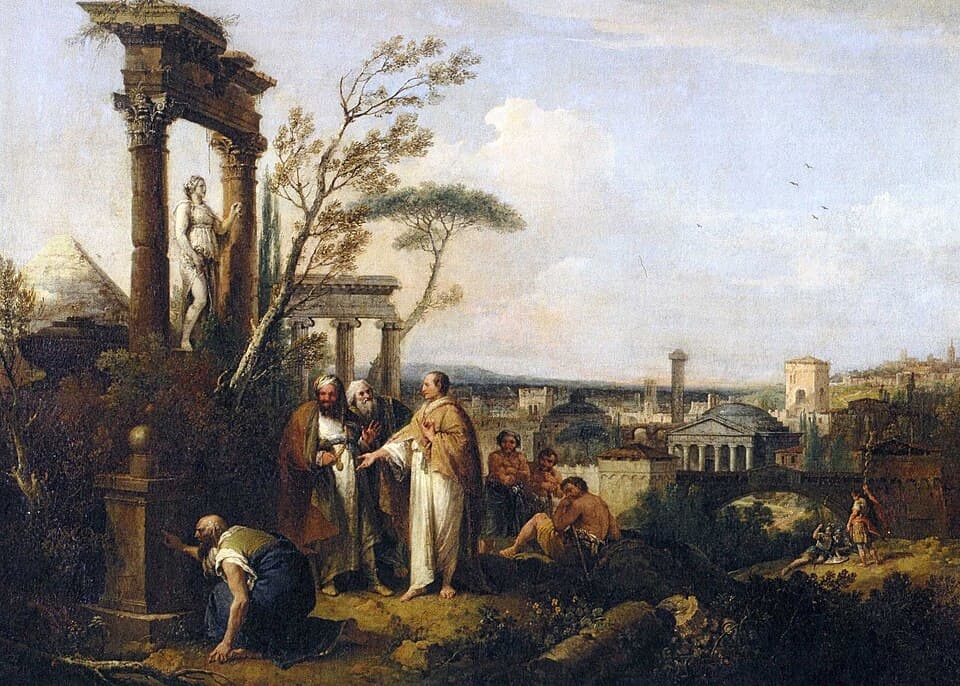
Late summer on the hills of Tusculum. In the villa where he has taken refuge to write, between two papyrus rolls, a man with tired features agrees to receive visitors; outside, Rome still rumbles. During an interview, he looks back on a life spent defending the Republic by the sole force of words.
—You were not born into the inner circle of Roman nobility. Where do you come from?
I was born in Arpinum, some one hundred twenty miles from Rome, into a family of the equestrian order—honest people, but without ancestors whose wax masks adorn the atrium. That is what they call a homo novus: a man with no consular ancestors, who owes his name only to himself. The hereditary nobility looked down on me as a provincial who had come up from his little town. Yet I kept all my life a pride in my municipal origins: the same small town had once given Marius to Rome. When you do not receive glory as an inheritance, you must seize it through speech. That was my only patrimony, and I made it bear fruit.
—How could a man without a name climb all the magistracies?
I completed the entire cursus honorum—quaestor, aedile, praetor, consul—and each time suo anno, at the youngest age the law allows. Understand what that means for a man from Arpinum: a patrician can afford to wait, to lose an election; his birth catches up with him. I had no such cushion; a single failure and I would return to obscurity. So I turned every trial into a campaign. My defense of Sextus Roscius, at age twenty-six, against a freedman of the dictator Sulla, made me famous overnight; my attacks on the governor Verres, plunderer of Sicily, established my reputation. The court was my battlefield, and words my only legions.
—Do you remember the night you confronted Catiline in the Senate?
It was November 8 of the year 63, during my consulship. Catiline, whose conspiracy threatened to burn Rome and slaughter the Senate, had the audacity to come and sit among us, in the Temple of Jupiter Stator. I rose, and the first words fell like iron: "Quo usque tandem abutere, Catilina, patientia nostra?"—How long, Catiline, will you abuse our patience? The bench around him had emptied; no senator wanted his toga to touch his. He understood he was alone. That very evening, he fled the city. I had drawn no sword—only four speeches. They study them, it seems, as models of eloquence. For me, they were above all four nights when the Republic hung by a thread of voice.
I had drawn no sword—only four speeches.
—You were proclaimed Father of the Fatherland. Yet that victory cost you dearly. Why?
The Senate had armed me with the senatus consultum ultimum, that ultimate decree authorizing the consul to do anything to save the state. I had the accomplices of Catiline who remained in Rome executed, without the trial a citizen could demand. At the time, I was carried in triumph; I was awarded the title Father of the Fatherland, to me, the new man from Arpinum—imagine the intoxication of that. But the right I had violated turned against me. Five years later, my enemies sent me into exile for those same executions and razed my house on the Palatine. I learned there that a consul who saves the state by trampling the law prepares his own trial. Glory and disgrace came from the same act.
—Before politics, there was Greece. What were you seeking there?
As a young man, after my first trials, I left for the East, around the year 79. I spent months in Athens, listening to Antiochus of Ascalon under the porticoes of the Academy, then I went to Rhodes to strengthen a voice that was breaking from too much shouting in court. Greek philosophy seized me there, in its very language. But back in Rome, I measured a lack: our Romans, so proud of their laws, had no Latin words for these ideas. A Greek would say poiotês; we, nothing. From that journey was born my late vocation—not to invent thought, the Greeks had already done that, but to tailor a Latin garment for it so that it could enter Rome.
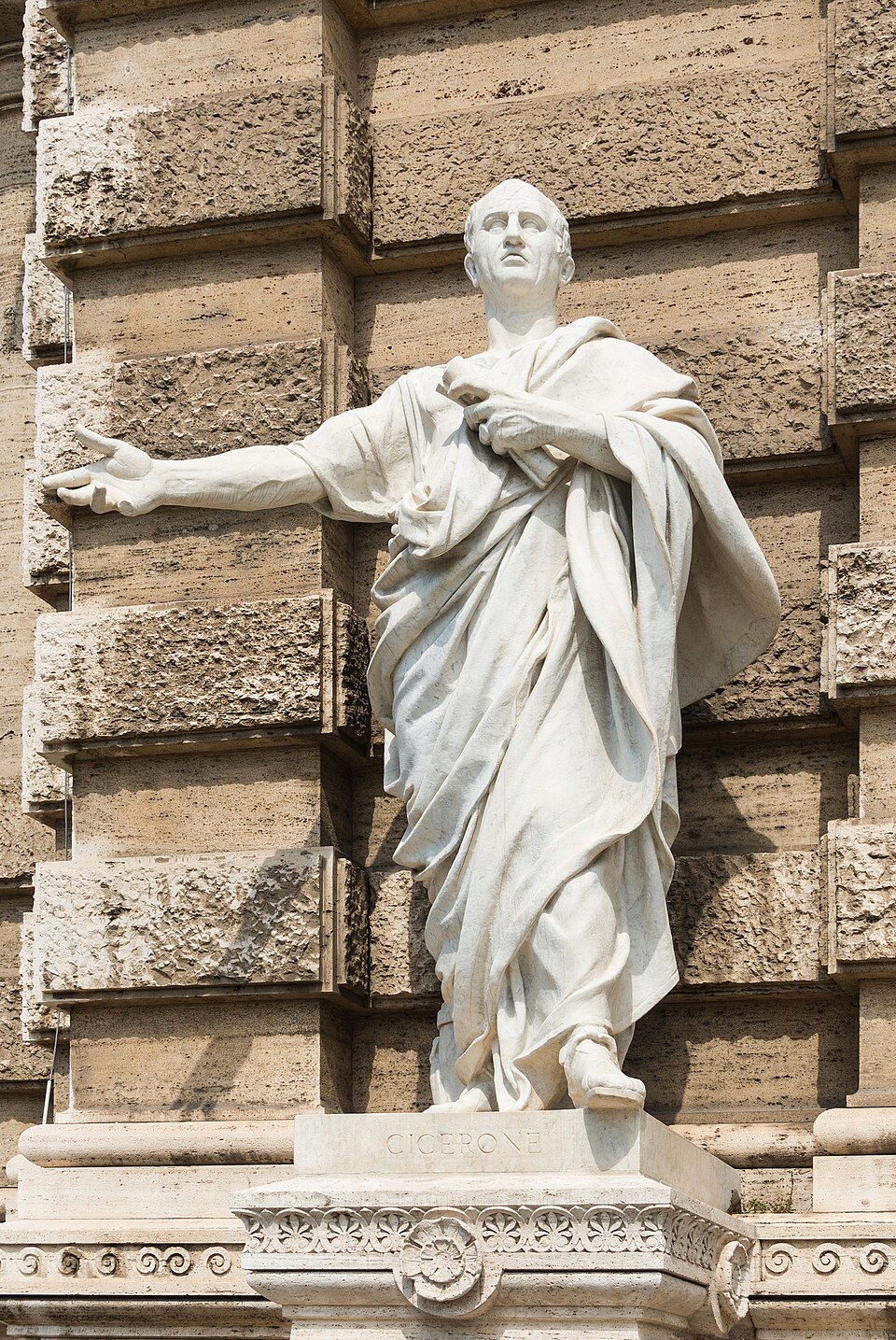
—They say you literally fabricated words. Which ones, and why?
When I write, I forge. It was necessary to give poiotês a Latin name: I said qualitas. Likewise moralis, for what the Greeks called ethics. And above all humanitas—that word I love above all, which says at once education, gentleness, and what separates the cultivated man from the brute. I wrote the essential in my villa at Tusculum, on these hills where the air is clear; my Tusculan Disputations were born there after the death of my daughter Tullia, when only philosophy kept me from sinking. If I am still read in a century or two, it may not be for my harangues, but for these words I left to Latin, as one leaves tools to one's sons.
—How does an orator work? Are you alone, pen in hand?
I work much at night, by oil lamp—we have a verb for that, lucubrare, to keep vigil by the flame. But I do not always write by my own hand: I walk, I dictate, and Tiro, my freedman turned secretary, runs behind my speech. He devised, to follow me, a system of shorthand signs, notes that catch a word with a single stroke. Without him, half of what I thought would have been lost in the air. I wear down the stylus on wax for drafts, then everything goes onto the volumen, those papyrus rolls that pile up by the hundreds in my library. People think the orator alone at his rostrum; in truth, behind every speech there is a faithful hand that has gathered everything under dictation.
—To whom do you confide what you tell no one?
To Atticus, I tell everything. He is my friend since childhood, and to him alone I write without a mask: my fears, my vanities, my bouts of discouragement. More than nine hundred of these letters lie scattered here and there, I suppose; I never imagined they would be read one day. In one of them, overwhelmed, I confess to him that these hours of leisure when I write to him are the only ones when I truly feel alive. That is what I call otium cum dignitate: not laziness, but dignified leisure, that which withdraws from affairs to think and to write. The Roman believes that life is entirely in the Forum. I came to believe that it is also in this silent dialogue with an absent friend.
—After Caesar's death, many advised you to keep silent. You chose the opposite. Why?
When Caesar was struck down on the Ides of March, I believed the Republic resurrected. Mistake: one master dead, another arose—Mark Antony. Old already, I had only my voice left; I threw it against him in fourteen speeches. I named them Philippics, after those that Demosthenes once launched against Philip of Macedon, for I felt like him: an orator alone, standing before liberty that is dying. My friends begged me to be silent, to withdraw to my villas. But what use is it to have praised the Republic all one's life if one hides when it is dying? I spoke knowing the price. One does not buy the dignity of an existence by haggling over one's last words.
What use is it to have praised the Republic if one hides when it is dying?
—You knew the danger. How did this life of words end?
The Second Triumvirate—Octavian, Antony, Lepidus—drew up its lists of proscriptio, those tablets on which men to be struck down are inscribed, their goods promised to the murderer. My name was on it: Antony had demanded it. I fled toward my villas on the coast; it was near Formiae, on the road to Gaeta, that they caught me. I could, they say, have stretched out my throat without trembling. What I did not see—and it is better that way—is that they nailed my head and hands to the rostrum of the Rostra, the very place where I had spoken so often. They say that Fulvia, Antony's wife, pierced my tongue with a hairpin. They killed the orator, then mutilated the mouth: they feared my words more than my person.
—What remains, in the end, of a life like yours?
At the very end, between two Philippics, I wrote for my son Marcus a treatise On Duties, the De Officiis. A father gives his son what he has most certain: not gold, but a rule for living rightly, the just balance between the useful and the honorable. I inscribed in it this idea that serves me as faith: "Non nobis solum nati sumus"—we are not born for ourselves alone; the fatherland claims a part of us, our friends another. My entire life perhaps fits in that sentence. I may have erred in alliances, hesitated, trembled; never did I believe that man belonged to himself. That is what I bequeath, more than my speeches: the idea that one owes oneself to something greater than oneself.
Never did I believe that man belonged to himself.

This imaginary interview was generated by artificial intelligence from sources documented in Cicero's profile. It dramatises what the figure might have said based on what we know about them, but does not constitute attested historical testimony. For primary sources and factual documentation, refer to the full profile.