Imaginary interview with Diane Nash
by Charactorium · Diane Nash (1938 — ?) · Society · Politics · 5 min read
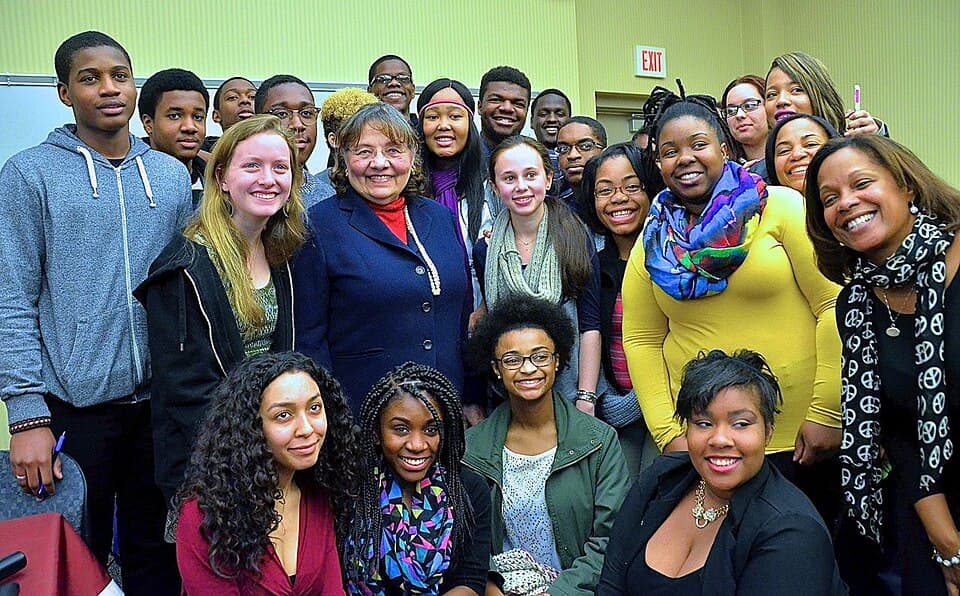
One autumn evening, in the basement of a Nashville Baptist church where the smell of cold coffee still lingers, Diane Nash sits on a folding chair, back straight, hands flat on the table. Over eighty, her voice remains low, precise, never hurried — that of a woman who learned that calm is a weapon. She agrees to return, one last time, to the years when young students disarmed an empire of fear by simply refusing to get up.
—How did a Chicago student end up in the heart of the segregated South?
I arrived at Fisk University in Nashville in 1959, coming from a Catholic neighborhood in Chicago where the color of my skin had never been a wall. I thought I knew my country. Then I saw, above two identical water fountains, those painted words: White Only and Colored. I was shown where to sit on the bus, which door to enter, which counter was forbidden to me. That daily humiliation, as regular as clockwork, first made me sick, then filled me with a cold anger. I hadn't chosen this struggle; segregation chose me. And I decided, very quickly, that I would not spend four years looking down.
I hadn't chosen this struggle; segregation chose me.
—Do you remember the day Nashville's lunch counters fell?
We had been occupying the stools at Woolworth and downtown department stores for weeks, enduring insults and coffee spilled on our shoulders. In the spring of 1960, after a bomb destroyed our lawyer's house, hundreds of us marched silently to city hall. Facing Mayor Ben West, I didn't give a speech: I simply asked him whether he, in his soul, thought restaurant segregation was moral. He hesitated, then said no. The next day, the counters served Black people. One honest question had done what years of patience had not achieved.
One honest question had done what years of patience had not achieved.
—People imagine the sit-ins as spontaneous, but you mentioned training. What did it involve?
Nothing was spontaneous; everything was rehearsed. In our workshops, some of us played the segregationists: they shouted in trainees' faces, pulled them from their seats, crushed a cigarette on their necks, spilled food. The others had to sit still, without a word, without raising a hand, eyes straight ahead. I insisted we read our rules of conduct before every action, like a prayer. We drew from the Gospels and the writings of Gandhi this demanding idea: take the blow without returning it. It's not passivity — it's the hardest discipline I know. A man who hits you expects you to hit back; when you don't, he is left naked before his own violence.
A man who hits you expects you to hit back; when you don't, he is left naked.
—Why were you so insistent that activists be immaculately dressed?
Because image was a battlefield. We showed up at the counters in neat dresses, polished shoes, buttoned jackets, an open book on our laps like any respectable student. Racism thrived on a caricature: the dirty, dangerous, unworthy Black person. By placing next to that caricature a young man quietly reading while ketchup was poured on his hair, we made brutality indefensible in the eyes of America. The dignity of our attire wasn't vanity; it was strategy. Every morning in Nashville, before sending out the groups, I checked collars as much as courage. They couldn't accuse us of provoking the blow that fell on us.
—In 1961, the Freedom Riders were beaten, their buses firebombed. Why not stop there?
Because stopping would teach the whole country a terrible lesson: that if you hit hard enough, justice retreats. After the beatings in Alabama and the burned bus, many rightly wanted to suspend the rides to save lives. I was twenty-three and disagreed with all of it. If the campaign died under the blows, violence would have the last word over nonviolence. So from Nashville, I gathered a second wave of volunteers ready to board the Greyhound buses and retrace the route exactly where blood had been shed. We knew some might not return. We went anyway.
—How do you send friends into danger you know is deadly?
You never do it lightly, and it never leaves you. I asked each one to write a will and give me their loved ones' contact information, because we had to face it: we could lose people on that road to New Orleans. But I was going with them, or I could have gone; I asked no risk I wouldn't have taken myself. It was that stubbornness that finally forced the Kennedy administration to protect the buses and enforce federal law. A government can ignore a complaint; it cannot indefinitely ignore young citizens offering their lives before the world's cameras.
I asked no risk I wouldn't have taken myself.
—In Jackson, pregnant, you were sentenced to two years in prison. Why refuse to pay the fine?
I was arrested in Mississippi for teaching Black teenagers how to disobey unjust laws with dignity. The judge offered the usual way out: pay, appeal, go home. I refused. Paying a fine would acknowledge that the law condemning me was legitimate, and it was not. I wrote to Governor Ross Barnett bluntly: “I have decided to serve my sentence rather than pay a fine or appeal my conviction.” I was carrying my first child. I didn't want him to come into the world already owing a lie about the justice of his country. Staying in that cell was, that day, the most maternal gesture I knew.
—Many saw nonviolence as just a tactic. What was it for you?
A tactic you put away when it's no longer useful. But I could never put this away. Before the Senate subcommittee in 1961, I said what I still believe: “Nonviolence is not a tactic; it is a way of life.” It means refusing to hate even the man who strikes you, seeking not to crush him but to awaken his conscience. We weren't attacking white people; we were attacking a system, segregation, that Jim Crow machine that damaged even those it claimed to serve. To win by force would have created new losers, hence new resentments. We wanted a reconciled country, not a reversed one.
Nonviolence is not a tactic; it is a way of life.
—People know your face in the streets, less your role as strategist. What did you do behind the scenes?
A campaign is not courageous improvisation; it's logistics. I filled entire notebooks: which businesses to target, how many groups to send, whom to contact among lawyers, where to house the injured, when to ease pressure and when to double it. With James Bevel, I drafted the strategic plan that targeted Dallas County, around Selma, as the place to provoke the decisive confrontation for voting rights. We sought a place where injustice would be so naked that the country could no longer look away. That document prepared the ground for the march that led to the Voting Rights Act of 1965. You didn't see me in the photos; I was in the papers.
You didn't see me in the photos; I was in the papers.
—How do you feel about the Edmund Pettus Bridge, now a global memorial site?
A grave pride, never easy. That bridge in Selma is the fruit of a patient plan, but also of blood shed one Sunday in March on marchers who only wanted to register to vote. In Birmingham two years earlier, I had helped imagine those children's marches — schoolchildren facing the sheriff's fire hoses — because we knew the world would not bear that sight. Those are terrible choices: sending kids, sending friends, so that the image forces a nation to look at itself. When I see visitors crossing that bridge today, I think of all those who did not live to see the law they made possible. Memory is good; but it will never replace their presence.
This imaginary interview was generated by artificial intelligence from sources documented in Diane Nash's profile. It dramatises what the figure might have said based on what we know about them, but does not constitute attested historical testimony. For primary sources and factual documentation, refer to the full profile.