Imaginary interview with Djibril Tamsir Niane
by Charactorium · Djibril Tamsir Niane (1932 — 2021) · Literature · Culture · Society · 5 min read
Dakar, one dry-season afternoon. In his office buried under manuscripts and field notebooks, Djibril Tamsir Niane receives guests in the shade of a struggling fan. A griot's kora echoes in the distance; he strains his ears even before the first question.
—Do you remember the exact moment you first heard the epic of Sundiata?
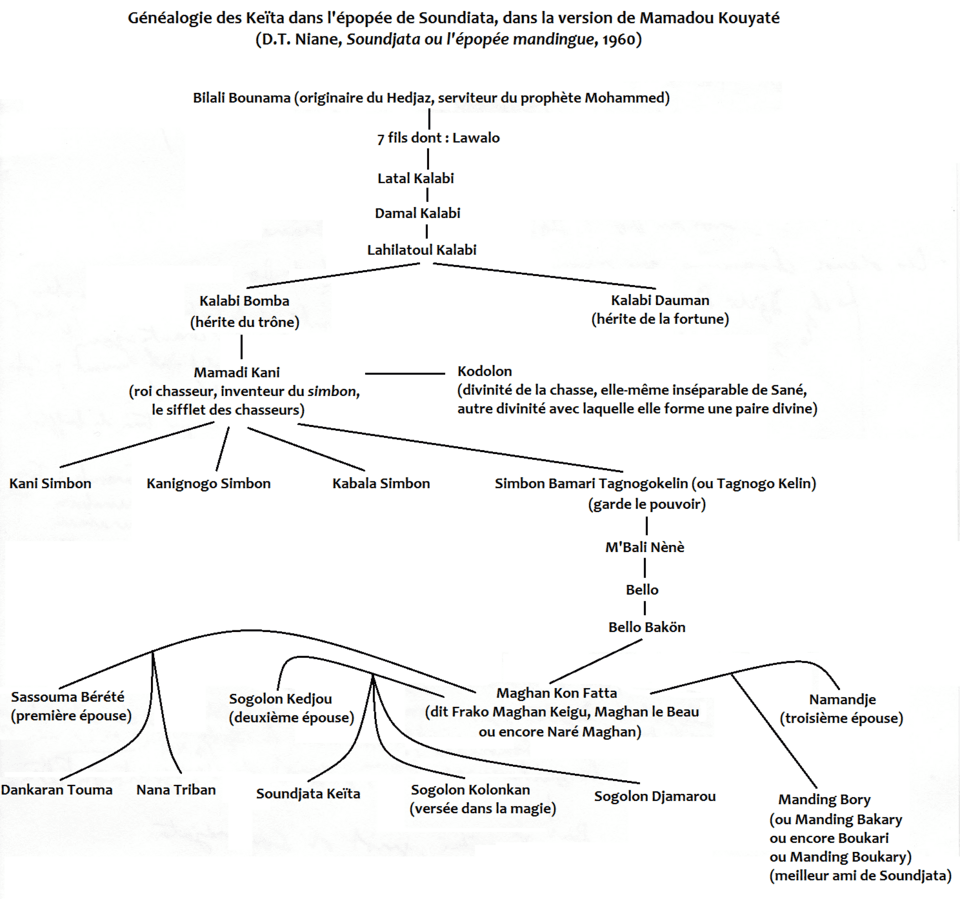
It was in the Hamana region of Guinea, in the mid-fifties. I was a young man with a notebook and a tape recorder heavy as a stone, and before me stood Mamadou Kouyaté, a djeli, guardian of a memory seven centuries old. He began to speak, not as one recites a lesson, but as one transmits a sacred trust, saying he had been in the service of the Keïta princes since time immemorial. I transcribed his words by lamplight at night, aware that every lost phrase would be lost forever. It was not folklore collection. It was saving the voice of an empire from oblivion.
He transmitted it not as one recites a lesson, but as one hands over a sacred trust.
—Many scholars of your time considered oral tradition to be legend. How did you respond to this contempt?
They told me: without written archives, there is no history, only bedtime stories. I responded with method. I recorded several djeliw, cross-checked their versions, noted where they diverged and where they agreed. Then I compared all that with medieval Arabic chronicles, with Ibn Battuta, with Al-Umari, those travelers who had seen the Mali court with their own eyes. When an oral date coincides with a written source from the other side of the Sahara, legend ceases to be legend. As early as my first Recherches sur l'Empire du Mali in 1959, I established this principle: the griot's memory is a source in its own right, verifiable, datable. The notebook and the manuscript are not opposed; they answer each other.
When an oral date coincides with a written source from the other side of the Sahara, legend ceases to be legend.
—Your book came out in 1960, the Year of Africa. Was this timing a coincidence?
No coincidence. In 1960, seventeen nations were born in a single year, from Senegal to Mali. These peoples were lifting their heads after a century in which they had been told they had no past worthy of the name. They needed to be given proof. Soundjata ou l'épopée mandingue, published by Présence Africaine in Paris, was that proof: the story of an empire founded in the 13th century, with its laws, its battles, its mansa. I wanted a child in Bamako or Conakry to say: this is where I come from, and it is great. Political independence without memory remains lame. Restoring the past is also restoring the future.
Political independence without memory remains lame.
—How do you explain that this epic became a textbook in African schools?
Because at the University of Dakar, now Cheikh Anta Diop University, where I taught in the afternoons, I saw every year students discovering with amazement that they had a history. The textbooks we had inherited began Africa with the arrival of Europeans. That is an amputation. With Jean Suret-Canale, in our History of West Africa from 1961, we wanted to write for high schools a narrative that reminds us that Ghana, Mali, Songhai flourished long before the 15th century. And Sundiata slipped into classrooms by itself, because a child remembers better a hero of his own blood than a list of foreign kings. Teaching this epic was decolonizing minds, one schoolbag at a time.
Teaching this epic was decolonizing minds, one schoolbag at a time.
—What did you say to those who doubted that a griot could tell the truth, since he is also in the service of kings?
A serious objection, and I never dismissed it. The djeli praises princes, yes; his function is also to flatter the lineage he serves. But the historian is not fooled: he separates the praise from the fact. When three griots from three different villages report the same battle, the same exile of young Sundiata, the same triumphant return, you have a solid core beneath the embroidery. And here again, the Arabic chronicle decides: Al-Umari describes a court, an administration, a gold trade that confirm the greatness the djeli sings. Oral tradition is not empty words; it is a living archive, which simply must be read with as much rigor as a parchment.
Oral tradition is not empty words; it is a living archive.
—In 1978, UNESCO entrusted you with editing a volume of its General History of Africa. What did this responsibility represent?
A dizzying feeling, first. I was asked to edit Volume IV, Africa from the Twelfth to the Sixteenth Century, and to bring together African, European, and American historians around the table. For the first time, it was not Europe telling Africa's story, but Africans placing their continent at the center of its own narrative. When the volume appeared in 1984, I wrote that our medieval civilizations were not isolated islands, but links in a global system of exchange, connected to the Sahara, the Sudan, the southern forests by the routes of gold and salt. It was the culmination of a life: seeing African historiography finally recognized as a science, not an exotic curiosity.
For the first time, it was not Europe telling Africa's story.
—Why did you choose the epic form rather than a scholarly treatise to reach your audience?
Because a people does not recognize itself in a footnote. The epic of Sundiata is to Manding Africa what the Iliad is to the Greeks: a foundational text, sung, carried by the kora and balafon during evening gatherings. If I had locked Sundiata in academic jargon alone, it would have remained on a few library shelves. By translating into French the words of Kouyaté, with their breath, repetitions, and formulas, I wanted the reading to still make the djeli's voice heard. The scholar establishes facts; the storyteller brings them to life. I tried to be both, without betraying either.
A people does not recognize itself in a footnote.
—During your investigations in Manding country, how did these encounters with griots actually take place?
We went to their homes at dawn, the cool hour, the hour suitable for recitations. Respect for customs was necessary: sit down, share the meal served in the calabash, listen for a long time before holding out the tape recorder. A djeli does not open up to someone in a hurry. The story came in the evening, at the gathering, when the tuned kora loosened speech and the elders corrected with a word the storyteller who strayed. I left with reels and blackened notebooks, and I spent my nights transcribing while the rhythm of the phrases remained alive in my ear. This hospitality of the Hamana, this trust they gave me, I carry it as a debt. Without it, the epic would have remained silent.
A djeli does not open up to someone in a hurry.
—You speak of restoring pride. Had colonization therefore erased something deeper than borders?
It had tried to erase memory, which is worse. One can reclaim land; rebuilding a consciousness takes longer. I grew up in Conakry under the French flag, in a school that taught me "our ancestors the Gauls." Understand the dizziness of a child whose true ancestors are denied. My entire work was born from this wound. Restoring Sundiata to high school students was telling them: your ancestors founded an empire, dispensed justice, traded the gold of an entire world. The Négritude of my elders, Césaire, Senghor, had affirmed the dignity of our cultures; it fell to me to provide the historical proof, dated, documented.
One can reclaim land; rebuilding a consciousness takes longer.
—If you could imagine being read a century from now, what would you want to be remembered from your work?
That I invented nothing. I only listened, cross-checked, transmitted. The credit goes to the djeliw who, from father to son, kept the word intact through the centuries, and to those empires — Mali, Gabou whose history I traced — which were great without needing us to know it. If I am still read, I hope it will be understood that Africa's history does not begin with the arrival of Europeans, and that a well-questioned oral tradition is worth any stone archive. The rest — the honors, the titles — belongs to the wind. What remains is the voice of Kouyaté, saved from oblivion, and passed on to those who will come.
That I invented nothing. I only listened, cross-checked, transmitted.

This imaginary interview was generated by artificial intelligence from sources documented in Djibril Tamsir Niane's profile. It dramatises what the figure might have said based on what we know about them, but does not constitute attested historical testimony. For primary sources and factual documentation, refer to the full profile.