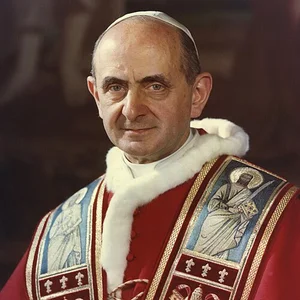

262nd pope of the Catholic Church from 1963 to 1978, Paul VI completed the Second Vatican Council and worked to modernize the Church and to foster dialogue with the contemporary world.
Paul VI(1897 — 1978)
Paul VI
Italie, Vatican, royaume d'Italie
6 min read
Frequently asked questions
Famous Quotes
« Development is the new name for peace.»
« Modern man listens more willingly to witnesses than to teachers, and if he does listen to teachers, it is because they are witnesses.»
Key Facts
- Elected pope on 21 June 1963, succeeding John XXIII
- Closed the Second Vatican Council in 1965
- Published the encyclical Humanae vitae in 1968 on the regulation of births
- Proclaimed Catherine of Siena and Teresa of Ávila Doctors of the Church in 1970, the first women to receive this title
- First pope to travel across several continents (the Holy Land, the UN in New York in 1965)
Works & Achievements
Paul VI brought to completion the great council begun by John XXIII, profoundly modernizing the liturgy, ecumenism, and the Church's relationship with the world.
The first encyclical of his pontificate, devoted to the Church's dialogue with the contemporary world.
A major text of Catholic social teaching, affirming that “development is the new name for peace.”
A reaffirmation of the Church's position on birth control, which sparked a lasting worldwide debate.
The introduction of the Mass in the vernacular language, one of the most visible transformations in the life of the faithful.
A foundational text on evangelization in the modern world, regarded as one of his most important writings.
A permanent institution regularly gathering bishops from around the world to advise the pope, born of the council's spirit of collegiality.
Anecdotes
In 1965, during the final session of the Second Vatican Council, Paul VI and the Orthodox Patriarch Athenagoras I jointly lifted the mutual excommunications that had separated Catholics and Orthodox Christians since the Great Schism of 1054. This symbolic gesture ended nearly nine centuries of official rupture between the two Churches.
On October 4, 1965, Paul VI became the first pope to travel by airplane and to visit the United States. He delivered a memorable speech before the General Assembly of the United Nations in New York, issuing his famous appeal: “No more war, war never again!”
In 1968, his encyclical letter Humanae vitae, which reaffirmed the prohibition of artificial contraception, sparked an enormous controversy throughout the Catholic world. Deeply affected by the criticism, Paul VI never published another encyclical during the final ten years of his pontificate.
Paul VI was the first pope of the modern era to travel extensively: he was nicknamed the “pilgrim pope.” He visited the Holy Land in 1964, India, Uganda — the first visit by a pope to Africa — and the Philippines, where he narrowly escaped an assassination attempt in 1970.
In 1964, Paul VI symbolically renounced the papal tiara, the triple crown worn by popes for centuries, and donated this treasure to the poor. No pope after him was crowned, marking the end of a thousand-year-old tradition.
Primary Sources
Development is the new name for peace. The hungry nations of the world cry out today, in dramatic terms, to the peoples blessed with abundance.
No more war, war never again! It is peace, peace, that must guide the destiny of peoples and of all mankind.
Each and every marriage act must remain open to the transmission of life.
Modern man listens more willingly to witnesses than to teachers, and if he does listen to teachers, it is because they are witnesses.
Key Places
Village in Lombardy where Giovanni Battista Montini was born in 1897, into a committed Catholic family.
Seat of the papacy where Paul VI carried out his pontificate from 1963 to 1978 and presided over the closing of the Second Vatican Council.
Large Italian diocese of which Montini was archbishop from 1954 to 1963, where he became known as a pastor close to the workers.
City in the Holy Land where Paul VI met Patriarch Athenagoras in 1964, the first journey by a pope outside Italy in more than a century.
Summer residence of the popes, in the hills south of Rome, where Paul VI died on 6 August 1978.
Place where Paul VI delivered his famous appeal for peace before the UN General Assembly in 1965, during the first journey by a pope to the United States.
Typical Objects

Triple crown worn by popes at their coronation, a symbol of their threefold authority. Paul VI was the last pope to wear it before giving it up in 1964 for the benefit of the poor.

A ring worn by the pope, engraved with the image of Saint Peter hauling in his nets, once used to seal official documents. It is destroyed upon the death of each pope.

A pastoral staff topped with a crucifix that Paul VI had made and carried during major ceremonies. This modern ferula was later taken up by his successors.

A solemn letter addressed by the pope to the whole Church to set out a teaching. Paul VI published seven, including Populorum progressio and Humanae vitae.

The distinctive white garment of the pope, worn together with the skullcap (zucchetto) and the mozzetta. It marks his unique rank within the Church.

A cross worn on the chest by bishops and the pope, hung from a chain or cord. It calls to mind faith and episcopal dignity.
School Curriculum
Vocabulary & Tags
Key Vocabulary
Daily Life
Morning
Paul VI rose early and began his day with prayer and the celebration of Mass in his private chapel. This was followed by the reading of the breviary and a period of meditation before work.
Afternoon
His afternoons were devoted to audiences: heads of state, bishops, diplomats, and pilgrims came one after another. He also studied the files of the Curia and worked on writing his texts, which he crafted with meticulous care.
Evening
In the evening, a discreet and reserved intellectual, he enjoyed reading, listening to music, and reflecting. He often continued his work late into the night, rereading his writings and preparing the next day's decisions.
Food
His table was plain, in the Italian style: pasta, vegetables, a little meat or fish, accompanied by fruit. Paul VI was known for his frugality and his indifference to the pleasures of the flesh.
Clothing
He wore the white papal cassock, the skullcap (zucchetto), and the mozzetta, with the pectoral cross and the Fisherman's Ring. For major ceremonies, he donned the liturgical vestments but renounced the most ostentatious displays of splendour, such as the tiara.
Housing
He resided in the papal apartments of the Apostolic Palace in the Vatican, and spent the summer at Castel Gandolfo. His living environment remained austere, reflecting his temperament.
Historical Timeline
Period Vocabulary
Liens externes & ressources
Références
Œuvres
Clôture du concile Vatican II
1965
Encyclique Ecclesiam suam
1964
Encyclique Populorum progressio
1967
Encyclique Humanae vitae
1968
Réforme liturgique et missel de 1969
1969
Exhortation Evangelii nuntiandi
1975
Création du Synode des évêques
1965