Kids interview Émilie du Châtelet
by Charactorium · Émilie du Châtelet (1706 — 1749) · Philosophy · Sciences · 6 min read
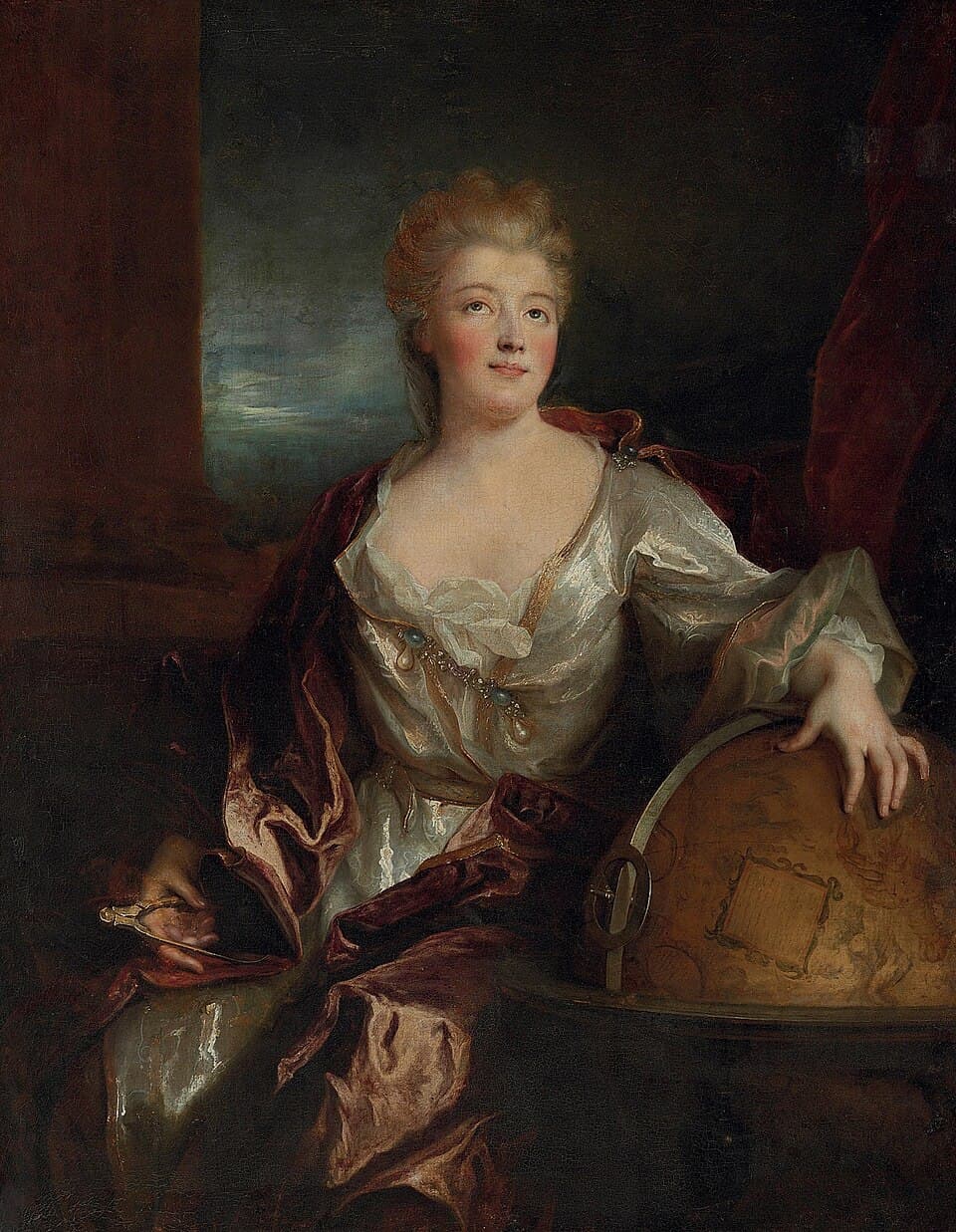
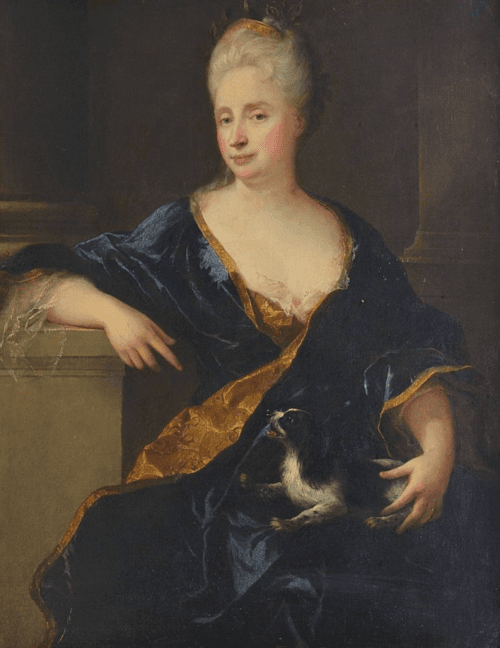
Two students, around twelve years old, are on a school trip when their teacher leads them into a sunlit room lined with books and curious instruments. Behind a wide oak desk sits a woman in silk and lace, surrounded by manuscripts filled with equations and diagrams. She sets down her quill and looks up with a warm smile — she was not expecting visitors, but she seems genuinely glad they came.
—Why did you dress up as a man just to go into a café?
Ah, you heard about that! Here is what you must understand: in Paris in my time, the cafés near the university were reserved for men. Scientists gathered there to argue about physics and mathematics — exactly the conversations I lived for. And I was simply not allowed in, not as a woman. One evening I made a decision. I borrowed a coat, a hat, a cravat, and I walked straight through the door. I sat down and talked about Newton's laws of motion as if it were the most natural thing in the world. No one guessed. But it makes you angry, you know — not at those men in particular, but at the rule that said my mind did not belong there.
—Were you upset that the science academy wouldn't let women in?
Yes — deeply, and for good reason. The Académie des sciences in Paris was the place that decided whose work counted. In 1738, I submitted a mémoire on the nature of fire — anonymously, because that was the only way. They were impressed enough to publish it. Still, no invitation. No membership. Never. I once wrote to King Frederick II of Prussia that many women never even discover what they are capable of, because no one teaches them properly. That injustice was not abstract for me. I lived it every single day. And yet I kept working, because that was the one thing no one could take from me.
—How did dropping lead balls into clay prove something about physics?
It is a beautiful experiment — and you could almost do it yourself! Imagine dropping a small stone into soft mud from your knee. It makes a little dent. Now drop the same stone from twice as high. The dent is not twice as deep — it is four times as deep. That difference is everything. There was a fierce argument in my time between two camps of scientists. One side said the force of a moving body equals its mass times its speed. The other — following Leibniz — said it equals mass times speed squared. My clay dents showed that Leibniz was right. I called it the vis viva, the living force. It is what you would now call kinetic energy.
—Who paid for those experiments? Did you buy the lead balls yourself?
Yes — out of my own pocket! No academy would give money to a woman scientist. So I used my own resources. I was a marquise, a noblewoman, and my rank came with an income. I chose to spend it on lead balls, clay slabs, furnaces, and prisms rather than on extra gowns. My companion Voltaire contributed too. Together we transformed the Château de Cirey into a private laboratory — one of the best-equipped in all of Europe at the time. People found it unusual for a woman of my station. But I had decided long ago: freedom to think requires the means to think. I was not going to wait for someone else to fund my curiosity.
—What was it like having a laboratory right inside your own castle?
It was the life I had always wanted! The Château de Cirey-sur-Blaise was not just a home — we turned it into something extraordinary. We installed a proper physics cabinet: lenses, prisms, telescopes, furnaces for fire experiments. Our library grew to more than twenty-one thousand volumes. Imagine a room where every wall disappears behind books, and in the middle a table holds globes and prisms and measuring instruments. That was my morning world. I would read and write, then move to the laboratory, and in the evenings — because a full life needs more than equations — we would stage a small play in our little theatre, or host philosophers for supper. Every single day was completely full.
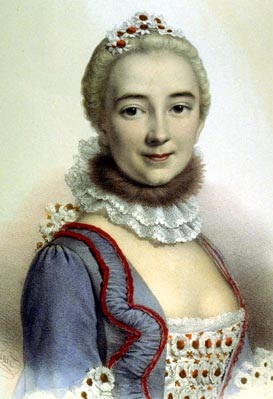
—What did your house smell like? What did you have for breakfast?
What a wonderful question — no one ever asks me that! In the mornings at Cirey, the house smelled of woodsmoke from the fireplaces and of candle wax, because I worked late into the night and burned many candles. Breakfast was simple: bread, a little fruit, sometimes warm broth. I ate quickly — I was always eager to get back to my papers. The laboratory had its own sharp, mineral smell from the fire experiments. And in the evenings, when supper was being prepared, the whole house would fill with the smell of roasted meat and warm pastry. Those suppers with Voltaire and our guests, talking philosophy around the table until midnight — those evenings are among the happiest of my life.
—Why were you working twelve hours a day near the end of your life?
Because I knew my time was running out. I was expecting a child — my fourth — and I had a deep, quiet certainty that I would not survive the birth. I was forty-two years old. And I had been working for years on the most important task of my life: translating Newton's Principia Mathematica from Latin into French. This is the great book of how the universe moves — gravity, orbits, the laws of force. No one had ever put it fully into French. I could not leave it unfinished. So I wrote. Sometimes through the night. Sometimes I forgot to eat. I completed the manuscript just weeks before I died in September 1749. Voltaire published it seven years later. It remains the only complete French translation in existence.
I had a feeling I would not survive. So I wrote.
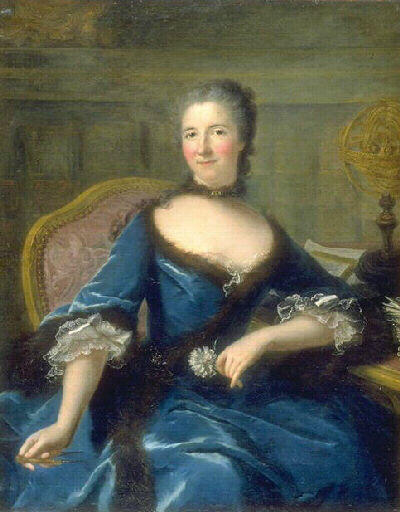
—Were you scared, knowing you might not have much time left?
Honestly? Yes. But here is what I learned: fear does not stop the work. Do you know that feeling when you are almost at the end of a very long task and time is running out — that mix of urgency and excitement all at once? That is what I felt. Not calm, not peaceful — racing. I wrote by candlelight until the sky turned grey. I knew that if I did not finish, no one else could: I had added my own mathematical commentaries alongside the translation, things only I could have written. When I finally set down my quill, the manuscript was complete. Whatever happened to me — and I knew what was coming — that work would survive. That was enough.
—What things in life made you truly happy?
I wrote an entire book to answer that question — my Discours sur le bonheur, published long after my death. Here is what I discovered: happiness does not arrive on its own. You have to pursue it, actively, with your whole self. For me, three things brought real joy. First: mathematics — the feeling when a proof suddenly works is unlike anything else I know. Second: friendship and love; my years with Voltaire at Cirey were full of laughter and argument and tenderness. And third — and this I want you to remember — the refusal to be discouraged. We must tell ourselves firmly: I have a mind capable of learning, and I intend to use it. That choice, made every morning, is itself a kind of happiness.
Happiness does not arrive on its own. You have to pursue it.
—What would you tell a girl who loves science but is told it's not for her?
I would tell her: the people who say that are afraid — afraid that she will prove them wrong. And she will. I was refused entry to the most powerful scientific institution in France. I was told, without words but very clearly, that abstract thinking was not a woman's work. And yet I translated the most difficult scientific book of my century, I won a physics argument that men had been fighting over for decades, and my work is still used today. Every door closed in my face — I found a window. Or I put on a hat and walked in anyway. Do not wait for anyone's permission to think. The universe asks only one question: do you understand it or not?
Do not wait for anyone's permission to think.
Read further
This imaginary interview was generated by artificial intelligence from sources documented in Émilie du Châtelet's profile. It dramatises what the figure might have said based on what we know about them, but does not constitute attested historical testimony. For primary sources and factual documentation, refer to the full profile.