Imaginary interview with Ernest Rutherford
by Charactorium · Ernest Rutherford (1871 — 1937) · Sciences · 6 min read
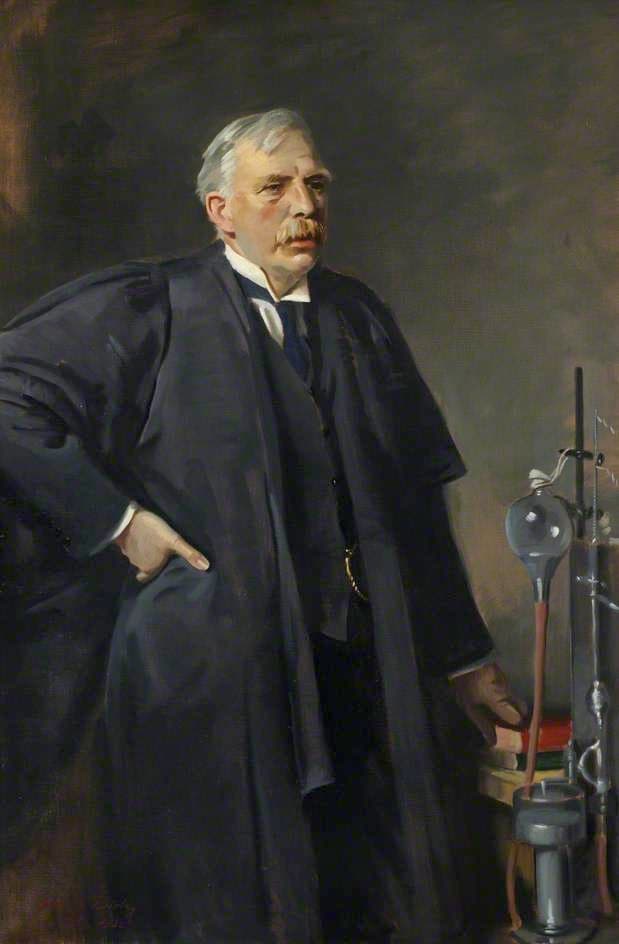
Cambridge, a foggy afternoon in 1932. In his office at Newnham Cottage, pipe in hand, the man who has seen into the heart of the atom receives, his bass voice already resonating down the corridor before he pushes the door open. He settles in, pushes aside a pile of article proofs, and agrees to look back on forty years spent bombarding matter to make it speak.
—How did a New Zealand farmer's son end up probing matter at Cambridge?
I was digging potatoes in my father's field at Brightwater when the telegram with my scholarship to England was brought to me. I was twenty-four, hands in the soil of the South Island, and I threw my spade in the air, swearing that was the last potato I would ever dig in my life. You grow up differently in a family of twelve children at the end of the world: you learn to tinker with your own instruments, to waste nothing, to distrust the comfort of ready-made theories. That peasant frugality never left me. In the lab, I kept telling my boys that we had no money, so we had to think. Everything I did later — the gold-leaf electroscope, the screens in the dark — came from that habit: looking closely, with almost nothing.
You grow up differently at the end of the world: you learn to tinker with your own instruments.
—In 1908 you were awarded a Nobel Prize... in Chemistry. How did that make you feel?
A magnificent joke. I spent my life gently mocking chemists, and there the Stockholm Academy ranks me among them! I said that evening that having observed so many rapid transmutations in my test tubes, the swiftest remained my own metamorphosis from physicist to chemist. The room laughed; I was fuming a little beneath the laughter. The truth is, the boundary between the two sciences always seemed to me an absurd customs post. When an atom of radium disintegrates and becomes something else, is that physics or chemistry? Both, and that is precisely the scandal that my work with Soddy introduced: matter is not the neatly bounded territory that textbooks claimed. The prize, at bottom, rewarded that disorder.
The boundary between physics and chemistry always seemed to me an absurd customs post.
—You started at a singular time: in a few years, everything changed in the knowledge of the atom. How did that feel?
Imagine the ferment. In 1895, Röntgen passed his rays through flesh and photographed the bones of a living hand; the following year, Becquerel noticed that his uranium salts fogged a plate locked in a drawer, without sunlight, without anything. Then Thomson, my boss at the Cavendish, uncovered the electron, that grain of charge smaller than the atom everyone thought indivisible. And in Paris, the Curies extracted radium from a mountain of pitchblende. I arrived in the middle of it at twenty-six, with the feeling that a door had just given way. We didn't yet know what we held; we held phenomena faster than explanations. My whole life was only an attempt to bring order to that vertigo of the 1890s.
We held phenomena far faster than explanations.
—With Frederick Soddy in Montreal, you stated in 1903 that radioactivity transforms one element into another. Why was that so revolutionary?
Because it killed Dalton. For a century, the atom was the eternal, indestructible unit, the brick that nothing could damage. At McGill University, measuring how the activity of a substance declined with clockwork regularity — what we called the half-life — Soddy and I understood that these atoms spontaneously metamorphosed, that one element changed into another by spitting out particles. Soddy cried out in the lab, “But it’s transmutation!” I told him never to utter that word in front of chemists, they’d have us hanged as alchemists. And yet the term was right. Atoms, I said in my lectures at Yale, are not the permanent units Dalton imagined, but foci of energy capable of transformation.
Never utter that word in front of chemists: they’d have us hanged as alchemists.
—Let's come to the gold foil experiment in 1909. What happened that day?
I had assigned Geiger and young Marsden a task I thought was thankless: bombard an ultra-thin gold foil with alpha particles and count, in total darkness, the tiny scintillations on the zinc sulfide screen. We expected everything to pass through, like bullets through mist. But some particles came back. It is the most incredible event of my entire life — as if you fired a fifteen-inch shell at a sheet of paper and it bounced back and hit you. It took months to digest this. The only tenable explanation: nearly all the mass, nearly all the charge of the atom was concentrated in a tiny central grain. The rest was only empty space where electrons dance.
As if you fired a fifteen-inch shell at a sheet of paper and it bounced back and hit you.
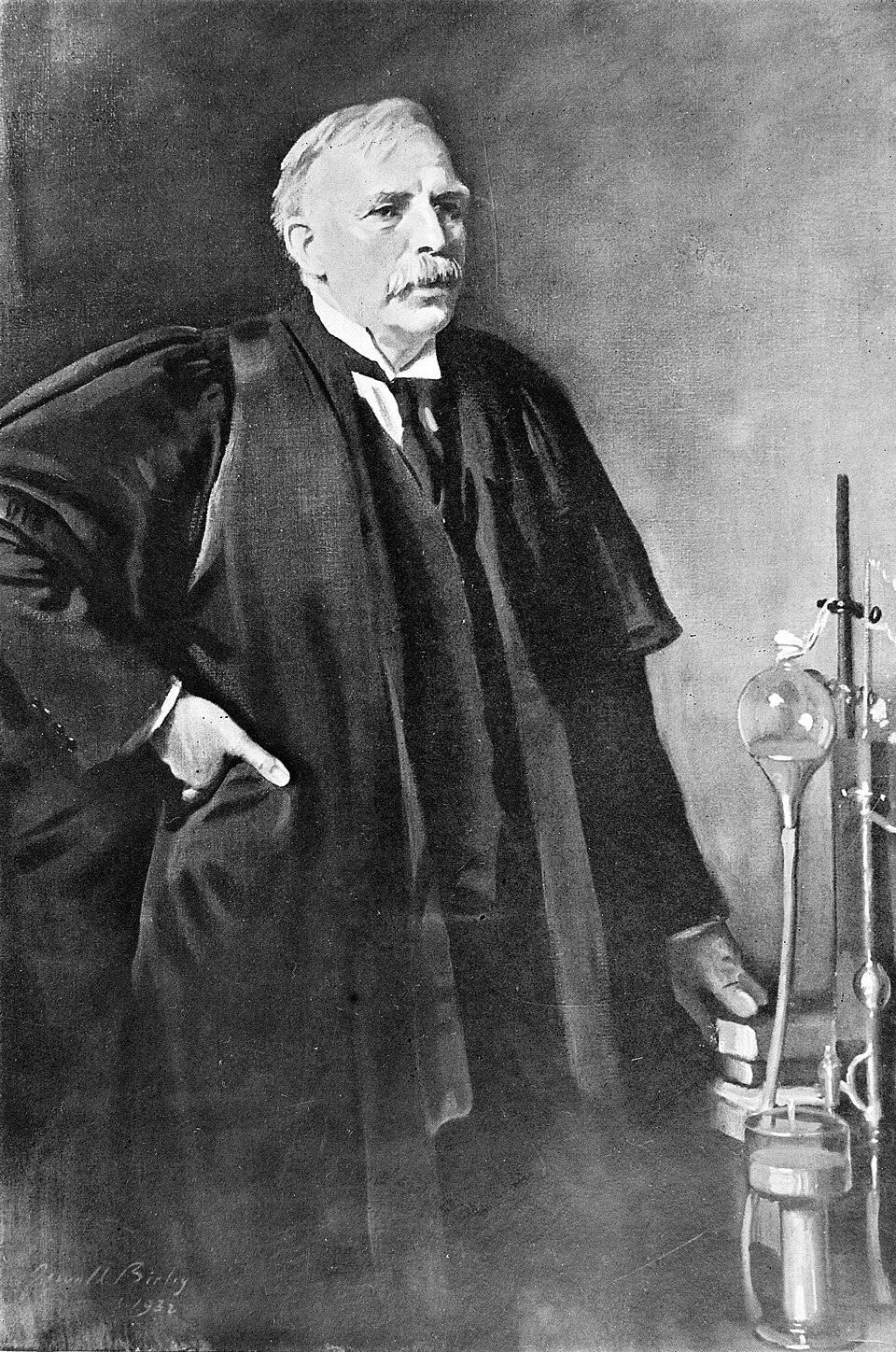
—From those flashes of light, in 1911, you derived the model of the atomic nucleus. How would you describe what you had discovered?
A sun and its void. I wrote, when presenting these results, that it was simpler to suppose that the atom contains a central charge concentrated in a very small volume, and that the large deflections of the particles are explained by this charge taken as a whole. That is the nucleus: a tiny citadel where almost all the matter is packed, surrounded by an ocean of electrons and nothingness. Consider the strangeness: the chair you are sitting on is, at that scale, almost entirely made of nothing. In Manchester, in front of the fluorescent screen, we had, without seeing it, looked at the architecture of the world. Young Bohr, two years later, came to place his quantum orbits on it, and the atom took the form we know.
The chair you are sitting on is, at that scale, almost entirely made of nothing.
—In 1919, you transformed nitrogen into oxygen. Were you aware that you were fulfilling the old dream of the alchemists?
I didn't like the word, but yes, I had broken an element by hitting it with alpha particles. Bombarding nitrogen, I saw long-range projectiles emerge that were not nitrogen atoms — I concluded they were most likely hydrogen atoms torn from the nucleus. For the first time, transmutation was no longer suffered but provoked by human hand: I had deliberately converted one atom into another. The alchemists sought gold in their furnaces; I, in a scintillation chamber, had turned nitrogen into a little oxygen. It is derisory in quantity, immense in principle. Matter, from now on, could be undone and remade. I did not yet measure what box that would open.
For the first time, transmutation was no longer suffered but provoked by human hand.
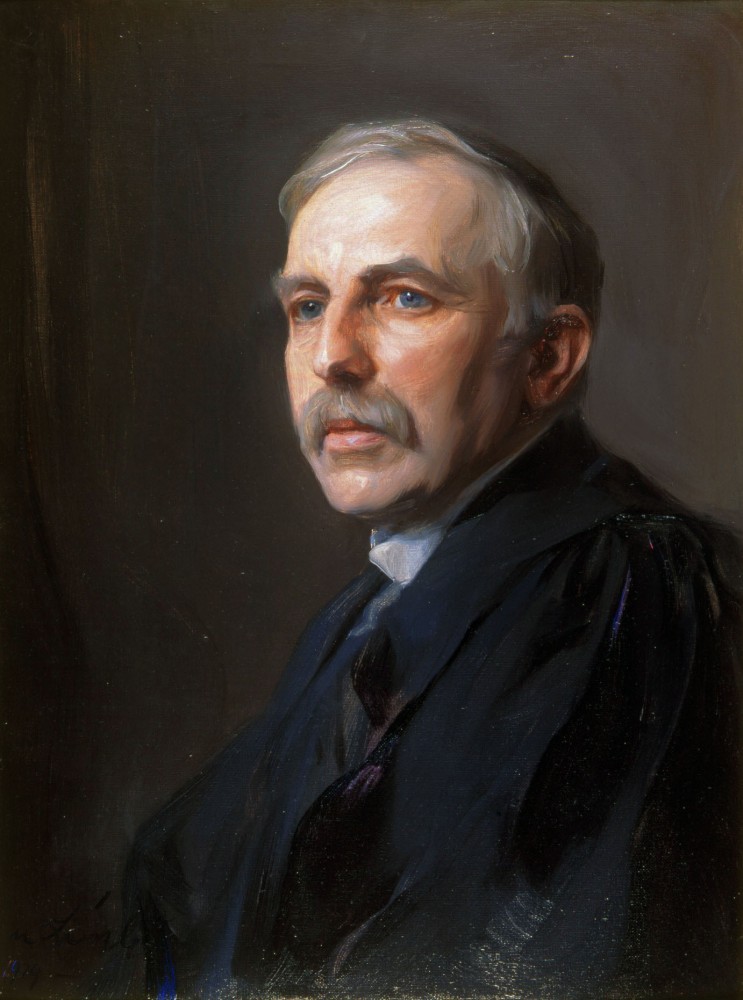
—They say that at the Cavendish, your researchers could tell from your voice alone whether an experiment was working. What kind of director were you?
Loud, apparently. When things went well, I would catch myself singing Onward, Christian Soldiers at the top of my lungs in the corridors, and my boys knew from that racket that the lab's barometer was set fair. Every morning I went from room to room, asking incisive questions, poking my nose into their setups. But I had a firm rule: no working in the evening. If you hadn't finished your work by six o'clock, you hadn't thought enough during the day. Fatigue is a bad counselor in front of a scintillation screen. I saw an entire generation pass through — Chadwick, who is at this very moment hunting the neutral particle I predicted. For me, directing means protecting minds, not exhausting them.
If you hadn't finished by six o'clock, you hadn't thought enough during the day.
—Speaking of which, you predicted as early as 1920 a particle without charge in the nucleus. What was that intuition based on?
On an accounting that didn't add up. The nucleus weighed heavier than its positive charge alone allowed; there was missing, in my ledgers, a mass without electricity. So I put forward the idea of a neutral companion to the proton, nestled in the heart of the atom, invisible to my Geiger counters because it carries no charge to detect. People looked at me as one looks at a man talking about a ghost. But I knew my numbers. It took twelve years, and it is my student Chadwick, in this same laboratory, who has just caught the beast. Prediction never intoxicated me; what delights me is that another, trained under my roof, made it tangible. Science advances like that, by relays.
There was missing, in my ledgers, a mass without electricity.
—You worked in constant dialogue with Becquerel, the Curies, Thomson, Bohr. What does your work owe to these neighbors?
Everything, or nearly. Without the happy accident of Becquerel and his drawer, without the radium painstakingly extracted by the Curies in Paris — that radium from which I drew my precious alpha particles — I would have had neither question nor projectile. Thomson taught me at the Cavendish that the atom had an internal structure, that it was not the solid ball of the Ancients. And Bohr, that gentle young Dane, took my bare nucleus and clothed it with his quantum jumps, where I had only a rough sketch. I distrust solitary geniuses; atomic physics was a multi-voiced conversation, across the Channel and the Atlantic. Each brought his shard of glass; in the end, we could see through the window.
I distrust solitary geniuses: atomic physics was a multi-voiced conversation.
This imaginary interview was generated by artificial intelligence from sources documented in Ernest Rutherford's profile. It dramatises what the figure might have said based on what we know about them, but does not constitute attested historical testimony. For primary sources and factual documentation, refer to the full profile.