Imaginary interview with Euclid
by Charactorium · Euclid (333 av. J.-C. — 284 av. J.-C.) · Sciences · 5 min read
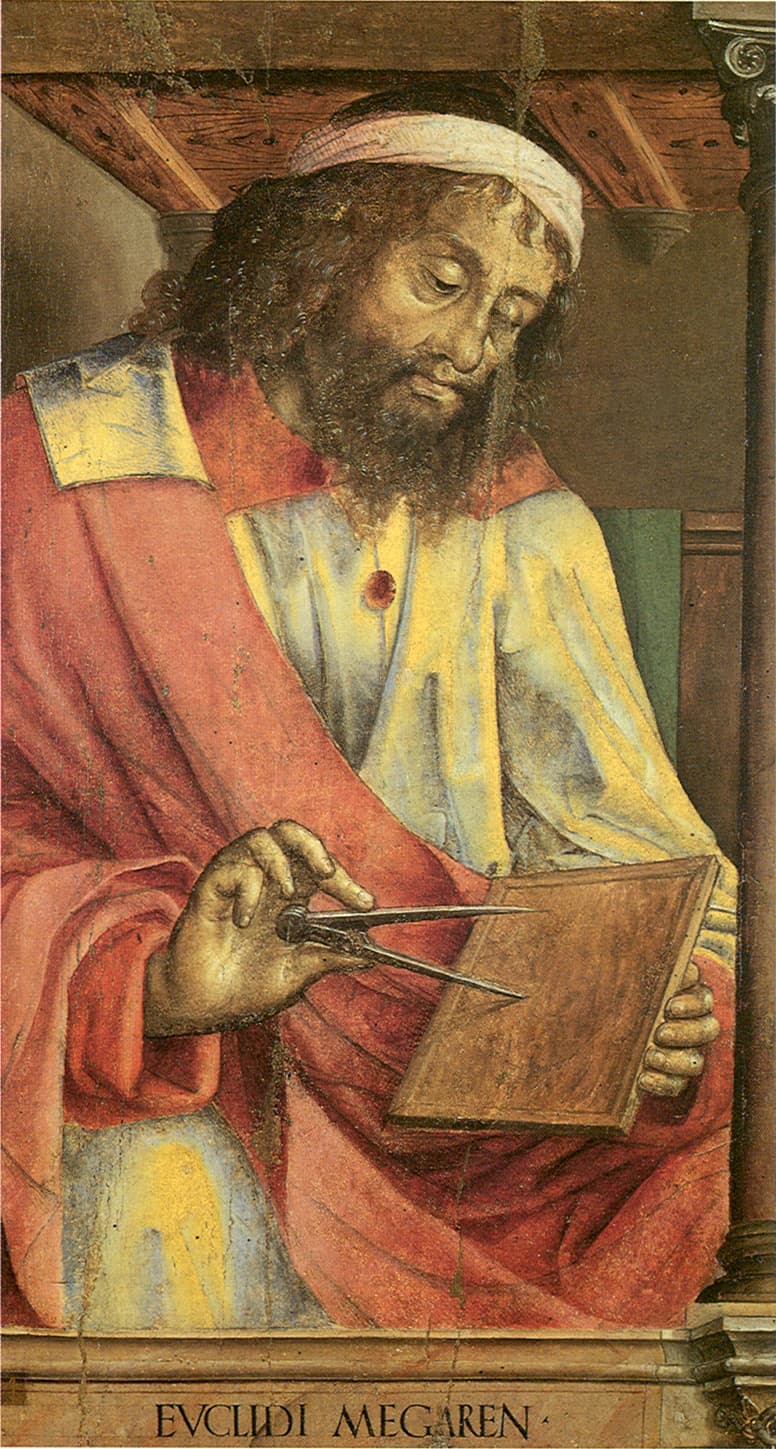
Alexandria, end of the reign of Ptolemy I. In a room of the Mouseîon where morning light falls on aligned papyrus rolls, a gray-bearded man wipes a figure from a wax tablet with his finger. Euclid agrees to answer, unhurriedly, as one demonstrates a proposition: one step after another.
—It is said that the king himself asked you for a shorter path to learning geometry. How did that happen?
Ptolemy, who welcomed me here and built this Mouseîon where we speak, was leafing through my thirteen books one day with the patience of a soldier before a siege that was too long. He wanted, he said, a faster route, worthy of a hurried king. I answered him, without detour, that there is no royal road to geometry. A theorem does not bow before the diadem as a city surrenders before Alexander. The first proposition requires drawing a straight line from one point to another; the second rests on it, and so on to the last. No step of this staircase can be skipped. The king commands men, not reasons.
A theorem does not bow before the diadem as a city surrenders before Alexander.
—What do you reply to those who demand, above all, the practical usefulness of geometry?
A boy, the other day, barely having learned the first proposition, asked me what profit he would gain from it. I called my slave and told him to give three obols to this young man, since he must, you see, earn something from what he learns. Geometry does not feed the belly nor levy taxes. It cleanses the eye of the mind. He who seeks the coin first will never see why the angles of a triangle always equal two right angles, regardless of its size, in Athens or Syracuse. What can be demonstrated cannot be bought. I prefer a poor student who contemplates to a rich merchant who calculates.
Geometry does not feed the belly: it cleanses the eye of the mind.
—Why did you base everything on a few principles accepted in advance, these axioms and postulates?
Every construction requires a ground. Before building, I lay down what no sensible person will refuse: that a point is that which has no part, that a line is a breadthless length. These are my axioms, my common notions. Then I ask that certain things be granted me, my postulates: that one may draw a straight line, extend a segment, describe a circle. From this little, and from the sole ruler and compass, everything else is deduced without having to take anyone's word for it. The Platonism I breathed at the Academy taught me this: truth is not voted upon, it is compelled. Give me what is not disputed, and I will give you back what is no longer disputed.
Give me what is not disputed, and I will give you back what is no longer disputed.
—Among your postulates, the fifth, on parallels, seems to have given you trouble. Do you remember that difficulty?
That one, yes, cost me nights by the oil lamp. The first four are conceded in a breath; the fifth, on lines that eventually meet, requires looking far, where the eye no longer follows. I long postponed its use in the Elements, doing without it as much as I could, like one keeps a debt one does not like to pay. I felt it less obvious than the others, closer to a disguised theorem than to an honest demand. But I could not prove it from the first, and I preferred to state it frankly rather than cheat. If some geometer, after me, unties this knot, let him be given more than three obols.
The fifth postulate, I felt it less obvious than the others, closer to a disguised theorem.
—What does a working day at the Mouseîon look like?
I rise before the sun, in my dwelling in the Brucheion, the royal quarter. A little barley bread, olives, goat cheese, and I go to the Mouseîon where the students await me. The morning is spent teaching, stylus in hand, tracing and erasing figures on wax — wax, you see, forgives error better than papyrus. In the afternoon, I dictate to a scribe who sets down my demonstrations on rolls; one does not write thirteen books by erasing. In the evening, sometimes we gather for a symposion, and there, over wine cut with water and astronomy, men reason more freely than before the king. It is a rare place: the Library holds more thoughts than any army has conquered provinces.
Wax, you see, forgives error better than papyrus.
—What makes Alexandria so different from Athens for a man of science?
Athens gave me Plato and the rigor of the Academy, but it is here, under Ptolemy, that thought found a roof and sustenance. The Mouseîon gathers under one portico scholars from all over the sea, housed, fed, free to seek. The Library swallows the rolls of every ship that enters the port. From the royal quarter, some days, I see the stones of the great lighthouse rising at the entrance of the harbor. A city that builds both a lighthouse for sailors and a library for minds knows that light has two faces. Nowhere else has a geometer had so much papyrus at hand or so many attentive ears.
A city that builds both a lighthouse and a library knows that light has two faces.
—Your work does not stop at pure geometry. What did you seek in studying vision in your treatise on optics?
The eye, I hold, sends its rays like straight lines stretched toward things, and these lines form a cone whose tip is within us. Hence, seeing becomes a problem of geometry: why distant objects appear small, why a straight road seems to narrow in the distance. All this is demonstrated with the same tools as in the Elements, the ruler of the mind applied to light. A gnomon planted in the ground teaches me this already: its shadow is merely a straight line drawn by the sun, and from that line I derive the height of the star. The visible world obeys the same proportions as my figures on wax. He who knows how to measure a shadow already knows much of the sky.
The eye sends its rays like straight lines stretched toward things.
—You also turned your gaze to the sky, in the Phenomena. What were you seeking up there?
The sky turns, and the stars rise and set according to an order that spherical geometry allows us to grasp. In my Phenomena, I treat the celestial vault as a sphere and the paths of the stars as circles drawn upon it. An armillary sphere, with its rings representing these circles, suffices to show why such a star appears in the east when another plunges into the west. I do not claim to say what the stars are made of — that I leave to philosophers. I only say where and when they appear, and that, measurement gives surely. The same compass that describes a circle on wax describes, in thought, the entire orb of the world.
The same compass that describes a circle on wax describes, in thought, the entire orb of the world.
—Your Elements also gather the work of those who preceded you. How do you see your part in this chain?
I did not invent everything, and I do not hide it. Before me, geometers had found scattered propositions, isolated demonstrations, like cut stones awaiting a wall. My task was to order them, to link them without flaw, each proposition drawn from the previous one, until the edifice stood on its own. That is why I named the work Στοιχεῖα, the Elements: the first letters, the foundations from which everything is read. The merit of a builder is not to have made the stone, but to have found the order in which none collapses. Let others after me add floors; the ground, at least, I wanted to be solid.
The merit of a builder is not to have made the stone, but to have found the order in which none collapses.
—If you could imagine being read still very far in the future, what would you like to be remembered?
I do not know where these rolls will travel once they leave the port. Papyrus is fragile, and fire, dampness, and oblivion lie in wait for every Library. But if some reader, in a century or ten, opens the Elements and takes up the demonstration for himself, then I will not have merely written: I will have taught beyond my own death. Let them not remember my face, of which no one will know much — let them remember the method. Start from what little is granted, advance only one sure step, and conclude with what was to be proved. A man goes out like the flame of an oil lamp; a correct reasoning, however, is rekindled in every mind that rereads it.
A man goes out like an oil lamp; a correct reasoning is rekindled in every mind that rereads it.
Read further
This imaginary interview was generated by artificial intelligence from sources documented in Euclid's profile. It dramatises what the figure might have said based on what we know about them, but does not constitute attested historical testimony. For primary sources and factual documentation, refer to the full profile.