Kids interview Euclid
by Charactorium · Euclid (333 av. J.-C. — 284 av. J.-C.) · Sciences · 5 min read
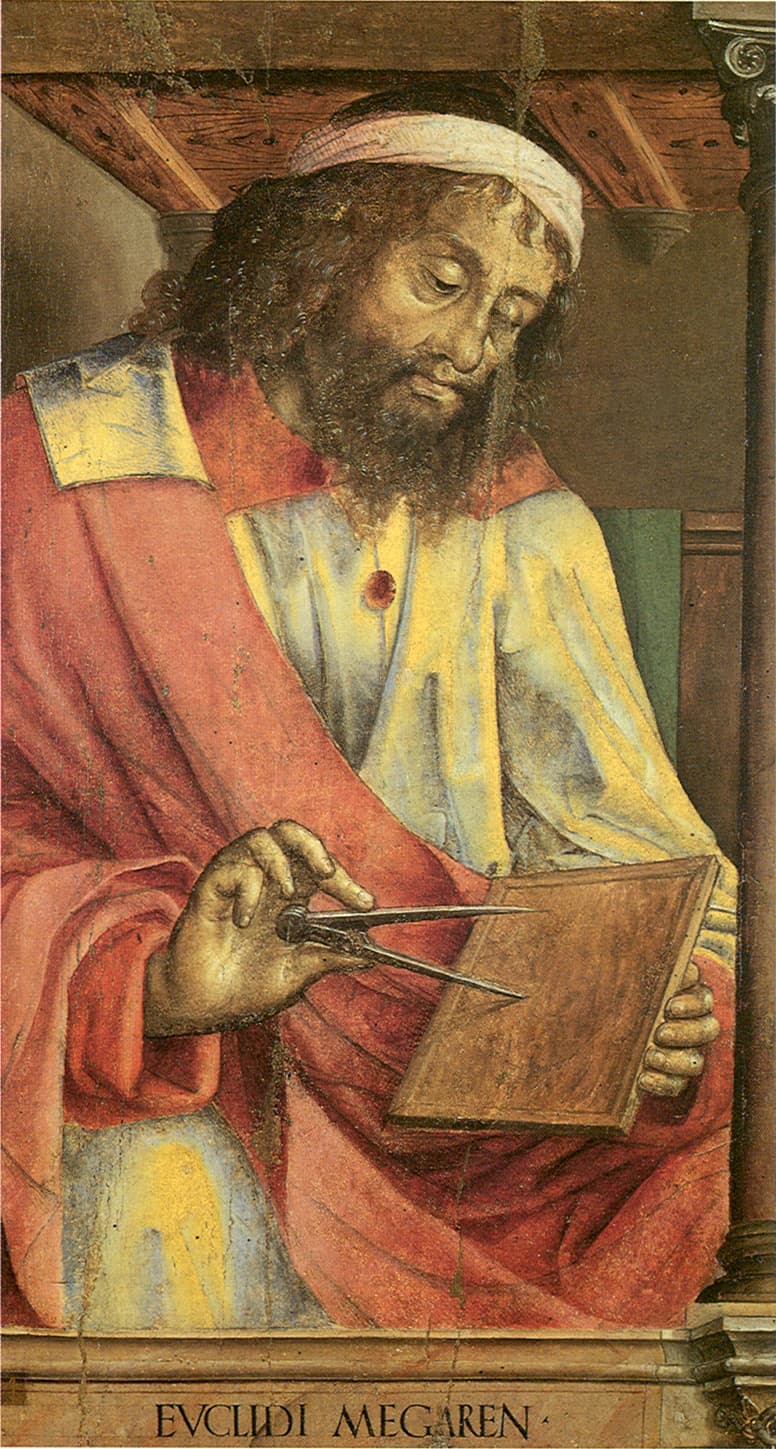
Two young visitors, twelve years old, push open the door of a room in the Alexandrian Mouseion. An old man with a long beard awaits them, a wax tablet resting on his knees. His name is Euclid, and he smiles: it is rare for children to come and talk about geometry.
—What was your home like in the morning when you woke up?
You know, my child, I wake up at dawn, when the sky over Alexandria is still pink. Imagine a very simple room, made of stone, with shelves full of papyrus rolls. I eat little: a piece of barley bread, some olives, a bit of goat cheese. Then I put on my chiton, my light linen tunic, because it gets hot here very early. And I walk to the Mouseion, the great house of knowledge built by King Ptolemy. That is where my students await me. Morning is the time for lessons. The smell? Papyrus, warm dust, and lamp oil.
I eat bread and olives, then go teach.
—And in the evening, what did you do? Did you have friends?
Oh yes! In the evening, we scholars gather for a banquet, what we call a symposion. Imagine a large room, low couches to recline on while eating, and wine mixed with water in cups. We talk about stars, numbers, shapes drawn in the sand. But I never stay too late. I go home, in the royal quarter, and reread my texts by the light of a small oil lamp. I correct, I scratch on my wax tablet. You see, a scholar works even when others sleep. It is in silence that one best hears one's ideas.
It is in silence that one best hears one's ideas.
—Is it true that a king wanted to learn geometry faster?
Ah, you know this story! Yes, King Ptolemy I himself asked me that question. He was powerful, he ruled all of Egypt, and he found my Elements too long to study. So he asked me if there was not a shorter, easier path, just for him, the king. And I replied: “There is no royal road to geometry.” Do you understand? Even a king must make the effort, like everyone else. You cannot buy knowledge; you must earn it. It is hard, but that is what makes geometry beautiful: no one can cheat with it.
There is no royal road to geometry.
—And the student who wanted to make money from your lessons, what was that about?
Ha! That one made me smile, and sigh a little too. A young man had just learned his very first lesson. Immediately he asked me: “What is the use? What will I get out of it?” So I called my servant and said: “Give him three obols, since he must profit from what he learns.” An obol was a small coin, almost nothing. Do you see the mockery? He sought profit, so I gave him a very small one. But the real treasure of geometry, my child, is not money. It is understanding. And that cannot be put in a purse.
The real treasure is not money; it is understanding.
—Your famous Elements, what are they really about?
Imagine a great book, thirteen papyrus rolls, where I build everything, brick by brick. The Elements means the basics, the foundations. I start with things we accept without debate: a point has no parts, a line is a length without width. These obvious starting points are called axioms and postulates, sort of rules of the game. Then, from them, I demonstrate, step by step, greater and greater truths: these are the theorems. And each demonstration ends with a formula: “what was to be demonstrated.” You see? We start from almost nothing, and we build an entire world of shapes.
We start from almost nothing, and build an entire world.
—Why only a straightedge and a compass? Can't we cheat a little?
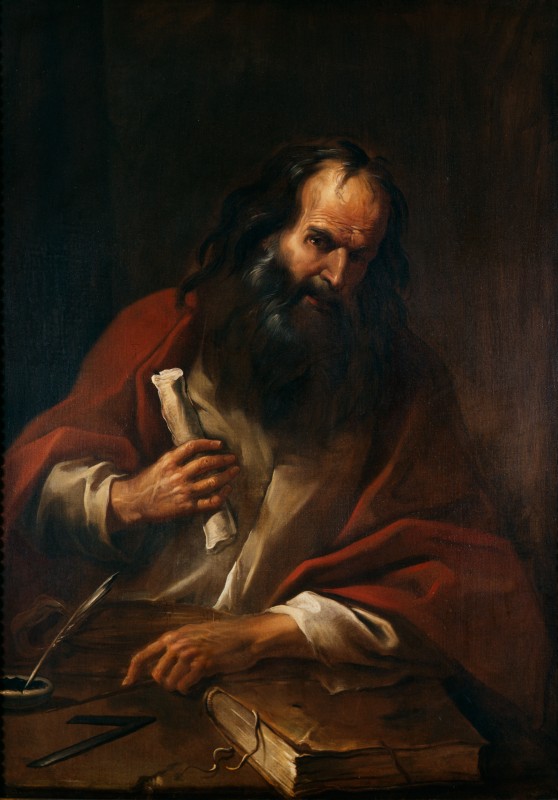
Ah, that is the whole game, precisely! With a straightedge, I draw lines. With a compass, I draw circles. And nothing else. Imagine you have only these two tools in your hands: no ready-made numbers, no random measurements. And yet, with them, you can construct a perfect triangle, a square, divide a line in two. It is like a challenge we set for ourselves. The rule we impose makes everything purer, more solid. If you cheat, you no longer know why it is true. But if you respect the two tools, then your figure stands on its own, forever. No one can ever contradict it.
The rule we impose makes everything more solid.
—Did you only do geometry, or other things too?
Oh, many other things! I took geometry everywhere. I wrote Optics, where I explain how we see. In my time, people thought that rays came out of our eyes, in straight lines, to touch objects. That was our way of understanding sight. I also studied the sky in Phenomena: how stars rise, how they set, imagining the sky as a great rotating sphere. For this, we used a gnomon, a simple stick planted upright, whose shadow tells you where the sun is. You see? Geometry is not locked in books. It is in your eyes and above your head.
Geometry is in your eyes and above your head.
—One of your books has been lost; that's sad, isn't it?
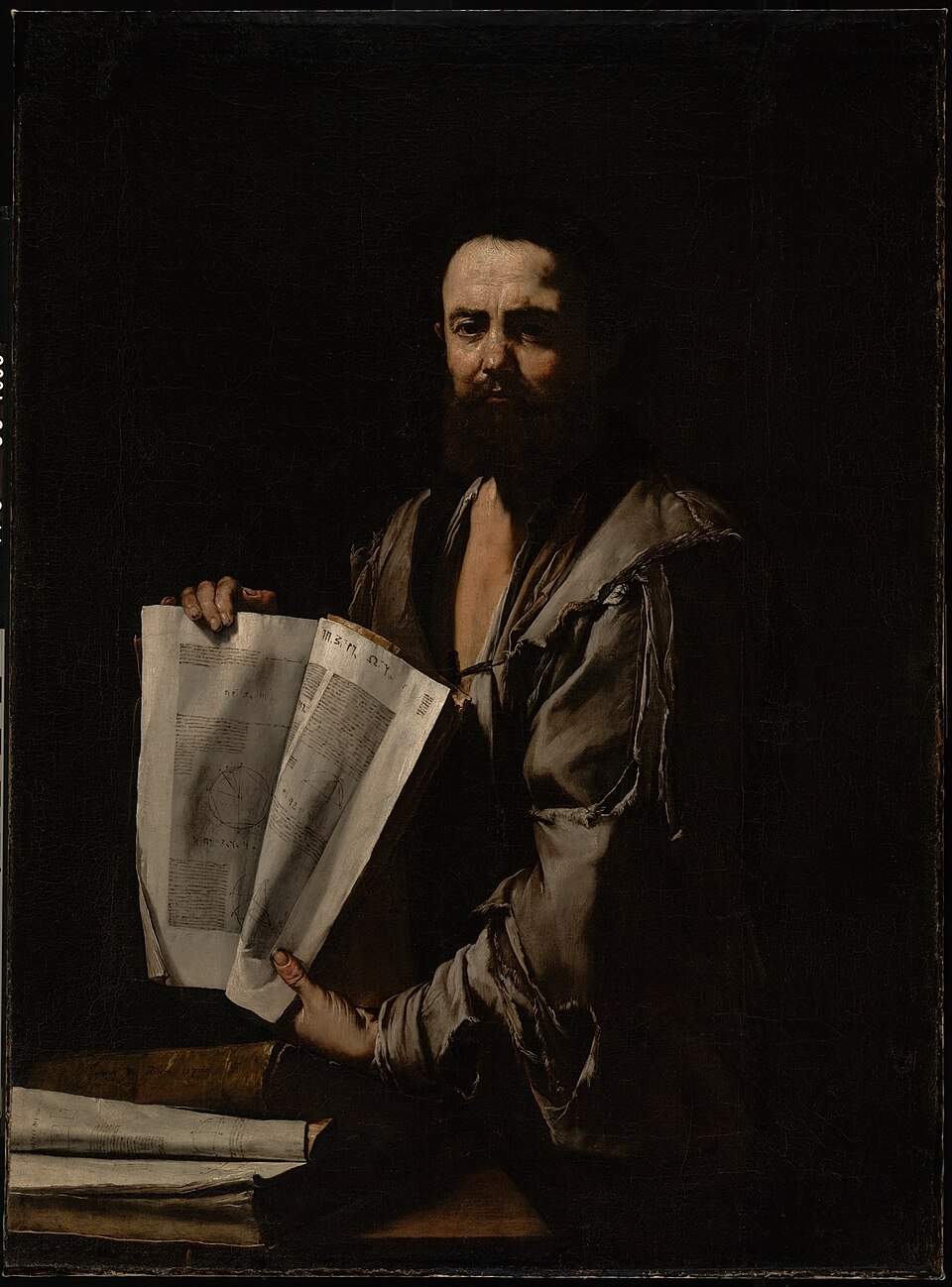
Yes, it is sad, I won't hide it. I had written a treatise on Conics: these are the curves obtained by cutting a cone, like the ellipse or parabola. Imagine a carrot that you slice in different ways: with each cut, a different curve appears. Well, that book disappeared. Later, another scholar, Apollonius of Perga, wrote a better, more complete one, and mine was forgotten. That is how it goes: we work, and sometimes others do better after us. It does not matter, my child. Knowledge is not about keeping for oneself. It is about passing the torch to someone stronger than you.
Knowledge is passing the torch to someone stronger than you.
—Is it true that almost nothing is known about your life?
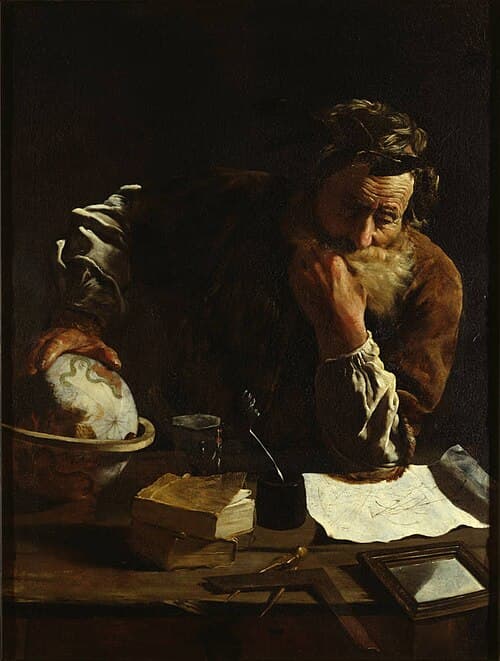
You are right, and it makes me smile a little. We do not even know where I was born! No certain date, no portrait. Worse: for centuries, I was confused with another man, Euclid of Megara, a philosopher who lived a hundred years before me. Two people mixed into one, can you imagine the mess? So how do we know that I existed? Thanks to others. The scholar Archimedes, who came right after me, mentions my work. He is the one who proves that I was indeed here, in Alexandria. You see, sometimes we know a man not by what he says about himself, but by those who remember him.
We know a man by those who remember him.
—How does it feel to know that your math is still taught today?
My child, if you knew how much that touches me. The Elements have been copied, translated, studied for over two thousand years. They say that after a certain Holy Book, it is the most printed text in the world. Children like you, in countries I could never have imagined, still draw the figures I thought up here, in Alexandria, on my wax tablet. I had neither gold nor army. Just a straightedge, a compass, and the desire to understand. And that is what has crossed the centuries. So remember this well: a true idea never dies. It travels much further than the one who had it.
A true idea never dies.
Read further
This imaginary interview was generated by artificial intelligence from sources documented in Euclid's profile. It dramatises what the figure might have said based on what we know about them, but does not constitute attested historical testimony. For primary sources and factual documentation, refer to the full profile.