Imaginary interview with Eugène Ionesco
by Charactorium · Eugène Ionesco (1909 — 1994) · Literature · 5 min read
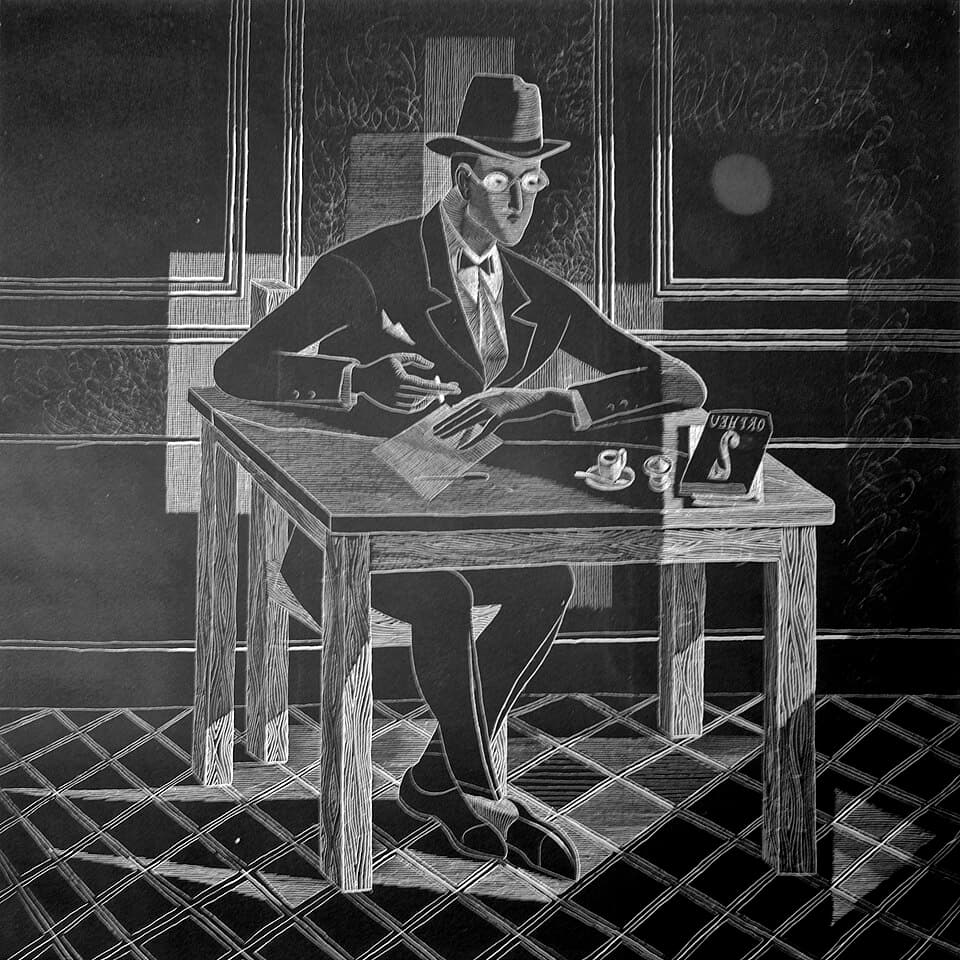
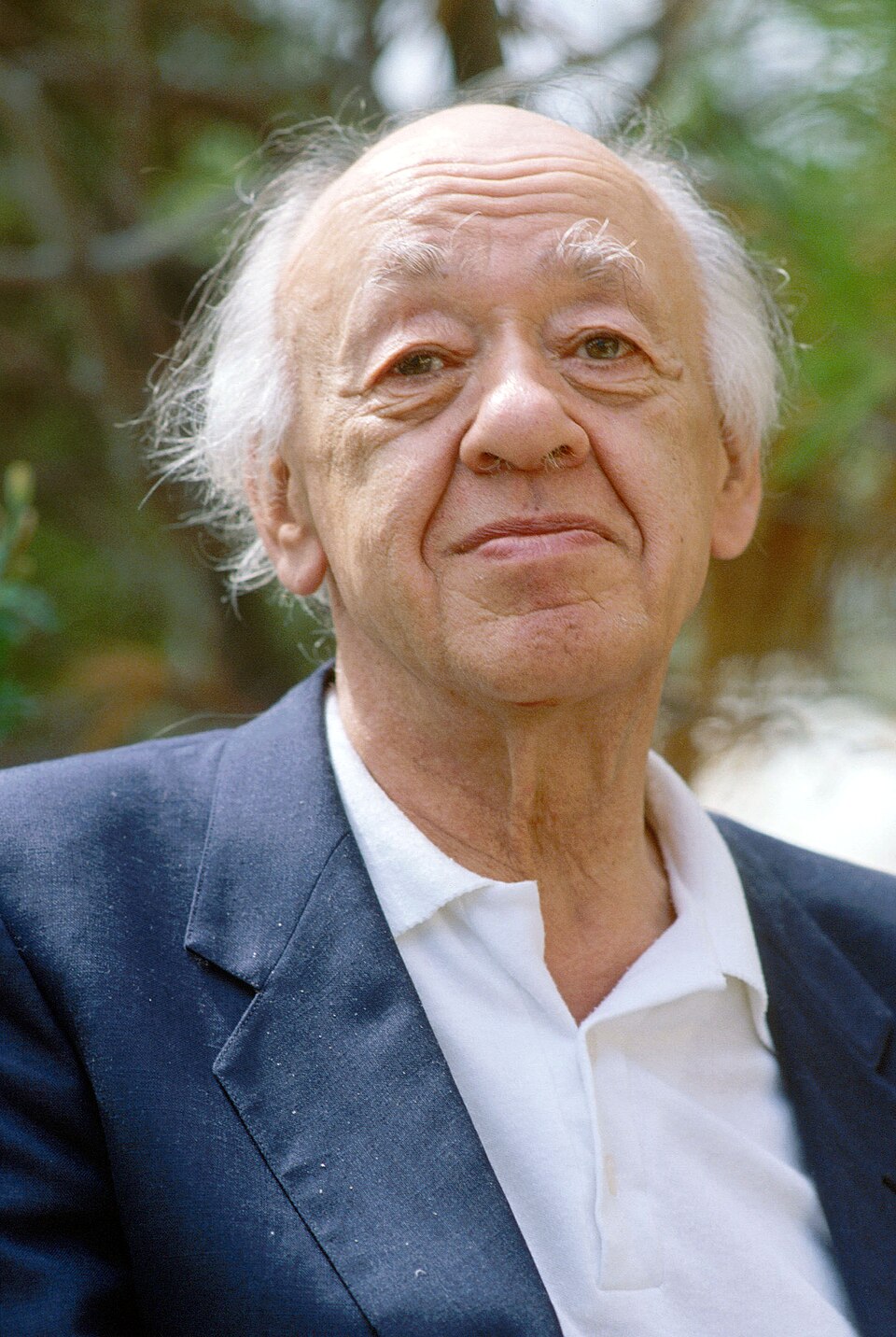
Grey late afternoon at the Tuileries. In his apartment cluttered with manuscripts and canvases populated by rhinoceroses, Eugène Ionesco receives us, his round eyes behind thick glasses, a cup of coffee within reach. The conversation opens, like his plays, with a burst of laughter that conceals an anguish.
—How could a simple language method give birth to a play?
I wanted to learn English, that's all. I opened an Assimil manual, and I found truths of stupefying obviousness: that the ceiling is up, that the floor is down, that the week has seven days. The more I copied these sentences to learn, the more they emptied before my eyes, like a bathtub being unplugged. Suddenly these Mr. and Mrs. Smith, these neighbors who discover they are husband and wife, were no longer a lesson but ghosts talking to each other without saying anything. The Bald Soprano was born there, in 1950, on a table where a school manual lay. The title itself is a rehearsal accident. And this anti-play was performed before three spectators, at the Noctambules. Three.
The more I copied these sentences to learn, the more they emptied before my eyes, like a bathtub being unplugged.
—How do you feel knowing that this play has been performed non-stop for decades?
There is an irony that I savor and that terrifies me at the same time. Since 1957, at the Théâtre de la Huchette, in that handkerchief-sized theater of the Latin Quarter, my characters repeat every evening the same banalities, the same broken clocks, before ever-new audiences. It has become, it seems, the longest-running show in the history of French theater. Think about it: a play about the emptiness of speech that perpetuates itself indefinitely, like a machine that cannot stop. My Smiths and Martins are condemned to the eternity of repetition. That is perhaps the most accurate staging of the absurd: not an end, but a repetition without term.
—Why did you give such a central role to chairs and objects in your theater?
Because objects speak when men fall silent. In The Chairs, in 1952, my old couple lines up empty chairs for a crowd of guests who do not exist, to hear a capital message that a mute orator will never deliver. The stage fills with absent presences. That is what obsesses me: proliferation, invasion. One chair, then ten, then a hundred, until the space is saturated with nothingness. I have always thought that theater should magnify things, push them to a paroxysm, as I wrote in my Notes and Counter-Notes. A banal object, multiplied to excess, becomes more terrifying than a monster. The empty chair says more about solitude than a thousand speeches.
Objects speak when men fall silent.
—Do you remember the experience that nourished your most political play?
I saw it with my own eyes, in Romania, in the thirties. Friends, intelligent, cultured, reasonable men, would one morning start speaking the language of the Iron Guard, that fascist movement, and you no longer recognized their faces. They were not coerced: they adhered with enthusiasm, as if catching a fever. That is what I called rhinoceritis. A refugee in Paris, living the Occupation in precariousness, I carried that image inside me for years before writing Rhinoceros, in 1959. To see a loved one harden, thicken, lower their head and charge into the herd: there is no more frightening spectacle. My play is nothing other than the story of that metamorphosis that I endured as a helpless witness.
They were not coerced: they adhered with enthusiasm, as if catching a fever.
—How did you want this transformation to be rendered on stage?
I wanted the spectator to be afraid in their gut, not just in their head. During rehearsals, I demanded that the actors physically imitate the beast, the stamping, the trumpeting, that blind mass that shakes the walls. Jean-Louis Barrault, who was staging the play, had to negotiate at length with me to find the balance between the absurd and realistic acting. Because it is not an amusing fable. As I wrote to him, Rhinoceros is a play against collective hysterias, those epidemics that disguise themselves as reason and generous ideas, but which remain serious illnesses. The laughter must freeze in the throat. If the audience leaves reassured, I have failed.
—What would you say about your election to the Académie française, you who mocked rituals so much?
Admit that it is a farce worthy of my own plays. I who spent my life denouncing empty speeches, frozen formulas, language running on empty, here I am elected in 1970 to seat number six, under the Dome, in green habit and sword at my side. Sartre, who refused these institutions, and many others, had good reason to sneer. But you see, I have always enjoyed playing my own role in the social comedy while looking at it sideways. Donning the uniform of conformism to better feel its absurdity from within: there is a secret coherence there. I gave my acceptance speech knowing full well that literature must remain capable of saying no.
Donning the uniform of conformism to better feel its absurdity from within.
—So you give literature a mission that goes beyond play and absurdity?
Under the derision, yes, there is a demand. I said under the Dome that literature is the conscience of a people, its living memory, and that it can also be its critical conscience, lucid, capable of saying no to what is not human. That may seem contradictory coming from the man who wrote plays where nothing is said. But the emptiness I stage is precisely a protest. Showing language in ruins is still bearing witness that it should mean something. My theater does not give lessons, I distrust it like the plague, but it refuses. And refusing collective lies is perhaps the only form of fidelity left to me.
—You often spoke of a fear that inhabited you. What did you call it?
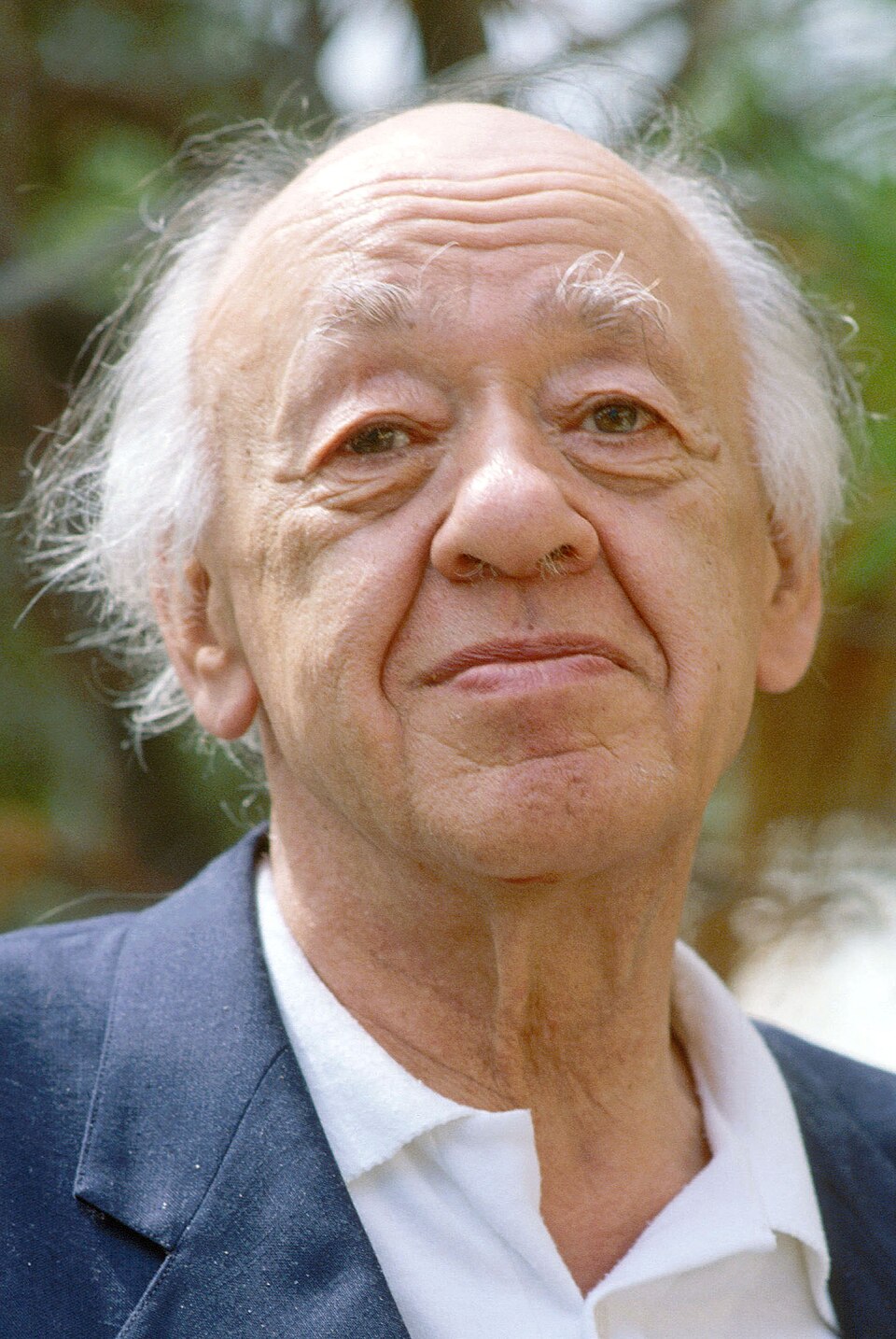
I called it the great absence. Death, not as a philosophical idea you toss around in a café, but as a physical panic that woke me at night. I recorded that without shame in my Fragments of a Journal, in 1967: I am afraid of dying and I am afraid of living, and these two fears are not alike, one is known, the other remains mysterious, and that is perhaps why it is even more terrifying. All my Franco-Romanian childhood, my insomnia, my notebooks placed on the nightstand where I noted my dreams upon waking, all of it revolved around this black hole. They think I am the author of laughter; I am above all the man who is afraid.
They think I am the author of laughter; I am above all the man who is afraid.
—How did this obsession shape one of your most intimate works?
With Exit the King, in 1962, I stopped hiding behind farce. Bérenger learns he will die in an hour and refuses, cries, begs, bargains, exactly as I would, as we all would. This king who collapses while his kingdom disintegrates around him is me, is everyone. There are no more invisible guests or rhinoceroses: only a naked man facing the unacceptable. I wrote this play like writing one's own will, sweating my own terror. It is probably the work where I protected myself the least. Making it universal did not make it less intimate: on the contrary, it is by stating my anguish that I touched that of everyone.
—Toward the end of your life, you turned to painting. Why this need?
Because words, those traitors I spent my life deconstructing, eventually no longer suffice. From the seventies onward, I took up brushes. On my canvases appeared ghostly figures, floating silhouettes, and my rhinoceroses, again them, as if the beast of my Romanian youth would not leave me. Painting was saying the unsayable without going through sentences, finally escaping that grammar that had betrayed me so much. I hung these images on the walls of my apartment, among my overloaded libraries, and I felt I was exorcising something. The silence of color rested me from the noise of words. It was another way of facing the great absence.
The silence of color rested me from the noise of words.
This imaginary interview was generated by artificial intelligence from sources documented in Eugène Ionesco's profile. It dramatises what the figure might have said based on what we know about them, but does not constitute attested historical testimony. For primary sources and factual documentation, refer to the full profile.