Imaginary dialogue between Jean du Bellay and François Rabelais
by Charactorium · François Rabelais (1500 — 1553) · Literature · 6 min read

It is in the gardens of Saint-Maur-des-Fossés, near Paris, that Cardinal Jean du Bellay receives his old physician and companion this autumn of 1552. The vines are turning red, a fire of vine shoots crackles in the next room, and on the table lie freshly printed sheets of the Quart Livre. For nearly twenty years the prelate has protected this former monk turned physician and storyteller, whom he has taken twice to Rome and more than once rescued from the wrath of the Sorbonne. Today, far from the affairs of the kingdom, he wants to hear the man behind the frock, the scalpel, and the pen.
—Master François, before I knew you, I heard that at Fontenay your Franciscan brothers confiscated your Greek books. What did they really take from you?
Monseigneur, they took from me far more than bound pages — they tore away a window onto the world. At Fontenay-le-Comte, my companion Pierre Amy and I read Plato in the original, and Homer, and the Greek Fathers. That was enough to make us suspect: a Franciscan who knows Greek, there's a heretic in the making! My brothers seized my books as one confiscates a weapon. That day I understood that ignorance is not content to be foolish: it wants everyone else to be foolish too. That is why I begged Rome to let me transfer to the Benedictines, who are kinder to good letters. They did not take books from me, Monseigneur — they taught me why I must defend them.
—And when you published that Pantagruel under that twisted name, Alcofribas Nasier, were you already afraid of the dogs of the Sorbonne?
You who have frequented the Sorbonne, Monseigneur, know what guard dogs bark there. Alcofribas Nasier is merely a carnival mask — the exact anagram of François Rabelais, but who could unravel it except the merry ones? I wanted my Pantagruel to run through fairs and taverns before those gentlemen could sniff out the author. In vain: they condemned it as obscene without understanding a single word of it. These Sorbonagres mistake laughter for debauchery and erudition for blasphemy. But the common folk laughed heartily — and a book read under the cloak sells ten times better than a sermon yawned from the pulpit. The mask, you see, was not cowardice: it was a captain's strategy.
These Sorbonagres mistake laughter for debauchery and erudition for blasphemy.
—You who have treated me more than once on the roads of Italy, tell me: those public dissections in Lyon, how did you bear them?
You remember, Monseigneur, the fevers that seized you on the roads of Italy — I learned to fight them not in the clouds, but on the flesh itself. At the Hôtel-Dieu de Lyon, from 1532, I opened bodies before students, something scarcely dared at the time. How can one heal what one does not know? Galen himself was mistaken for lack of enough dissections. I had taken my medical degree at Montpellier two years earlier, in a few weeks it is true, but with forty years of Greek in my head. To see with my own eyes the path of veins, the seat of the liver, the fabric of the brain: that is my true theology. The human body is the most beautiful book God ever wrote, and too many doctors refuse to open it.
—You edited the Aphorisms of Hippocrates in Lyon. Why does a teller of giants also become a philologist of medical Greek?
Because there are not two men in me, Monseigneur, but one who loves the truth in all its robes. When I edited the Aphorisms of Hippocrates in Lyon, in 1532, I collated the Greek manuscripts like a goldsmith weighing gold, for the copyists and Latin translators had corrupted the text with a thousand errors. A physician who reads Hippocrates in bad Latin heals blind. The same care I take to make Pantagruel amusing, I take to make Hippocrates accurate — for both aim to heal man, the one his body, the other his sadness. Good letters and good medicine drink from the same source: Greece. Separate them, and you will have nothing but a pedant or a charlatan.
—In your Gargantua, that abbey of Thélème where one lives according to 'Do what thou wilt,' were you thinking of the cloisters you fled?
You have pierced my design, Monseigneur, you who have seen me wince in more than one cloister. Thélème is the exact opposite of the convents where I froze my youth: where the rule says 'thou shalt not,' my only law says Do what thou wilt. Not a license for swine, mark me: I house free people, well-born, well-educated, who through that very freedom flee vice and pursue honor. Servile souls need bars; free souls govern themselves. I built on paper the abbey I would have liked to inhabit — without a bell to mark the hours, without vows to chain desire. When one has worn the habit for thirty years, Monseigneur, one dreams of a house without locks.
Servile souls need bars; free souls govern themselves.

—Without bell or clock, you say? So your Thélémites rise whenever they please, with no constraint of the hour?
Precisely, Monseigneur! In my book, they rise from bed whenever they please, drink, eat, work, sleep when the desire comes. No one wakes them, no one forces them to anything. I have had too many frozen matins, pulled from sleep by a stupid bell, not to hate the tyranny of the clock over free men. Note well that I am not speaking of the lazy: my Thélémites are so well-born and raised in good company that they naturally have an instinct that drives them to good. That is my faith, Monseigneur: constraint breeds the hypocrite, freedom reveals the honest man. Remove the chains from one who is good, he will remain good; remove them from the wicked, he was already so beneath his fetters.
—Do you remember, on our return from Rome, those little bags of seeds you clutched like relics? What did you hope to do with them?
Ha, Monseigneur, you mock, but those bags were worth more than many bulls! From our journeys to Rome I brought back seeds of romaine lettuce, melons, and those artichokes hardly known in France. While you negotiated with the Holy Father, I prowled the gardens and markets, my nose in herbs and vegetables. A physician must know what his patient eats: the table is the first of pharmacies. I saw there plants our ancients spoke of that no Frenchman had tasted. Bringing them back was to enrich both our kitchen gardens and our plates. Conquerors are remembered for the cities they burn; I would like to be thanked for an artichoke. That, Monseigneur, is my way of serving the kingdom.
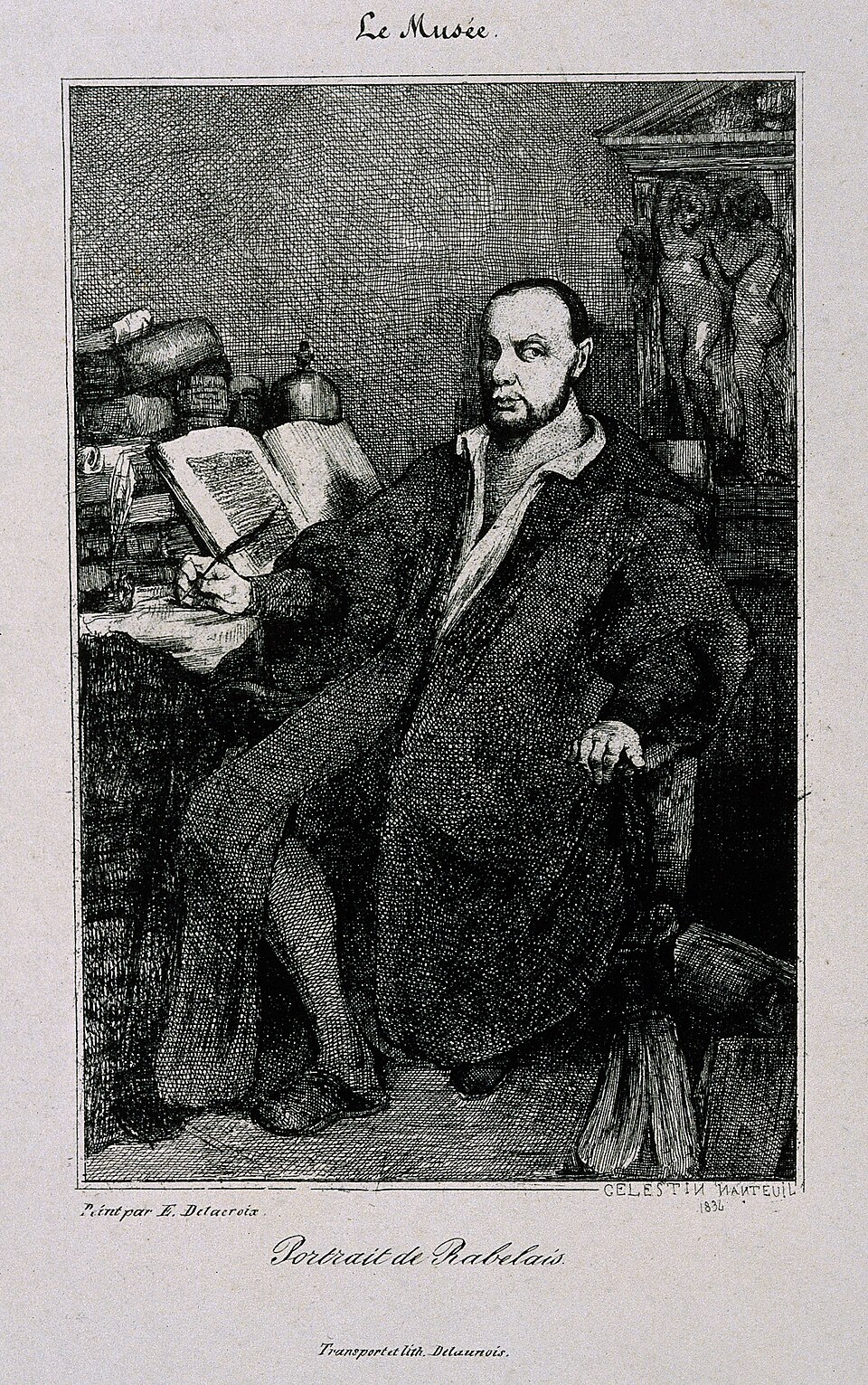
—When I dragged you through the streets of Rome to study the ancient ruins, what were you looking for, you the physician?
Was I looking for ruins, Monseigneur? I was looking for masters! Those broken columns, aqueducts, marbles taught me a grandeur our Gothic centuries had forgotten. I measured stones, drew plans, dreamed of a faithful description of ancient Rome. But you know that in Rome I had another business, more pressing for my salvation: to obtain from the Holy Father absolution for my apostasy, I who had left the frock without leave. Thanks to your credit, Monseigneur, I was able to re-enter the Church through the main door, a secular priest and in good standing. Strange thing: the same city that washed away my sin as a monk made me fall in love with the pagans of old. But the humanist that I am sees no war between Athens and the Gospel.
—They say laughter heals. You, both physician and storyteller, do you truly believe you heal men through your tales?
That is my most serious jest, Monseigneur! Yes, I maintain that laughter heals. I have seen patients whom no electuary relieved regain strength from a good joke. Grief thickens the blood, joy makes it clear — it is physical as much as moral. My pantagruelism, you see, is neither drunkenness nor folly: it is a certain gaiety of spirit steeped in contempt for fortuitous things, a way of living in peace despite the pox-ridden, wars, and Sorbonagres. I write for the very illustrious topers and the very precious pox-ridden, that is, for all men, for all suffer. If my giants make a single dying man laugh, I will have practiced better than with all my bloodlettings. The physician heals the body for an hour; the good storyteller gladdens the soul for life.
The physician heals the body for an hour; the good storyteller gladdens the soul for life.
—Now that I have obtained for you the living of Meudon, will you finally rest your pen, or will Pantagruel sail on?
Grow wise? Monseigneur, you know me too well to hope for it! I am infinitely obliged to you for this living of Meudon — a priest who loves his vines and his parishioners, that suits me. But do you think a priest cannot hold a pen? My Quart Livre has just appeared, and Pantagruel has not yet reached the oracle of the Dive Bouteille he seeks beyond the seas. As long as I have ink and wine from Touraine, my giants will sail. I am aging, it is true, and the Sorbonne does not disarm; but you cannot silence a man by giving him a parish. I want to die pen in hand and glass full, laughing at death as one laughs at a sergeant who knocks at the wrong door.


This imaginary interview was generated by artificial intelligence from sources documented in François Rabelais's profile. It dramatises what the figure might have said based on what we know about them, but does not constitute attested historical testimony. For primary sources and factual documentation, refer to the full profile.