Imaginary interview with François Rabelais
by Charactorium · François Rabelais (1500 — 1553) · Literature · 6 min read
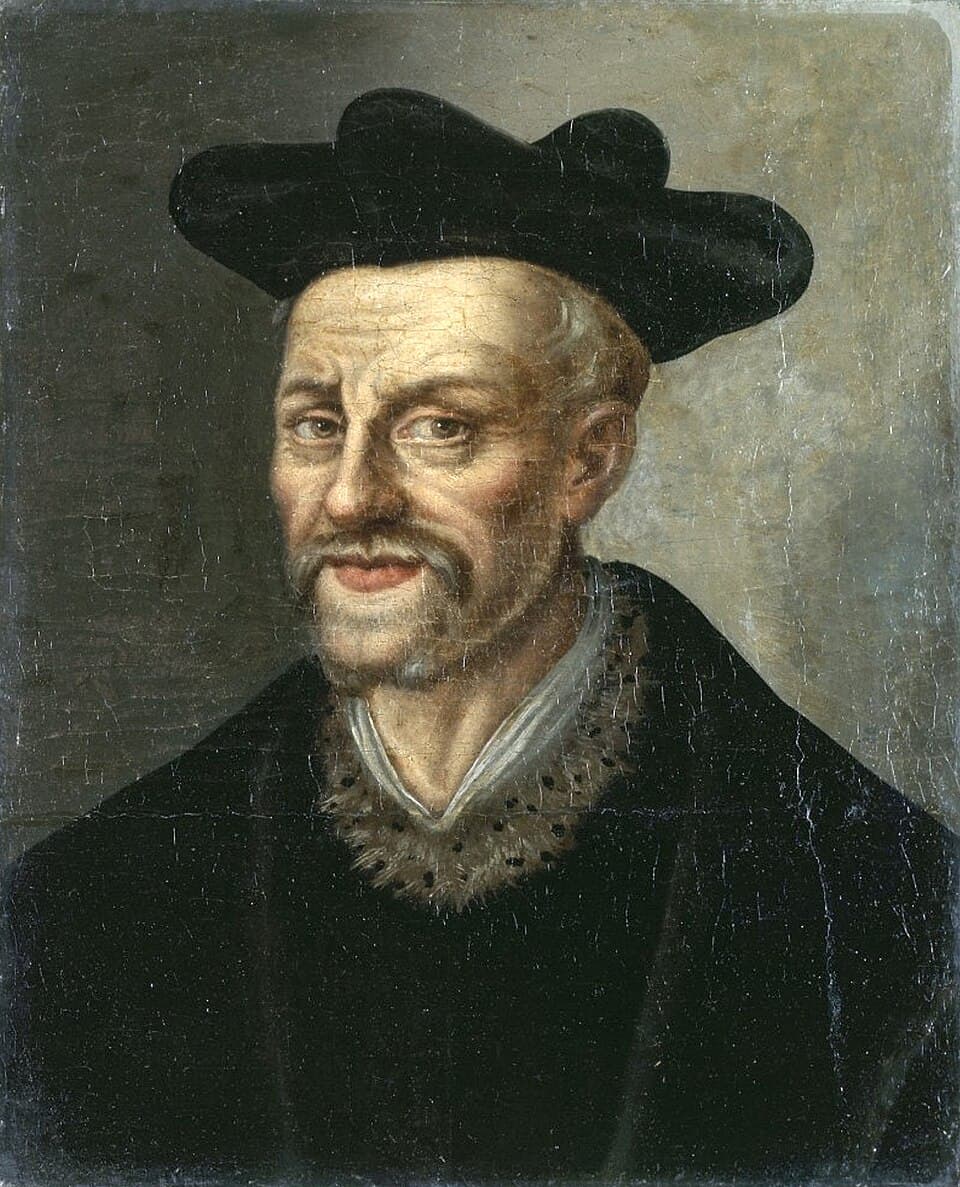
Meudon, autumn 1552. The parish priest has just set down his pen after the Quart Livre has come off the press; a fire of vine clippings crackles, a bottle of Touraine wine waits on the table. François Rabelais, in his dark doctor's robe and with a twinkling eye, agrees to answer, between sips, anyone willing to listen to him talk about giants, flasks, and pyres.
—How did a young monk come to be so passionate about the Greek language that he aroused the suspicions of his superiors?
At the Franciscan convent of Fontenay-le-Comte, I was a Franciscan, and I had discovered through my friend the jurist Pierre Amy something more intoxicating than any wine: ancient Greek. Reading Hippocrates in his own language, hearing Plato without the mediation of kitchen-Latin daubers, that is what kept me awake. My good friars, for their part, saw only sorcery and Lutheran temptation. One fine morning, they seized my Greek books, as one confiscates a dagger from a soldier. I felt as if my eyes were being torn out. For in my eyes, I tell you without joking, it is a disgrace for anyone to call themselves learned without the Greek language. They had made me a monk; that day, they made me a rebel.
They had made me a monk; that day, they made me a rebel.
—From that narrow coarse-wool habit, how did you pass to the doctor's robe?
The Franciscan habit was too tight for me; I obtained the pope's permission to transfer to the Benedictines, an order broader in its shoulders regarding studies. Then I simply threw off the habit for the long robe and the doctor's bonnet. At Montpellier, in 1530, I earned my medical degree in a few weeks — I was criticized for this haste, but I had read Galen before setting foot there. From there, at the Hôtel-Dieu de Lyon, I became a physician for good: I opened corpses in public, scalpel in hand, before a crowd that didn't know whether to cry out wonder or sacrilege. Thus the thwarted monk became an anatomist. The same curiosity, believe me, guides the blade into the belly of a corpse and the pen into the belly of a giant.
The same curiosity guides the blade into the belly of a corpse and the pen into the belly of a giant.
—Why did you publish your first novel, Pantagruel, under the mask of an invented name?
In 1532, in Lyon, I had Pantagruel published, signed by a certain Alcofribas Nasier. Look closely at the letters: it is the perfect anagram of François Rabelais, no more, no less. Why this mask? Because a physician at the Hôtel-Dieu who amused himself by recounting the testicles of a giant and mocking the Sorbonne would have been hanged high and short under his real name. The mask, you see, was not to hide me completely — the anagram is too transparent — but to give a false impression and to laugh. The theologians condemned the work as obscene, which delighted me: nothing sells a book better than a thundering censorship. Diogenes rolled his barrel; I rolled my Alcofribas.
Nothing sells a book better than a thundering censorship.
—What exactly do you reproach those doctors of the Sorbonne whom you mock relentlessly?
I dubbed them with a word of my own invention: sorbonagres — half Sorbonne, half dappled ass. These people comment on Aristotle without understanding him, argue for hours over whether a chimera buzzing in a void can eat second intentions, and meanwhile true knowledge slips past their noses. I write in Gargantua's letter to his son that I now see 'the brigands, the executioners, the adventurers, the grooms of today more learned than the doctors and preachers of my time.' That is my grievance: these gentlemen have turned study into dusty scholasticism, a brake, where it should be an intoxication. They confiscate Greek as mine was confiscated. I answer them with laughter, which is the weapon of free men.
They confiscate Greek as mine was confiscated.
—In Gargantua, you imagine the Abbey of Thélème. What kind of monastery is that?
An upside-down monastery, sir, the exact opposite of those where I wore out my knees. At Thélème, in my Gargantua of 1534, no walls, no clock, no matins to drag the wretches out of bed. A single rule, engraved on the pediment: 'Do as you will.' For I wrote that there 'their whole life was spent not by laws, statutes, or rules, but according to their own will and free choice. They rose from bed when it seemed good to them, drank, ate, worked, slept when the desire came to them.' People think me mad: to leave people free, is that not opening the door to vice? Quite the contrary. A well-born, well-educated man uses his freedom only for good. It is slaves who need locks.
It is slaves who need locks.

—What distinguishes your Thelemites from the religious you had encountered in real life?
A Thelemite is everything I could not be under the habit. My brothers of the Cordeliers lived under the bell, with the breviary in hand, eyes downcast, fear of the superior in their bellies, suspecting Greek and joy as twin demons. My Thelemites, on the other hand, are handsome, learned, courteous, speaking five or six languages, playing the lute and riding horses. Men and women are received together — absolute scandal for a real cloister! I do not invent this paradise out of spite: I set it up as a mirror, so that people might see how much real convents shrink the soul instead of enlarging it. When I left the habit for the parish of Meudon, I had already built, in spirit, the abbey where I would have liked to live.
—It is often forgotten that you were a learned editor of medical texts. What did this scholarly work represent to you?
The same year as Pantagruel, in 1532, I had printed in Lyon, at the good workshops, my annotated edition of Hippocrates' Aphorisms, in Latin, collated against the Greek text. This is not a pastime: to heal a body, one must first read the Ancients correctly, Hippocrates and Galen, freed from the errors that ignorant copyists had sown in them. The philologist and the physician are the same man in me. When I correct a poorly transcribed Greek word, I may save a patient from a misplaced bloodletting. That is why I laugh at the sorbonagres: they believe that erudition and practice are two separate worlds. I move from the bedside of the feverish to the proofreading of the printing press without changing hats — the same doctor's bonnet serves for both.
When I correct a poorly transcribed Greek word, I may save a patient from a misplaced bloodletting.
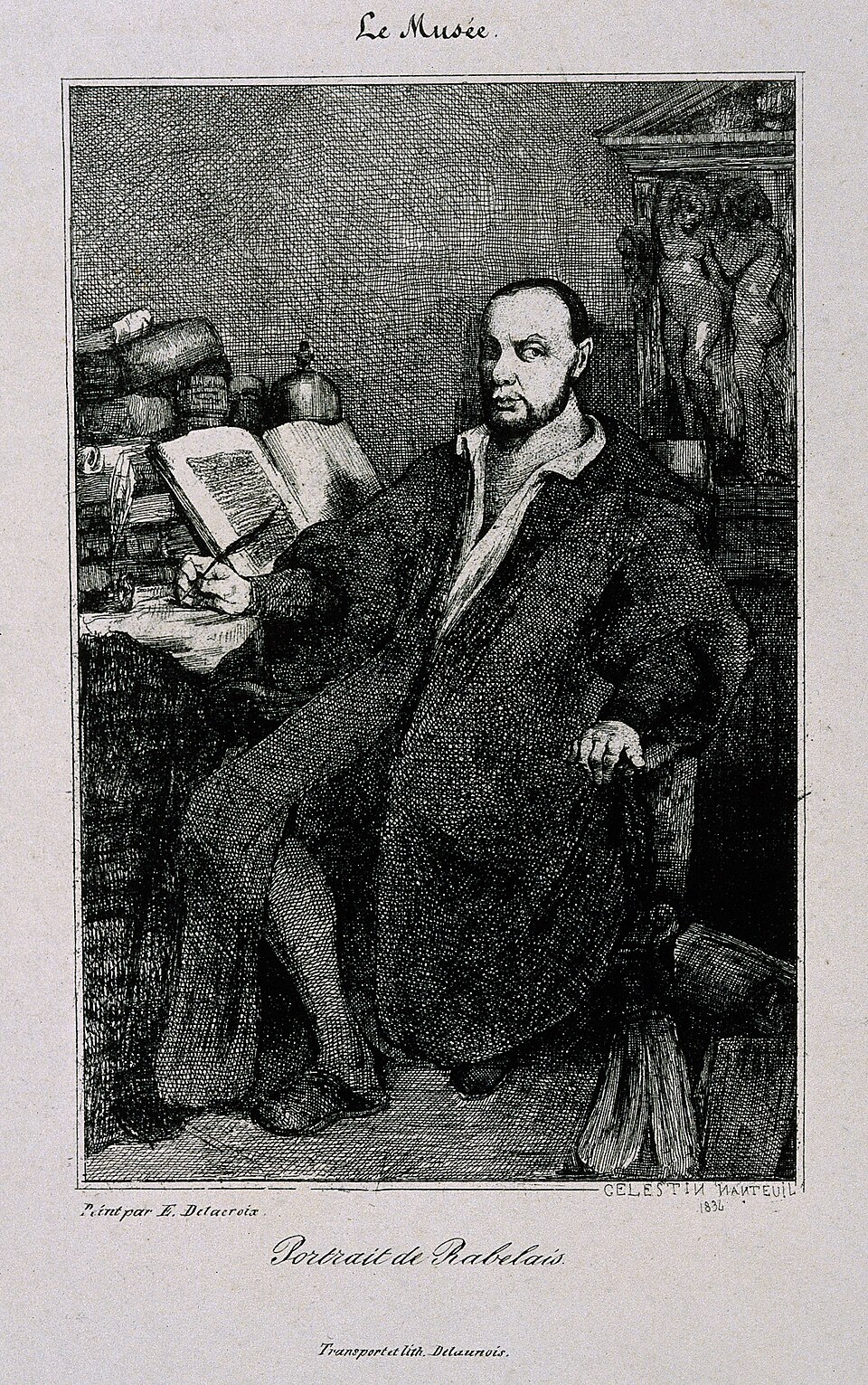
—Did your travels to Italy, with Cardinal du Bellay, bring you anything besides memories?
I went to Rome twice as the personal physician of Jean du Bellay, and there I even obtained my papal absolution, which is no small thing for a runaway monk. But do you think I only contemplated ancient ruins and gardens? I mostly laid in provisions as a gardener! I returned with my pockets full of seeds: romaine lettuce, melons, and those strange thistles called artichokes, then unknown on our French tables. A humanist, you see, does not bring back only manuscripts in his luggage; he brings back things to enrich the vegetable garden and the pot. Botany is the sister of medicine — every plant is a remedy that does not know itself. And I maintain that a good melon says as much about the generosity of nature as a fine verse of Virgil.
—You wrote in an age of pyres. How does one keep laughing when one's friends are burning?
Ah, that is the dark underside of my farce. In 1534, the Affair of the Placards unleashed repression: placards were posted even on the king's door, libels against the Mass, and France began to burn its sons. And in 1546, my friend the printer Étienne Dolet was hanged and then burned at Place Maubert, for heresy — a man of letters reduced to ashes with his books. How to still laugh? Because laughter is my way of not screaming. I firmly believe that 'laughter is the proper of man'; to take away my laughter is to take away my humanity. My comedy is not an escape: it is a dike against terror. One does not burn a man who makes you laugh — at least, I long hoped so.
Laughter is my way of not screaming.
—The Tiers Livre, you signed with your real name despite censorship. Why take that risk?
For the Tiers Livre, in 1546, I threw off the mask of Alcofribas: it bears 'François Rabelais, doctor of medicine.' What point in still dissembling, when one has the king's privilege in pocket and age at one's temples? The Sorbonne censored it all the same, as was fitting. And in the Quart Livre, six years later, I redoubled: that whole voyage to the Dive Bouteille is a long gallery of allegories against fanatics of every stripe, papimanes and antiphysiques. Signing with my name was to say: here I am, I hide no longer, burn me if you dare. The same month that Dolet went to the stake, I held my pen more firmly. A man who no longer writes except under a false name has already half capitulated.

This imaginary interview was generated by artificial intelligence from sources documented in François Rabelais's profile. It dramatises what the figure might have said based on what we know about them, but does not constitute attested historical testimony. For primary sources and factual documentation, refer to the full profile.