Imaginary interview with Galileo
by Charactorium · Galileo (1564 — 1642) · Sciences · 6 min read
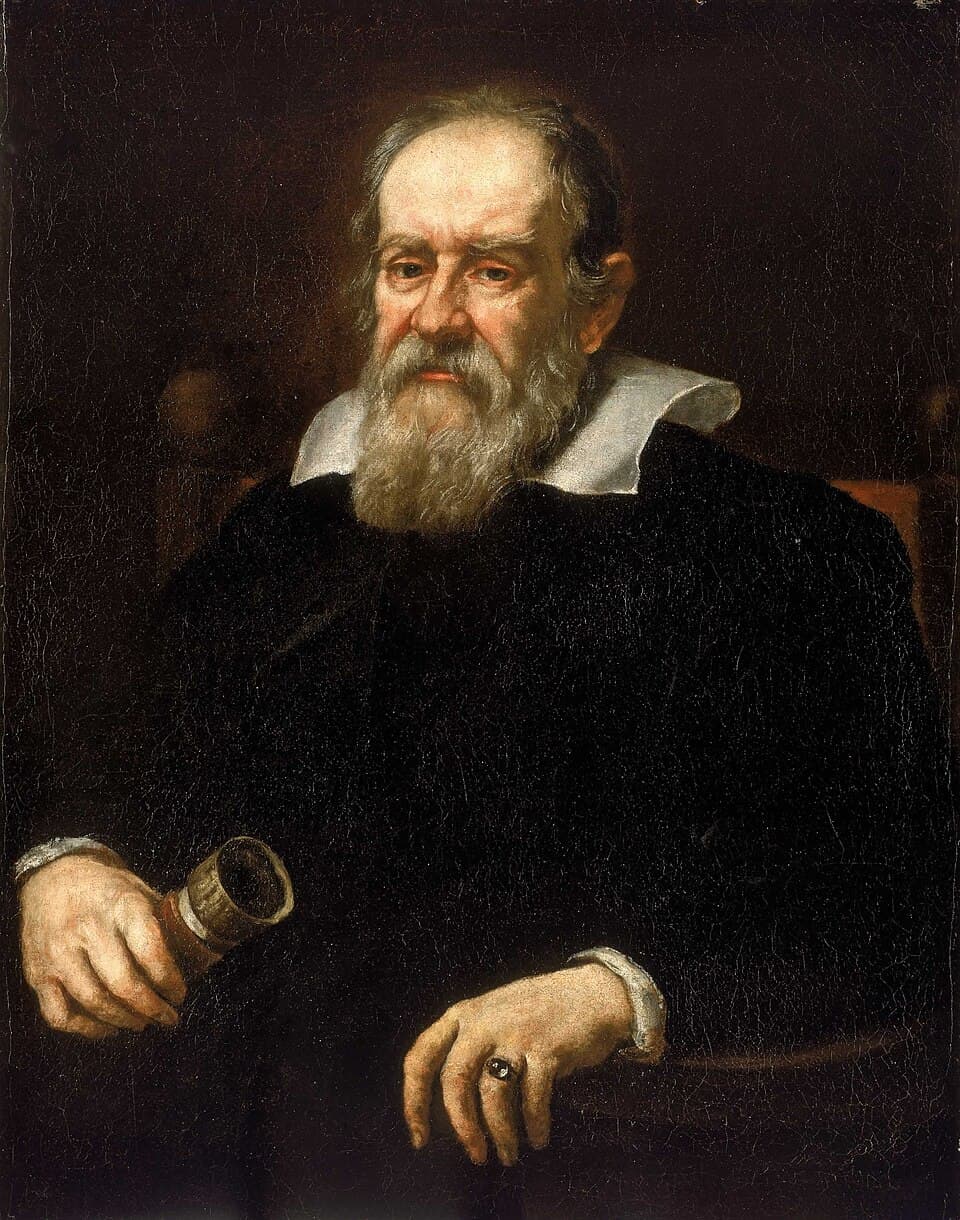
Hills of Florence, winter 1641. In the Villa Il Gioiello in Arcetri, a blind old man receives us by the hearth, a viola leaning against the wall. Beyond the window, olive trees slope down toward the convent where his daughter lived; he, ear attuned to our questions, agrees to retrace the thread of a life spent scanning the skies.
—How did that night when you pointed your instrument at Jupiter begin?
It was winter 1610, and I held in my hands a lead tube I had polished myself until it magnified nearly twenty times. The Dutch had turned it into a fairground toy; I made it a new eye. When I directed my cannocchiale at Jupiter, I saw three small lights aligned, then a fourth, which changed position night after night. Understand: no man before me had ever laid eyes on stars invisible to the naked eye. I realized they orbited the planet, like a court around its prince. I named them Medicean stars, in homage to my Florentine patrons — and, I confess, to secure their goodwill.
The Dutch had turned it into a fairground toy; I made it a new eye.
—What did the publication of Sidereus Nuncius that same year mean to you?
I wrote Sidereus Nuncius feverishly, in a few weeks, because a discovery delayed is a discovery stolen. I described the mountains and valleys of the Moon — imagine the audacity: the Moon was no longer that perfect, smooth sphere that Aristotle's followers had touted for centuries! I also showed that the Milky Way is nothing but a dust of countless stars. That little book earned me the chair of mathematician and philosopher to the Grand Duke of Tuscany, and allowed me to leave Padua. The sky ceased to be a painted backdrop: it became a territory to explore, spyglass in hand.
—Many imagine your experiments atop the Leaning Tower of Pisa. What is the truth?
People readily attribute to me that theatrical gesture of dropping two weights from the top of the tower of my hometown, Pisa. A fine story! The truth is humbler and more reliable: I rolled bronze balls along an inclined plane, over and over, to slow the fall and make it legible to the eye. A raw fall is too fast to measure; tilt the slope, and the motion can be tamed. With a clepsydra, I weighed the water that flowed to measure time, lacking a sufficiently precise clock. And I discovered that all bodies, whether heavy or light, descend at the same rate when air does not hinder them.
A raw fall is too fast to measure; tilt the slope, and the motion can be tamed.
—Why do you assert that mathematics is the key to understanding nature?
Because I understood, through constant observation, that the great book of nature is written in mathematical language, and its characters are triangles, circles, and geometric figures. I wrote it in black and white in Il Saggiatore, in 1623. Without these characters, one wanders vainly in a dark labyrinth. The philosophers of my time sought truth in old texts; I sought it in the movement of a ball and the curve of a projectile. It is this conviction I pursued to the end in my Discorsi, where I finally establish the laws of uniformly accelerated motion. Measuring, that is my prayer. The rest is mere schoolroom chatter.
The philosophers of my time sought truth in old texts; I, in the movement of a ball.
—How did you reconcile your discoveries with the Holy Scriptures?
I long pondered this quarrel, and I took up my pen in 1615 to address it to the Grand Duchess Christina of Lorraine. My position was simple, perhaps too simple: the intention of the Holy Spirit is to teach us how to go to heaven, not how heaven goes. The Bible speaks the language of the people; it says the Sun rises to be understood by all; it is not a treatise on astronomy. Two books come to us from God: Scripture and nature, and they cannot contradict each other. To decide a question about the movement of the stars with a verse is to confuse what wisdom should keep distinct.
Scripture teaches us how to go to heaven, not how heaven goes.
—Did the memory of Giordano Bruno's burning weigh on you?
How could I forget it? In 1600, in Rome, Bruno was given to the flames for his theses on the infinity of worlds. I then held the chair of mathematics at Padua, and the news swept across all Italy like a cold wind. Then came 1616: the Holy Office declared heliocentrism contrary to Scripture and placed Copernicus's work on the Index. I understood that day that one must advance masked, speak through hypotheses, never affirm where one could suggest. A scholar is not a martyr; my office was to look at the sky and describe it, not to end on a pyre. Prudence, alas, was my companion as much as the spyglass.
—Do you remember the moment you decided to write the Dialogue Concerning the Two Chief World Systems?
I thought I had found a clever ruse. Rather than assert, I would have three men converse — one for Ptolemy, one for Copernicus, one as arbiter — and let the reader judge. The Dialogo appeared in Florence in 1632, and I had put all my old polemicist's cunning into it, in Italian, so that I might be read in courts as in shops. But I was imprudent: the defender of geocentrism, poor Simplicio, seemed too foolish, and it was whispered that he bore the features of the pope himself. That book, my finest pleading, was also my intellectual death sentence. It was seen not as a dialogue, but as a provocation.
—What remains in you of the 1633 trial and that abjuration?
An old wound that does not heal. Before the tribunal of the Holy Office, on my knees, clad in the penitent's shirt, I had to abjure, curse, and detest the error I had defended all my life. At over seventy years old! They say that as I rose I murmured "Eppur si muove" — and yet it moves. I do not recall saying it, and no one heard it; but if the phrase was not on my lips, it was in my heart. My Dialogo was placed on the Index of forbidden books, where it still languishes. One can silence a man; one cannot make a planet retreat.
One can silence a man; one cannot make a planet retreat.
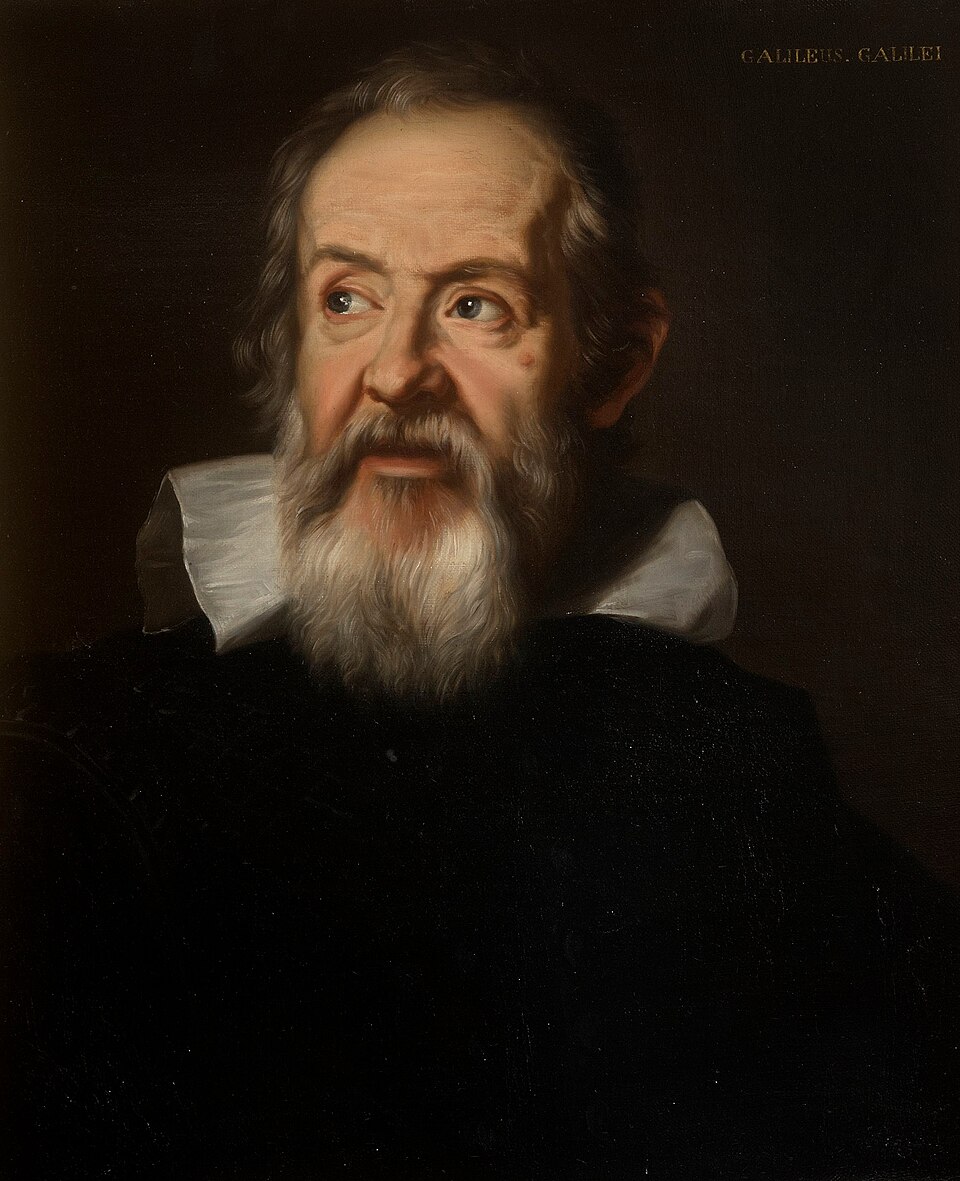
—How did you manage to publish your Discourses despite the censorship against you?
Under house arrest, my books banned in Catholic lands, I still had the cunning of the defeated. I smuggled the manuscript of the Discorsi e dimostrazioni out of Italy, and a printer in the Netherlands published it in 1638, far from the Inquisition's reach. It is in this work, not in my celestial quarrels, that I place my most lasting pride: I founded a new science of motion and the resistance of materials. The laws of fall, the curve of projectiles — all of mechanics is there in embryo. I was forbidden to speak of the heavens; so I spoke of the earth, of beams and balls, and no censor saw malice in it.
—How do you continue to work now that your sight has left you?
What cruel irony: these eyes that saw farther than any man before me were the first to go dark. The sky I unveiled is now an endless night for me. But I am not alone in this villa in Arcetri: my disciples serve as my eyes. Young Viviani transcribes my thoughts, and Torricelli, that keen mind, comes to discuss mechanics by the fire. I dictate, they write; I reason, they calculate. Dawn finds me dictating letters to scholars across Europe, for correspondence is my last thread to the world. The eye of the body has closed, but the eye of the mind has never seen so clearly.
These eyes that saw farther than any man before me were the first to go dark.
—Do you still play the lute, as your father taught you?
My fingers remember it better than my memory. My father, Vincenzo Galilei, was a renowned musician and theorist, and it was he who placed a lute in my hands even before mathematics. Without knowing it, he taught me everything: for what is a taut string, if not a number that sings? Length, tension, pitch — all is proportion and ratio. In the evening, at Arcetri, when the cold descends from the hills, I still take up the instrument and let my fingers find the intervals. Music taught me, long before the spyglass, that the harmony of the world can be counted. Perhaps that is my first and sweetest lesson.
This imaginary interview was generated by artificial intelligence from sources documented in Galileo's profile. It dramatises what the figure might have said based on what we know about them, but does not constitute attested historical testimony. For primary sources and factual documentation, refer to the full profile.