Kids interview Galileo
by Charactorium · Galileo (1564 — 1642) · Sciences · 5 min read
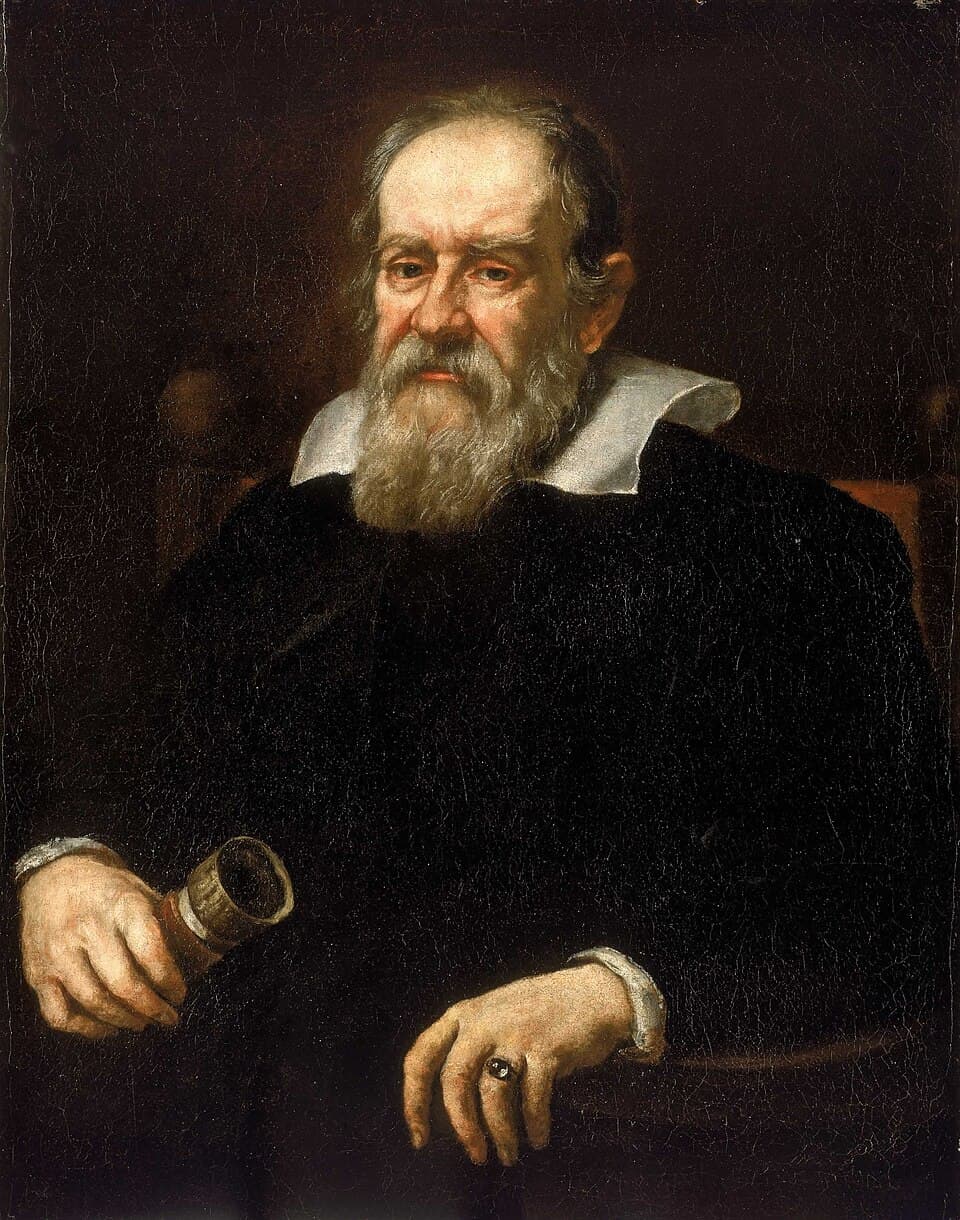
Two twelve-year-old visitors, on a school field trip, pushed open the door of an old Tuscan villa covered in vines. An almost blind old man was waiting for them, seated near a brass telescope. He smiled at them: "Come closer, I'll tell you about the heavens."
—What was it like the first time you looked at the sky through your telescope?
You know, my child, my heart beat very fast. In 1609, I took a lead tube and glass lenses, and I built a cannocchiale — that's the Italian word for a spyglass that brings distant things closer. Mine magnified twenty times. One night, I pointed it at Jupiter. And there, surprise: four tiny points of light shone beside it! Imagine seeing four little lamps attached to a star. They were moons, satellites orbiting Jupiter. No one had ever seen them. I thought I was dreaming; I watched them every night to be sure.
Four little lamps circled Jupiter, and no one had ever seen them.
—Why did you name Jupiter's moons after the Medici?
Ah, that was clever of me, I admit! The Medici were a very powerful family in Florence, rich princes who could protect and pay me. So I called my four moons the "Medicean stars," in their honor. It was like giving them a gift you can't buy anywhere: a piece of the sky. You see, in my time, a scholar had no fixed salary. You had to please a prince to work in peace. I wrote all this in my little book, the Sidereus Nuncius, in 1610. And it worked: I was appointed mathematician to the Grand Duke of Tuscany.
I gave them a gift you can't buy anywhere: a piece of the sky.
—Is it true you dropped balls from the Leaning Tower of Pisa?
Ha! That story is told, but between us, it's probably invented. I was born in Pisa, yes, and there's that famous leaning tower. But to understand how objects fall, I didn't need to climb so high. I did something smarter: I took an inclined board, an inclined plane, and rolled bronze balls down it very slowly. That way, I could measure time with a water clock, a clepsydra. And what did I discover? That a big ball and a small one fall at the same speed. The heavy one doesn't arrive before the light one. It seems crazy, but it's true.
The big ball and the small ball fall together: the heavy one does not arrive first.
—Why did you roll balls instead of just dropping them?
Good question, you have the eye of a true scientist! The problem, you see, is that a falling object moves much too fast. In a heartbeat, it's over, you see nothing. So I had an idea: slow down the fall. By rolling a ball down a gentle slope, the motion becomes slow, and I can watch it calmly. With my clepsydra, my water clock, I counted how much water flowed while the ball rolled. That's how I found the rules of motion. I wrote them down much later, in my Discorsi, in 1638. Patience and measurement: those were my real tools.
To understand nature, you must first slow down what goes too fast.
—Why did you say that nature speaks mathematics?
Because that's what I saw with my own eyes, my child! Look at a rolling ball, a planet turning: everything follows rules, numbers, shapes. I liked to say that the great book of nature is written in mathematical language. To read it, you must learn its letters: circles, triangles, curves. I explained this in a book from 1623, Il Saggiatore — The Assayer. And I wrote it in Italian, not in scholarly Latin! With my inkwell and quill pen, I wanted ordinary people to understand. A natural philosopher, that is, a scientist, must observe before believing.
The great book of nature is written in mathematical language.
—Didn't that cause problems with the Church, talking about science and the Bible?
Yes, and I walked on eggshells, believe me. Many thought science contradicted Scripture. So I wrote a letter to a great princess, Christina of Lorraine, in 1615. I said a simple thing: the Bible teaches us how to go to heaven, not how the heavens go. You see the difference? Religion speaks of our soul, how to live well. Science speaks of stars and stones. They are two different books, and they don't quarrel. But this idea upset people. Some preferred to believe I wanted to destroy faith. That was false.
The Bible tells us how to go to heaven, not how the heavens go.
—Were you afraid when they put you on trial?
Yes. I was almost seventy years old, old and tired. In 1633, I was taken to Rome, before the tribunal of the Inquisition, the Holy Office. My crime? Having published a book, the Dialogo, where I compared the two ways of seeing the world: Earth at the center, or the Sun at the center. I had shown that the Sun won out. That displeased them. Imagine yourself alone in a great stone hall, facing judges in dark robes, knowing that a man named Giordano Bruno had been burned for similar ideas. Fear, yes, I knew it. I had to keep silent to stay alive.
Alone in a stone hall, facing judges who could condemn me to the fire.
—Is it true you whispered “and yet it moves” after the trial?
Ah, that story! They say that after I abjured — abjuring means publicly denying what you believe — I muttered under my breath: Eppur si muove, “and yet it moves.” A beautiful phrase, isn't it? But I must be honest with you: no witness from my time wrote it down. It's probably a legend added later. Yet deep down, I truly believed it. The Earth turned before I was born and will turn after I die. I was forced to say the opposite, and my book was put on the Index, the list of forbidden books. But my mouth could lie; the heavens never lie.
My mouth could lie; the heavens never lie.
—What was your life like after the trial, in your house?
I was under house arrest, meaning I could no longer leave. I ended my days in a small villa on the hills of Florence, in Arcetri. A modest house, surrounded by vines and olive trees. In the morning, I rose early and dictated letters to scholars all over Europe, for I wrote a great deal. A little bread, cheese, fruit, and to work! Nearby lived my daughter, who had become a nun under the name Sister Maria Celeste. Knowing she was so close, in her convent, warmed my heart. I was a prisoner, yes, but never quite alone.
I was a prisoner on my hills, but never quite alone.
—How did it feel to go blind, you who loved looking at the stars so much?
It is the cruelest thing that happened to me, my child. Just think: I who had seen Jupiter's moons and the mountains of the Moon, those eyes went dark. The heavens I had opened to everyone, I no longer saw. But I didn't stop working! Faithful young men came to help me, Viviani and Torricelli. I dictated my ideas to them, they wrote them down. And in the evening, sometimes, I took up my lute — I had learned to play thanks to my father, a musician. Music replaced the stars. My hands saw what my eyes could no longer.
My eyes had gone dark, but my hands still saw.
This imaginary interview was generated by artificial intelligence from sources documented in Galileo's profile. It dramatises what the figure might have said based on what we know about them, but does not constitute attested historical testimony. For primary sources and factual documentation, refer to the full profile.