Imaginary interview with Georges Bizet
by Charactorium · Georges Bizet (1838 — 1875) · Music · 6 min read

Bougival, spring 1875. In the country house by the Seine, the composer receives visitors, looking tired but sharp-eyed, a few weeks after the stormy premiere of Carmen. An upright piano occupies the corner of the room, manuscript scores lie on the table, and the smell of cigar still hangs in the air.
—How does a child enter the Paris Conservatory at age nine?
My father taught singing, and he sensed something in me before I could even explain it. At nine years old, I was pushed through the doors of the Paris Conservatory, and I entered it as one enters a second home. I grew up under the watch of Halévy, Marmontel, Gounod — men who forgave neither laziness nor half-measures. They call me a child prodigy; I think I was above all a child who never knew any other language than that of notes. The piano was my playground while others ran in the yard. This precocity has a downside: you grow up fast, you doubt even faster, and you carry all your life the impatience of those who started too early.
I was a child who never knew any other language than that of notes.
—They say Liszt considered you one of the best pianists in Europe. Why did you give up the keyboard?
The keyboard never left me — see this upright piano where I spend my mornings, cigar in mouth, searching for chords that don't yet exist. It was rumored that after hearing me sight-read a score, Liszt ranked me among the three best pianists on the continent. Flattering, no doubt exaggerated. But virtuosity is a vanity that comes at a high price: you become a slave to halls, applause, the claque hired to carry you. I prefer to be the man who writes the music rather than the one who performs it to please. The concert pianist fades with the last chord; the composer, on the other hand, bets on a score that may outlive him. I chose the shadow of the study over the light of the stage.
Virtuosity is a vanity that comes at a high price.
—What did your stay at the Villa Medici, after winning the Prix de Rome, mean to you?
The Prix de Rome, won at eighteen, in 1857, opened the doors of the Villa Medici for three years. I wrote to my mother then that Rome is wonderful, that I worked a lot and was happy — and it was true, a happiness I had not known in Paris. Italy gave me ideas that France would never have inspired in me: the light on the stones, the grain of voices in the streets, a certain way of singing that cannot be commanded. There I learned that the orchestra could breathe like a living body, that a melody did not need to be learned to be right. When I returned, I was no longer the same musician. Rome had loosened something in me.
Italy gave me ideas that France would never have inspired in me.
—Did your early operas, like Les Pêcheurs de perles, already bear this Italian imprint?
Les Pêcheurs de perles, premiered at the Opéra-Comique in 1863, were born of that return. I had wanted a dreamlike Orient, Ceylon as a backdrop, and at the heart of the work that duet, Au fond du temple saint, where two men remember together. The reviews were tepid, the audience polite but no more. But I already heard the color that Rome had whispered to me: a romanza that unfolds without shame, a vocal line that dares sweetness. Later, La Jolie Fille de Perth, after Walter Scott, allowed me to strengthen the hand that was still learning to conduct a drama. One does not become a theatre musician overnight; one gropes from opera to opera, fails, starts over, and one evening the orchestra finally obeys.
—How would you describe your way of composing, day after day?
I say it bluntly: I am a man of the theatre; I cannot make music without having before me a drama, passions, living characters. My mornings are spent here, at the upright piano, orchestrating note by note, cigar after cigar, in a smoke that eventually clouds the windows. The manuscript score lengthens under my pen, each part annotated, each entry weighed — orchestration is an ant's work that no one sees. In the afternoon, I rush to rehearsals, or give lessons to wealthy students to make ends meet, because music poorly feeds its man. In the evening, the Opéra-Comique, to study what others do. Composing is not an inspiration that falls: it is a craftsman's trade, with its rejects and erasures.
Composing is not an inspiration that falls: it is a craftsman's trade.
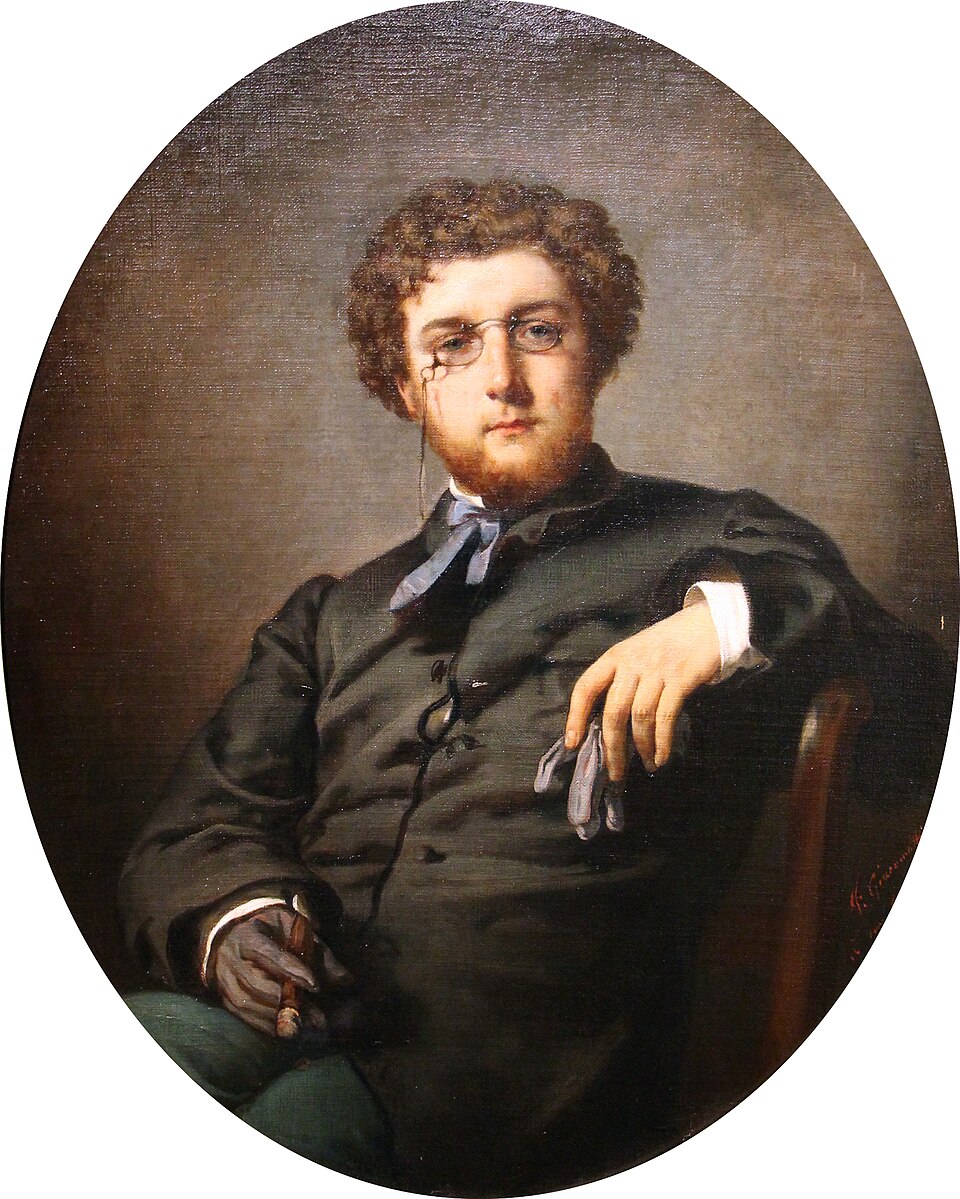
—You seem to flee abstract music. Is drama indispensable to you?
Without drama, I dry up. Give me an empty orchestral score and a pure idea, I'll go in circles; give me a woman defying her fate, a smuggler, a soldier who loses himself, and the music comes on its own. That's why I orchestrated five pieces from Jeux d'enfants, or composed the incidental music for L'Arlésienne for Daudet's play in 1872: I need a body, a situation, passions to clothe with sound. My Symphony in C, written at seventeen as an exercise, sleeps in a drawer — music without characters does not resemble me. I can only paint beings who suffer, love, lie. The ear alone bores me; it is the heart I want to seize, even if by jolting it.
—You lived through the collapse of the Second Empire. How did that era affect your work?
In 1870, when war fell upon us and Paris found itself besieged, I did not play the composer above the fray: I enlisted in the National Guard. One composes poorly on an empty stomach, under shellfire. Then came the Commune, and the Third Republic proclaimed on still-smoldering ruins. I had married the year before Geneviève Halévy, the daughter of my old master, and I had to build a man's life in the midst of a France that no longer knew who it was. Those years of turmoil hardened my music, I believe. One does not emerge unscathed from a siege; something of the real, of blood, of fear, entered my scores and never left.
One does not emerge unscathed from a siege; something of the blood entered my scores.
—Let's return to Carmen. Why did you choose such a scandalous heroine for the Opéra-Comique?
Because real life is scandalous, and it mocks our drawing-room decencies. Carmen is a worker in a cigar factory, free, insolent, who chooses death over submission — and I placed her on March 3, 1875 on the stage of the Opéra-Comique, that theatre accustomed to very proper engagements. The libretto by Meilhac and Halévy, based on Mérimée's novella, shrank from nothing: smuggling, jealousy, a murder in full light. I felt the audience freeze that evening. They called it an immoral work, they reproached me for disdaining the public. But I did not write to reassure; I wrote so that one might hear a heart of flesh beat, even if it be that of a woman deemed lost.
I did not write to reassure; I wrote so that one might hear a heart of flesh beat.
—Auguste Vitu's review in Le Figaro was scathing. How did you receive that verdict?
The day after the premiere, Vitu wrote in Le Figaro that I belonged to the school of the chiseled, the convoluted, that I had the cult of the ear and the disdain of the heart. The disdain of the heart! To me, who have never composed but for it. One always reproaches novelties for being what they are not. I know these Parisian halls, their habits, their claque ready to hiss at what disturbs — I spent my evenings there, at the Opéra as at the Opéra-Comique, watching works die that time resurrects. That review hurt me, I admit, more than I show. But the orchestration of Carmen, its frankness, its realism, I claim them. If today's audience rejects them, I will bet on tomorrow's.
—Imagine you are still read a century from now. What fate would you wish for Carmen?
That's a cruel game you propose. If I could believe that Carmen would still be performed when I am gone, I would die less anxious. I have been told that Tchaikovsky considers it a masterpiece, that it might become the most performed opera in the world — but these are a convalescent's dreams, and I know too well how premieres fail to trust them. I now live here, in Bougival, by the Seine, tired from a battle the hall did not spare me. If a single measure of mine survives, let it say this: that a man tried to put the raw truth of life into the orchestra pit, without asking forgiveness. The rest belongs to a future I will not see.
If a single measure of mine survives, let it say that a man put the raw truth of life into the orchestra pit.
This imaginary interview was generated by artificial intelligence from sources documented in Georges Bizet's profile. It dramatises what the figure might have said based on what we know about them, but does not constitute attested historical testimony. For primary sources and factual documentation, refer to the full profile.