Imaginary interview with Georgia O'Keeffe
by Charactorium · Georgia O'Keeffe (1887 — 1986) · Visual Arts · 5 min read
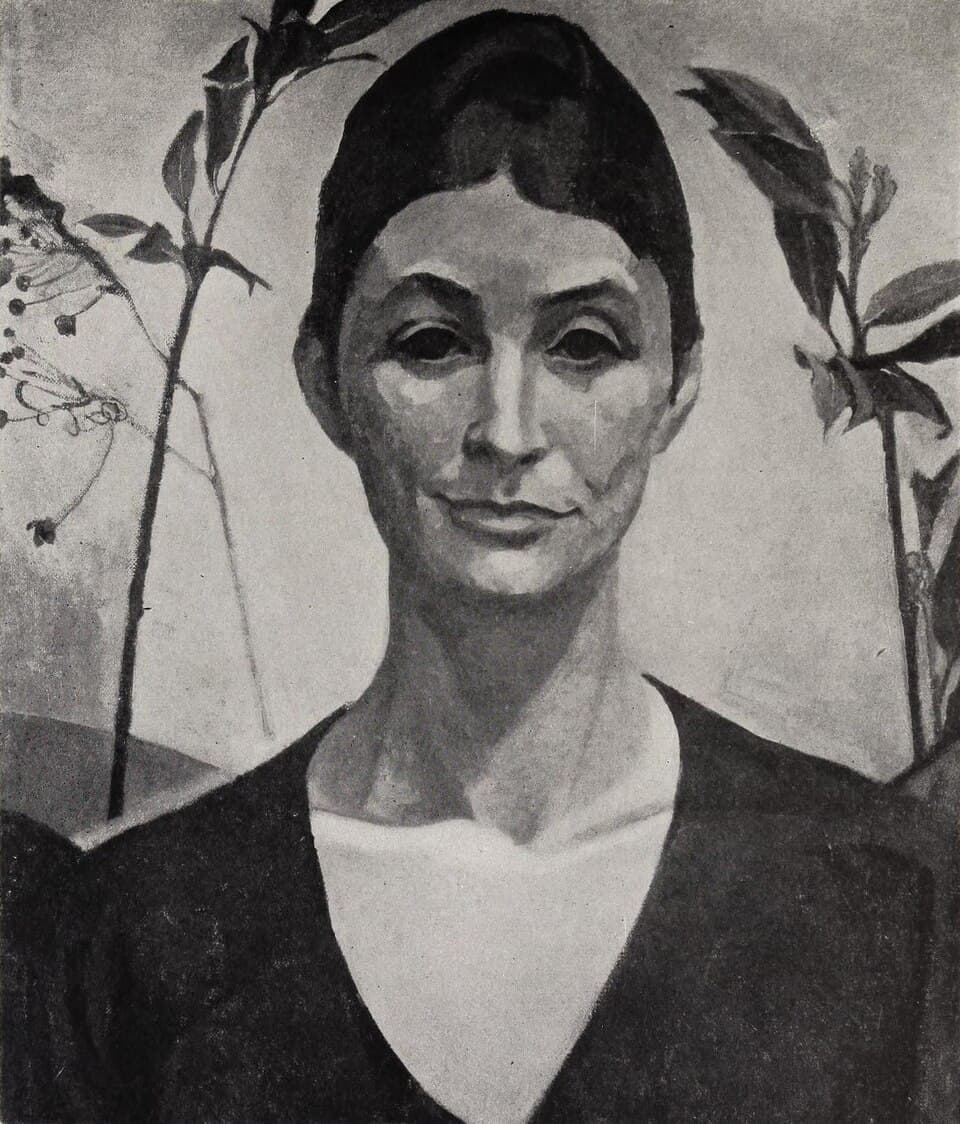
June 1977. The adobe house in Abiquiú smells of sun-baked earth; on a windowsill framing the desert like a picture, white bones and stones are arranged like sculptures. Georgia O'Keeffe, ninety years old, her gaze still sharp under a severe haircut, agrees to look back on seven decades of painting.
—Why did you choose to paint flowers on such an enormous scale?
Because no one looks at a flower. You pick it, put it in a vase, forget it. So I decided to paint it large enough that you can't walk past without stopping — an iris as tall as a man, a petal that becomes an entire landscape. My Black Iris from 1926, now at the Metropolitan Museum, is not a flower: it's a constraint placed on the viewer's eye, the obligation to truly see. I worked with very fine brushes, sable hair, to blend one color into another without ever revealing the boundary. It was a matter of patience more than inspiration. An enlarged flower is simply the time I give you to look at it.
An enlarged flower is simply the time I give you to look at it.
—Many have interpreted these flowers as female bodies. What do you say to such readings?
People project onto my canvas what they already have in their heads, and then they attribute the intention to me. I've heard countless scholarly speeches about my white datura, my Jimson Weed, about what secret and feminine thing it might hide. I hid nothing. I looked at a flower growing near my door, from above, and I painted exactly what my eyes saw, enlarged. If I had wanted to say those things, I would have said them — but there it is: "I found I could say things with color and shapes that I couldn't say any other way — things I had no words for." What I paint has no translation. That's why I never allowed words to be put in place of my forms.
People project onto my canvas what they already have in their heads, and then they attribute the intention to me.
—Do you remember the moment the New Mexico desert entered your life?
1929. I arrived with my photographer friend, stepped off the train, and it was a slap of light. A raking light that sculpted every hill, ochre lands as far as the eye could see, a silence like I had never known in New York or on Lake George. I wrote then a very simple, almost childish sentence: "The desert is the most wonderful thing I have ever seen. I want to paint it — I must paint it." That must was not a whim; it was a physical necessity. I returned every summer for years, before realizing I could never live anywhere else. The rest of my career was played out there, in that first breath of dry air.
A slap of light, and I knew I could never live anywhere else.
—How would you describe the special bond that ties you to Ghost Ranch and Abiquiú?
It's not a bond; it's a belonging. "When I got to New Mexico that was mine," I said one day — as soon as I saw it, it was my country, even though I had never seen anything like it. The cliffs of Ghost Ranch, Cerro Pedernal in the distance, that flat mountain I painted hundreds of times, joking that eventually God would give it to me. In Red Hills and Bones, from 1941, I placed the red hills of Abiquiú against bleached bones: my whole desert in a single painting, stone and death reconciled in beauty. My painting has never been anything other than the expression of the relationship between me and this place where I live.
As soon as I saw it, it was my country — even though I had never seen anything like it.
—What drove you to collect and paint skulls and bones found in the desert?
My morning walks. I would get up before dawn, go out when the light was still lying on the ground, and bring back what the desert offered me: a stone, a dried flower, a bleached bison skull years in the sun. People found it morbid. To me, these bones were more alive, more intensely present, than the animals running around me. They are hard, they have a perfect form, and they outlast everything. I painted them floating in a blue sky, as if death could levitate, light. In the desert, a skull is not an end — it's what remains when everything superfluous has been blown away by the wind.
These bones were more alive, more intensely present, than the animals running around me.
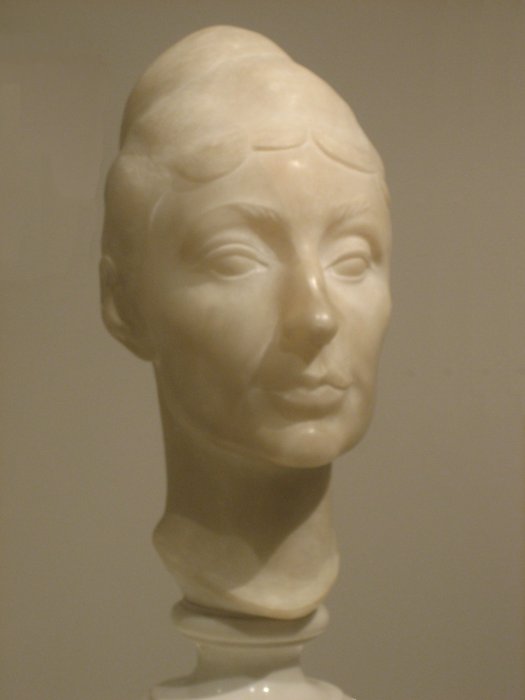
—In 1931, you placed a skull against a background in the colors of the American flag. What were you trying to say?
In New York, I was constantly told that real American painters had to go to Europe to find their subject, or line up skyscrapers like in my Radiator Building. I thought it was ridiculous. The America I knew, the real one, was dry bone, burnt earth, the immense space of the West. So in Cow's Skull: Red, White, and Blue, I planted a cow skull in the center, straight as a totem, between two blue bands and a bold red. It was a serious joke: here is your "great American novel", here is your national identity, dry and magnificent. The painting is now at the Metropolitan, and I think few people grasped how serious I was while laughing.
Here is your national identity: a dry and magnificent bone.
—How did your early works end up exhibited at Gallery 291?
Without my permission! In 1916, I had sent some charcoal drawings to a friend, very intimate abstractions, almost confidences. She took them to Alfred Stieglitz, who ran the famous 291 gallery on Fifth Avenue, the only place in America where you could then see Picasso, Matisse, Cézanne. He hung them without warning me. I arrived furious, ready to demand they be taken down — and he stood his ground. That's how the most decisive thing in my artistic life began: my encounter with the man who would believe in me before anyone else, and who would exhibit me the following year for the first time under my own name alone.
He hung my drawings without warning me; I arrived furious, ready to take everything down.
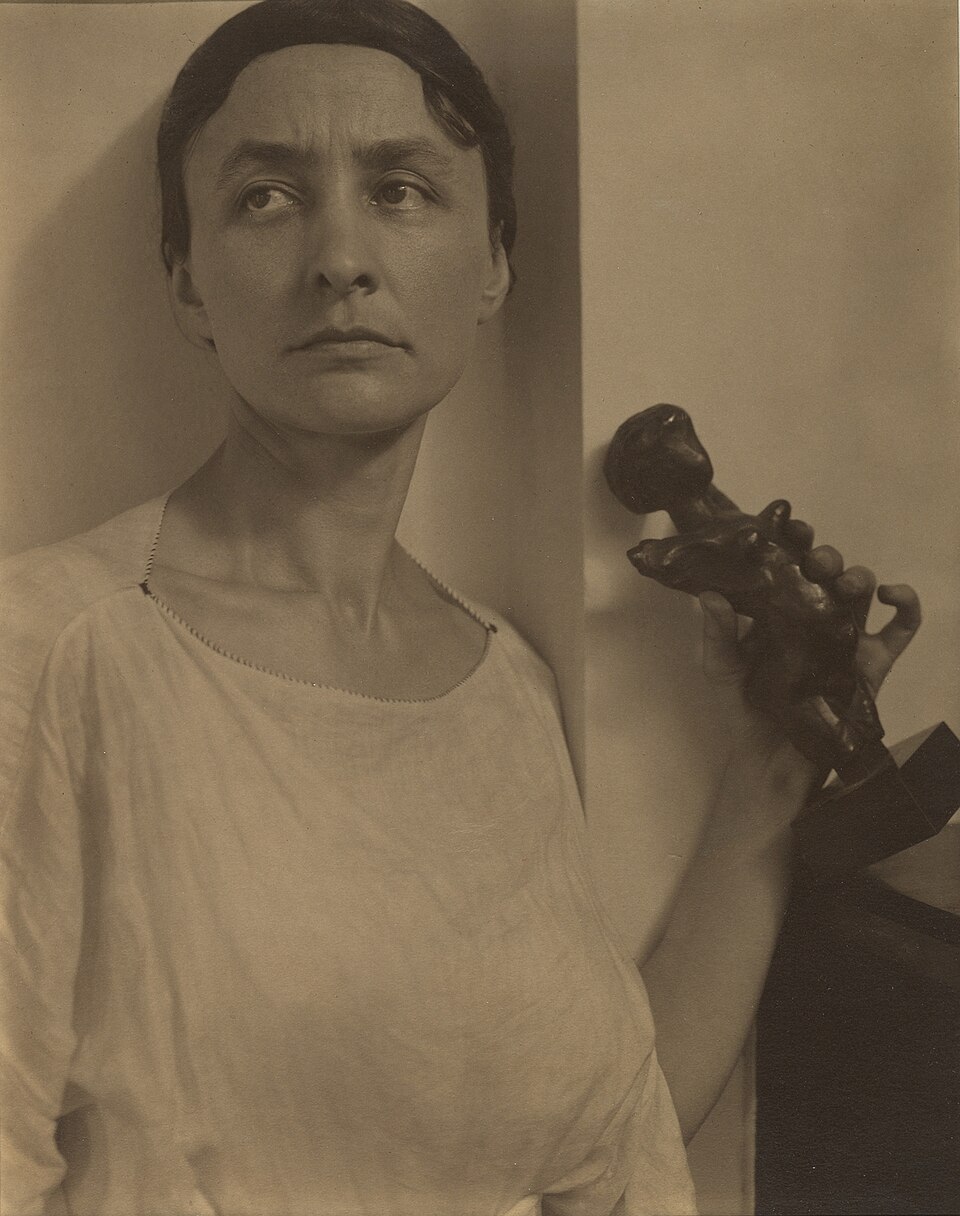
—What does it mean to you to have been, for years, Stieglitz's photographic model?
Between 1917 and 1937, Alfred made over three hundred portraits of me — my hands, my face, my body, at every age. No artist, I think, has ever been looked at so long by another. It was exhilarating and exhausting. Because at the same time I was his wife — we married in 1924 —, his model, and a painter who had her own path to carve amid his circle of friends, Marsden Hartley, Arthur Dove, all those brilliant men who gravitated around him. During the summers at Lake George, in his family's house, I sometimes suffocated under so many gazes and conversations. I had to go West to become simply myself again, a painter and nothing else.
No artist has ever been looked at so long by another. It was exhilarating and exhausting.
—Very early on, you asserted a distinctly feminine voice in art. Where did that conviction come from?
From very far back, and very young. As early as 1915, still a student, I wrote to a friend: "I feel there is something unexplored about woman that only a woman can explore. Men have done all they can do about it." I absolutely believed it. Men had painted woman as seen by them; there remained an entire continent that only a woman could reach, because she lives it from the inside. I did not want to paint "like a woman" in the way it was understood — pretty, decorative, minor. I wanted to paint what no one had yet dared to look at. All my life I wore black dresses, no jewelry, no frills: the essential, nothing but the essential. My art had to reflect that austerity.
There remained an entire continent that only a woman could reach, because she lives it from the inside.
—Now that you are receiving the highest honors, how do you view your place apart from the major movements of your time?
This very year, President Carter awarded me the Presidential Medal of Freedom. At my age, I am treated as a monument. But I have never marched to anyone's beat. When all of New York was ablaze with Abstract Expressionism, with the grand furious gestures of those gentlemen throwing paint, I was already far away, in my desert, slowly painting a red hill. I was called old-fashioned, then a pioneer; both words are indifferent to me. I painted what I loved, on a land I loved, and all my work is nothing but the expression of that bond. That young women painters today see it as encouragement — that is the only medal that truly touches me.
I was called old-fashioned, then a pioneer; both words are indifferent to me.
This imaginary interview was generated by artificial intelligence from sources documented in Georgia O'Keeffe's profile. It dramatises what the figure might have said based on what we know about them, but does not constitute attested historical testimony. For primary sources and factual documentation, refer to the full profile.