Imaginary dialogue between Alfred Stieglitz and Georgia O'Keeffe
by Charactorium · Georgia O'Keeffe (1887 — 1986) · Visual Arts · 6 min read
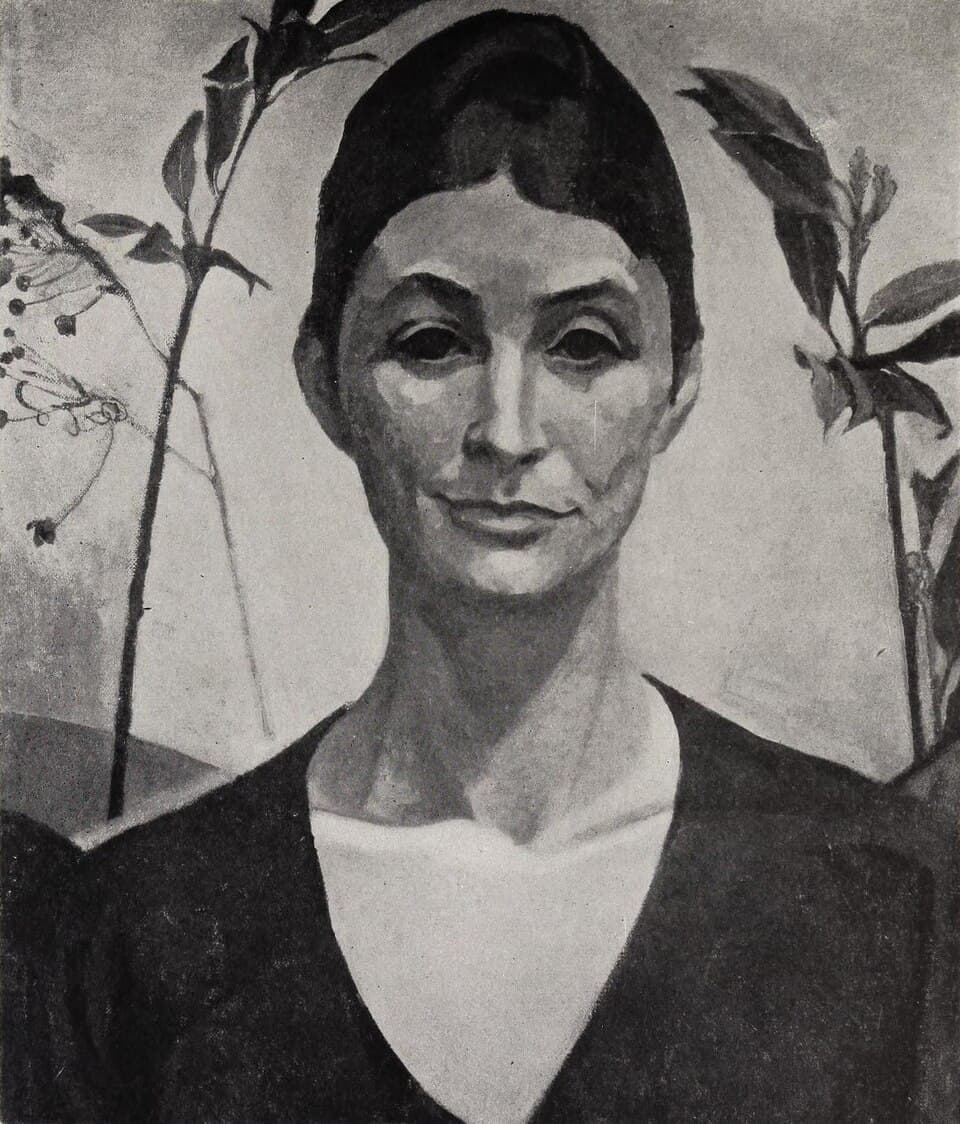
It is at Lake George, in the Stieglitz family home, that this interview takes place in the autumn of 1940. Golden light falls on the lake, and photographic prints are still drying on a wooden table. Married since 1924, Alfred and Georgia have known each other for more than twenty years—but she is already preparing to leave again for New Mexico, where she has just bought a house at Ghost Ranch. He, his eye fixed on the woman he has photographed hundreds of times, comes to find what the lens never managed to capture.
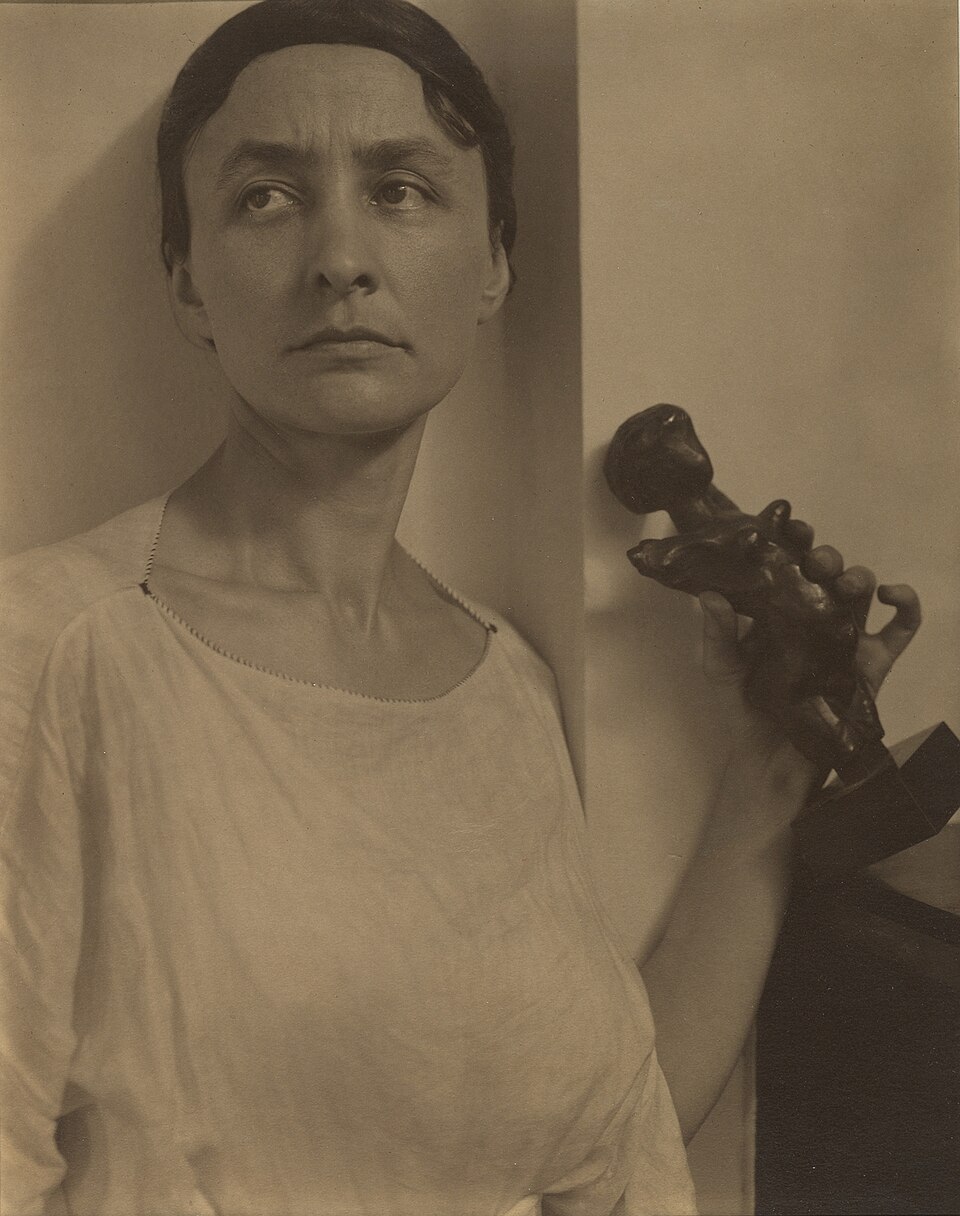
—Georgia, I have photographed you more than three hundred times since 1917. Tell me: what did you feel, all those hours, under my lens?
You who held that camera for so many years, Alfred, you know I was not always willing. At first, posing for you made me feel like I existed twice—in your darkroom and in my own work. You framed my hands, my neck, my face the way I frame a flower: by getting so close that only the essential remains. I learned that from you, I think. My little Brownie, I took it to look at the world the way you looked at me—by tightening, isolating, forgetting the rest. But there were days when I had enough of being your subject. I wanted to be the one who looks, not the one who is exhibited.
—When you started those enormous flowers, around 1924, many laughed. Why on earth paint them so big, Georgia?
Because no one takes the time to look at a flower, Alfred. It is small, people think they know it, they pass by. So I decided to paint it so big that one could no longer ignore it—an iris as tall as a door, a poppy filling the whole canvas. New York is immense, its skyscrapers crush everything; I thought that if I painted a flower the size of a building, then busy people would stop, surprised, and finally truly see it. It is a kind of trick, if you will. I give the humblest thing the dimension of a landscape, to force the eye to linger where it used to glide without seeing.
I paint the flower so large that one can no longer ignore it.
—Critics keep seeing symbols in them, allusions to the female body. Does that make you angry?
It exasperates me, yes. Those gentlemen—and they are almost always gentlemen—look at my black iris and project their own thoughts onto it, then they write that it was I who put them there. I have never painted a flower to talk about anything other than the flower. When I look very closely at a petal, its curve, the shadow in the hollow, it is that shape that interests me, not a story to be told in drawing rooms. You know that, you who have seen me work: I do not put literature into my painting. People have written things about my work that have nothing to do with me. I paint what I see, and what I see is enough.
—As early as 1915, you wrote to your friend Anita that there is in woman a territory that only a woman can explore. Do you still believe that?
I wrote it, and I do not deny it. I feel there is something unexplored about woman that only a woman can explore—it seemed to me, at twenty-seven, that men had said all they could say, and that there remained a part of experience they would never touch. But understand me well, Alfred: I do not want to be shut up in the "women painters" section. When I am called that, I hear a diminishment, as if I were playing in a separate category. I am a painter, that is all. I want my canvas to be judged as any man's canvas hanging next to it would be—without indulgence and without condescension.
—In 1929, you left for New Mexico with Rebecca Strand, and you wrote me a letter I have not forgotten. Do you remember it?
How could I forget? I wrote you that the desert was the most beautiful thing I had ever seen—I must paint it, I told you, I must paint it. It was stronger than me, Alfred. The light falls horizontally there, skims the red earth, and the hills seem to have been shaped the day before. I found bleached bones there, skulls cleaned by the sun, and their beauty seized me as no still life in New York ever had. I know that letter hurt you, because it announced that I would no longer stay by your side all year. But I could not lie: there, I could breathe.
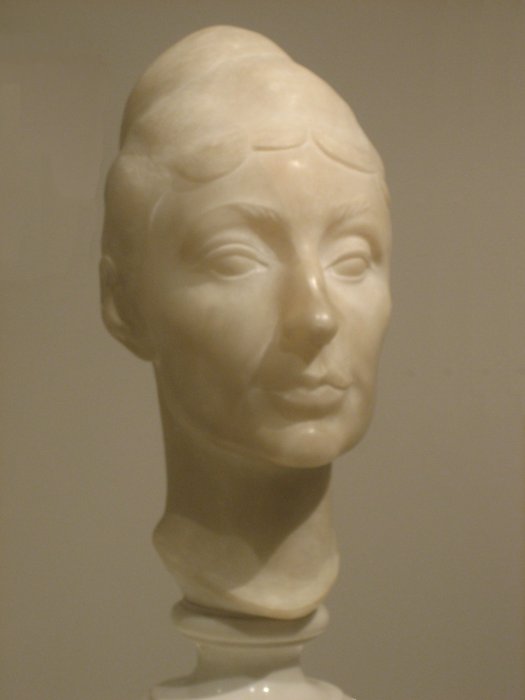
—You now call that dry country "yours." What did it have that New York, where I gave you everything, did not?
You gave me New York, it is true, and the gallery, and the exhibitions—I do not forget that, Alfred. But New York was your country, made of your friends, your battles, your own light. New Mexico, no one gave it to me: I recognized it, as one recognizes a face one has always known. There, the space is so vast that it gives me back to myself. I can drive my Ford for hours on the trails without meeting a soul, stop at the foot of a cliff, and set up my easel in the silence. In New York I painted despite the city; in the desert, I paint with it. That is the difference between a house lent to you and a land that was waiting for you.
In New York I painted despite the city; in the desert, I paint with it.
—Describe your days there to me, Georgia. How does one live, alone, in that desert you speak of with such fervor?
I get up before dawn, Alfred, so as not to miss the moment when the light brushes the cliffs—you would understand that, you who watch for the same hour with your camera. I walk a long time, I pick up a bone, a stone, a dried flower, and I bring them back as others bring back trophies. In the afternoon, I paint, sometimes for hours on a single petal, spreading the color in gradations that the eye must not catch. I eat what my vegetable garden grows—vegetables, herbs; I have hardly touched meat for many years. And in the evening, I read, often those Eastern wisdoms that speak of emptiness. Emptiness, you see, is never nothing: it is what makes a canvas breathe.
—I am told your house is bare as a monk's cell—mud walls, almost nothing on the walls. Why this austerity?
Because I need nothing else. My house is made of adobe, of raw earth dried in the sun, with thick walls and windows that cut the desert into so many already-framed paintings. Inside, I keep only the essential: a bone placed there, a stone, a spiral of dead wood—arranged like sculptures. You know the way I dress, Alfred: black, white, gray, no frills. It is the same for my house and for my painting. Everything superfluous bothers me, clutters my eye and mind. When one removes the excess, what remains finally becomes visible. I have spent my life removing, subtracting, until only the right form remains.
—Remember: in 1916, I exhibited your drawings at 291 without warning you. You were furious. Do you still hold it against me?
Furious, I was, and you knew it when you hung my charcoals without saying a word! I stormed into the gallery to demand that you take them down—that is how we truly met, do you remember, in an argument. You refused; you said those drawings had to be seen. In hindsight, I know what I owe you: 291 was the only place in America where modern art was taken seriously, where Picasso and Cézanne rubbed shoulders with our own research. Without that gallery, without you who believed in what no one yet understood, would I have become a painter? Perhaps. But surely not so quickly, nor in this way. I resented you, and I am grateful to you—both at once.
I resented you, and I am grateful to you—both at once.
—They make you a symbol—of American art, of the free woman. Do you recognize yourself in that image, Georgia?
Symbols are yet another story others tell in my place. I have been called the mother of some modernism or other, they want to make me a flag. But I never got up in the morning thinking I represent America or women. I get up to paint what is in front of me: a flower, a skull, a red hill. If that speaks of independence, it is because I have earned the right to live where I want and paint as I want—without asking permission, not even yours, Alfred. Let people draw whatever lessons they will from my work; I see only one thing: the relationship between me and this place I love. The rest belongs to those who look.
This imaginary interview was generated by artificial intelligence from sources documented in Georgia O'Keeffe's profile. It dramatises what the figure might have said based on what we know about them, but does not constitute attested historical testimony. For primary sources and factual documentation, refer to the full profile.