Imaginary interview with Golda Meir
by Charactorium · Golda Meir (1898 — 1978) · Politics · 6 min read
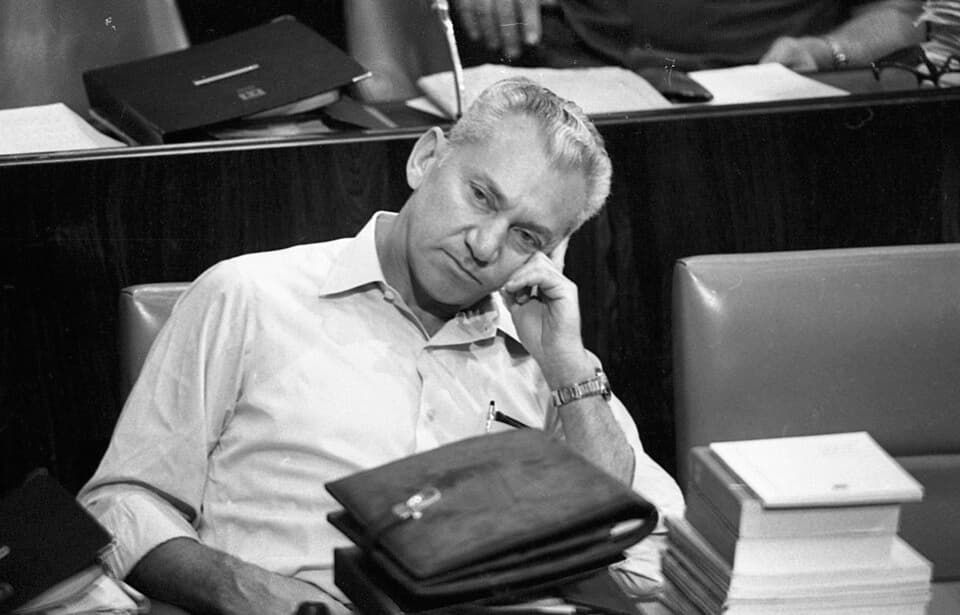
Jerusalem, late winter 1974. In a modest kitchen where the coffee pot never cools, a seventy-five-year-old woman, black handbag set beside her chair, lights a cigarette and sits down. Golda Meir has just left power; she agrees to look back, in a low voice, on the path that took her from Kiev to the Knesset.
—What is your earliest childhood memory, back there in Ukraine?
My father nailing planks across the door. That's the image that stays with me from Kiev. I was maybe four years old, and there were whispers that a pogrom was coming, that men would come to smash the windows and worse. I didn't understand the words, but I understood the fear in my father's back, nailing wood as if wood could stop hatred. You grow up fast when you learn, very young, that you can be killed for what you are, not for what you've done. Later, when people asked why I believed so fiercely that we needed a land of our own, I never needed long theories. I just had to remember those planks.
My father nailed wood as if wood could stop hatred.
—How did that little girl from Kiev become an activist on the other side of the ocean?
At age eight, I was shipped off to America, to Milwaukee. My sister and I sold ice cream to scrape together money for our schoolbooks. America gave me school, the freedom to speak loud in a crowded room — and I learned to speak loud. I became a teacher, and then I could think of only one thing: Palestine. My comrades thought it romantic, a girl from Wisconsin dreaming of a desert. But Zionism was not a dream for me; it was an answer. The answer to the planks nailed across the door. In 1921, I made my aliyah, and I left for good to live at the Merhavia kibbutz, because you don't defend an idea from a comfortable armchair.
—In early 1948, you were sent to the United States with an almost impossible mission. Tell us about it.
We had almost nothing: no money, not enough rifles, and the Arab armies were about to fall on us as soon as we declared independence. Our treasurer said we might scrape together five million dollars. I left for America without even a proper winter coat, and I spoke, city after city, before Jewish communities. I didn't promise them victory — I told them we would fight anyway, and they had the choice to arm the living or mourn the dead. I came back with fifty million dollars. Ben-Gurion once told me that when the history of the state was written, they would say that a woman had found the money that made it possible. I never stopped being proud of that.
They had the choice to arm the living or mourn the dead.
—A few days before independence, you attempted a secret and perilous mission. Why take such a risk?
Because before signing for war, I wanted to have tried everything for peace. In May 1948, I wrapped myself in Arab women's clothes and crossed secretly to Amman to meet King Abdullah of Jordan. I asked him not to join the attack. He replied, courteously, that he was no longer the sole decision-maker, that he was caught in a current too strong. I came back empty-handed, and on May 14, I signed the Declaration of Independence in that hall in Tel Aviv. I wept as I wrote my name — with joy for the state being born, and already with grief for the boys that signature would send to die.
Before signing for war, I wanted to have tried everything for peace.
—You were nicknamed "the grandmother of Israel." What did you do in that famous kitchen?
I did what I do best: coffee, cakes, and politics. I was appointed Prime Minister in 1969, at age seventy-one, and I had no intention of becoming solemn for that. My ministers would come in the evening to sit at my kitchen table, I served the coffee myself, I cut the strudel, and it was there, between cups, that decisions were sometimes made that official councils didn't dare to settle. People laughed at my "kitchen cabinet." But I tell you: a man who has drunk your coffee and eaten your cake lies with more difficulty. The table taught me more about my ministers than all the reports in the world.
A man who has drunk your coffee lies with more difficulty.
—Wasn't that deliberate simplicity also a way of governing?
Of course. I come from the kibbutz, from Merhavia, where we share soup and sweat. I never believed you govern better by surrounding yourself with gilding. I got up at five-thirty, read the security reports with my first cigarette between my lips, and in the evening I received people in my kitchen rather than in a formal salon. Some saw it as an old lady's coquetry. It was the opposite: it was a pioneer's conviction. A leader who forgets the smell of the earth and the price of a loaf of bread ends up deciding for a people they no longer know. I wanted to remain a woman you could talk to across a tablecloth, not a statue behind a desk.
—Your photographs almost always show you with the same black handbag and a cigarette. What do these objects say about you?
That I was never taken for a fashionista, and that suited me fine. My black handbag, I set it down everywhere, at the podium and at the negotiating table, like a housewife back from the market — and in a way, that's what I was. My dark suits, my strict bun, my flat shoes: no frills, no jewelry. As for the cigarette, I had it on my lips even in full council, and the doctors already scolded me. Western female leaders tended to their attire; I had neither the time nor the taste for that. I was judged on my decisions, not my hairstyle, and that was exactly the deal I wanted.
I set my bag down everywhere, like a housewife back from the market.
—October 1973. You are woken in the middle of the night. What goes through your mind at that moment?
It's two in the morning, on Yom Kippur, the great fast. I am warned that Egypt and Syria are about to attack within hours. My generals urge me to strike first, as in 1967. And I refuse. I refuse because I know that an Israel that fires the first shot loses something more precious than a battle: it loses the world, it loses America, it loses the right to say it was attacked. That night, I chose to absorb the first blow so as not to lose the second battle, the battle for hearts and minds. No decision ever cost me so much. It saved our credit with the nations — and it haunted me for the blood it may have let flow.
I chose to absorb the first blow so as not to lose the battle for hearts and minds.
—After that war, how did you bear the responsibility for what happened?
Like a weight that never left me. Before the Agranat Commission, I did not try to hide behind my generals: a prime minister's responsibility cannot be delegated. I spent my nights bent over the front maps, following positions name by name, knowing that behind every arrow on the paper there were twenty-year-old boys. We eventually repelled the enemy, but the price was terrible, and the country did not forgive me. In 1974, I resigned. Not because I was forced to entirely, but because I felt I no longer had the strength to carry both the families' grief and the burden of the state.
—You have often been criticized for your hardness toward Arabs. How do you receive that criticism?
I am not hard, I am clear-sighted, and clarity sometimes passes for hardness among those who would have me dream. I once said to journalist Oriana Fallaci a phrase that was much criticized: "We can forgive the Arabs for killing us. But we cannot forgive them for forcing us to kill their children. Peace will come when the Arabs love their children more than they hate us." Some saw arrogance. I put into it all the grief of a woman who has buried too many sons, her own and those on the other side. I never hated an Arab mother weeping for her child. I only refused to be forced to make her weep.
Peace will come when the Arabs love their children more than they hate us.
—Now retired, what would you say to those who will one day read your story?
I have just finished my book, My Life, where I wanted to tell everything, from the child of Kiev to the old woman of Jerusalem. If I am read in a century, I hope they will not look for a saint or a statue. That they will see an ordinary woman, daughter of immigrants, who sold ice cream in Milwaukee and ended up signing the birth of a state. I had no particular genius — I had obstinacy, and the conviction, born before my father's nailed door, that a people without a land is a people at everyone's mercy. If they remember one thing about me, let it be this: you do not survive by waiting for others' pity.
You do not survive by waiting for others' pity.
This imaginary interview was generated by artificial intelligence from sources documented in Golda Meir's profile. It dramatises what the figure might have said based on what we know about them, but does not constitute attested historical testimony. For primary sources and factual documentation, refer to the full profile.