Imaginary dialogue between Carl von Nägeli and Gregor Mendel
by Charactorium · Gregor Mendel (1822 — 1884) · Sciences · 5 min read
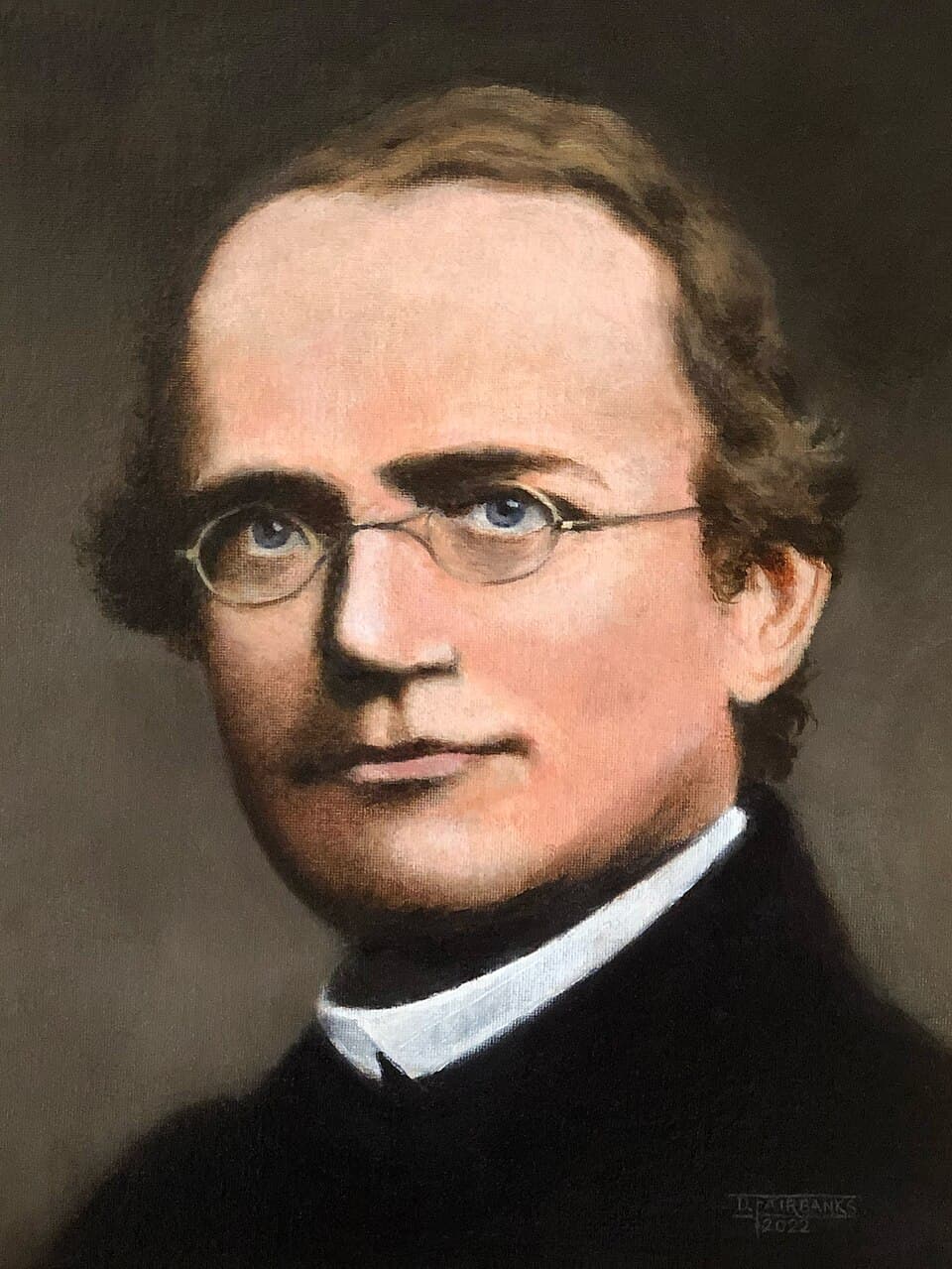
It is in the garden of St. Thomas's Abbey in Brno, on an afternoon in the summer of 1873, that Carl von Nägeli finally visits the man whose letters he has been commenting on for seven years. Between the rows of climbing peas, the smell of turned earth mingles with the buzzing of the hives the abbot has installed near the wall. The two botanists have known each other by correspondence since 1866, without ever having met; Nägeli, skeptical but curious, comes to see with his own eyes this garden from which Mendel claims to have drawn laws. The abbot, burdened by years and administrative worries, welcomes him with the caution of a man who has learned not to be believed.
—My dear abbot, here you are in this famous garden. How many seasons have you spent on your knees between these rows of peas?
Eight full years, my dear Nägeli, from 1856 to 1863. You who cultivate your hawkweeds know what patience costs, but imagine: nearly twenty-nine thousand plants of Pisum sativum, sown, labeled, counted one by one. Every morning, before the heat rose, I recorded the condition of the plants and noted everything in my notebooks. I did not trust the impression of the eye — I counted the seeds, tens of thousands, by hand. It is from this tedious accounting that the regularity emerged: three dominant traits to one recessive, always. Numbers do not lie when you collect them with enough obstinacy.
I did not trust the impression of the eye — I counted the seeds, tens of thousands, by hand.
—You wrote to me that you fertilized each flower yourself. How does one man control the purity of so many crosses?
With a fine brush and much scruple, Nägeli. I opened the flower before maturity, removed the stamens to prevent any self-fertilization, then carried the chosen pollen myself onto the stigma. Everything first rested on the pure varieties — those lines that the Germans call Stamm — which I had tested for several years until they produced only their like. Without this initial purity, no ratio would have appeared, and one would have seen only confusion. The pea is a docile subject: its seven characters are clear-cut, without half-tone. That is why I preferred it to any other plant. You, with your Hieracium, have chosen the most recalcitrant subject that nature could oppose you.
Without this initial purity, no ratio would have appeared, and one would have seen only confusion.
—Let us speak frankly between us. When you read your results before the Brno Society in 1865, what did you read on the faces of the audience?
Nothing, Nägeli. Nothing at all. I spoke in two sessions, I showed my tables, my segregation ratios, and when I fell silent, there was not a single question. Not an objection, not even a misunderstanding I could have corrected — the silence of polite men waiting for the end. My learned neighbors knew my peas as a hobby of a gardening abbot, not as a matter of science. I understood that day that numbers move no one if they have not first touched the imagination. My paper appeared the following year in our Proceedings; it still sleeps there. I do not complain: I knew as I stepped up to the podium that what I brought resembled nothing of what was expected.
The silence of polite men waiting for the end.
—In your letters, you defended your numbers with an assurance that I admit I have not always shared. Where does this certainty come from, despite the indifference?
From the fact that the numbers repeated themselves, year after year, without ever betraying me. You have more than once opposed your doubts to me, Nägeli, and I have been grateful for it — a contradictor is worth more than a mute audience. But I wrote to you as I think: it is only a matter of time before this is recognized as work of considerable importance. I do not say this out of pride. I say it because the law I saw is not mine; it was in the pea before me, and it will be there after me. They may ignore me, but they will not erase the ratio of three to one. Time, which has so failed me, will eventually prove me right.
The law I saw is not mine; it was in the pea before me, and it will be there after me.
—Everyone is reading this book by Darwin on the origin of species. He too seeks the laws of heredity. Do you feel close to this Englishman?
Close in the question, distant in method. I have read Darwin with admiration: he has set before all of Europe the enigma of the transmission of traits, without being able to answer it. He accumulates observations like an ocean accumulates drops; I wanted to count the drops one by one. Where he sees a continuous, elusive variation, I found clear units, which separate and recombine according to fixed ratios. We work, he and I, on the two sides of the same coin, and yet we have never spoken to each other. Perhaps my little Moravian pamphlet will never cross the Channel. But I have the feeling, Nägeli, that what he seeks in the vastness of the living, I have held, modestly, between two pea pods.
What he seeks in the vastness of the living, I have held, modestly, between two pea pods.
—Do you believe that your segregation ratios could one day illuminate the great theory of descent, or is that a gardener's dream?
I believe that one cannot stand without the other, but I will not have the presumption to assert it too loudly. Darwin explains how species transform; he lacks knowing how a trait passes whole from parent to child without being diluted. Yet this is precisely what my peas show: the recessive trait disappears in the first generation, then reappears intact in the second, as if it had traveled hidden. This, the idea of a blending of bloods cannot explain. I do not know if these two edifices, his and mine, will ever be brought together. I am only a man from a Moravian monastery, without a chair or a school. But nature does not distinguish the illustrious scientist from the obscure monk — it obeys the same laws for both.
The recessive trait disappears, then reappears intact in the second generation, as if it had traveled hidden.
—You have been abbot for five years now. Seeing you among these registers and accounts, I ask you bluntly: have you abandoned science?
Let us say that science has left me as much as I have left it, Nägeli. Since my election as head of St. Thomas's in 1868, my days belong to administration, to the affairs of the community, and above all to that endless war I wage against the tax authorities, who want to tax our religious houses. You do not know what it is to trade a notebook of botanical counts for a register of dues. I hate this paperwork as much as I loved my peas. The garden is still there, under my windows, but I no longer have the time or the freedom to kneel there for whole seasons. An abbot is not a free man — he is the steward of all others.
You do not know what it is to trade a notebook of counts for a register of dues.
—I have heard that you wanted to resume your experiments on bees. What came of it, you who so loved the clarity of peas?
A fine disappointment, I admit. I installed hives at the far end of the garden, hoping to find in the bee the clear ratios that peas had given me. But the bee is a sneaky beast for the naturalist: its queen mates in midair, beyond all control, and one never knows which male fertilized which brood. Where my brush governed every pea cross, I had no hold. My registers filled with lawless numbers. I had to give up. It is the humility of the researcher, Nägeli: nature allows itself to be questioned only in subjects it deigns to make docile. The pea had spoiled me; the bee reminded me of my place.
Nature allows itself to be questioned only in subjects it deigns to make docile.
—Before I leave you, tell me: if no one reads you in your lifetime, what good was it to count so much, to note so much, to wait so long?
Because truth does not need to be read to be true, my friend. I failed twice the exam that was to make me a professor of natural sciences — in botany and zoology, precisely. I was judged unfit to teach what I was about to discover. I learned that day not to measure my work by the esteem of examiners. My notebooks exist; my ratios are correct; they will await the reader they need, even if from another century. You are perhaps, Nägeli, the only scholar in Europe who has truly read me, and for that I will always keep gratitude, even when you contradict me. The rest belongs to time. And time, you see, is the only judge that does not mistake the generation.
Truth does not need to be read to be true.
This imaginary interview was generated by artificial intelligence from sources documented in Gregor Mendel's profile. It dramatises what the figure might have said based on what we know about them, but does not constitute attested historical testimony. For primary sources and factual documentation, refer to the full profile.