Imaginary dialogue between Walter Fürst and William Tell
by Charactorium · William Tell · Mythology · 5 min read
It is on the Rütli meadow, on the shores of Lake Lucerne, that one misty evening Walter Fürst meets William Tell, his son-in-law. The water laps against the pebbles, a crossbow rests against a stump, and the scent of resin descends from the forests of Uri. The two men have sworn an oath side by side against the bailiffs of the Habsburgs; Walter has come to listen to the man he saw tremble at Altdorf, where no one else would have dared to bend his bow.
—William, my son, I was in the square at Altdorf that day. Why did you refuse to salute that hat planted on the pole?
You were there, Walter, so you know what I saw: a felt bonnet placed on a pike, and the order to bow before it as before the duke himself. A hat! Saluting emptiness, that's what Gessler demanded to better bend our backs. I walk through the square as a free man walks: head held high, my child by the hand. Kneeling before that rag would have been kneeling for the whole country of Uri. The bailiff wanted a sign of submission; he got a man who looks straight ahead. I did not think of the punishment, I swear to you. I only thought that bending there, that day, was bending forever.
Saluting emptiness, that's what Gessler demanded to better bend our backs.
—Then came the ordeal. The bailiff placed the apple on your boy's head. You, who handle the bow better than anyone, what did you feel as you aimed?
I no longer felt the cold, Walter, nor the crowd, nor even Gessler sneering. The world had shrunk to three things: the apple, my arrow, and my son's forehead beneath it. I drew a first arrow from my quiver, and slipped a second into my shirt — that one, you know who I was keeping it for. My hands, which had never trembled while hunting chamois, wanted to tremble. I forbade them. Then I released the string, and the apple split in two while the child remained standing, alive. People cried out around me. As for me, I heard only my own breath, finally returning.
The world had shrunk to three things: the apple, my arrow, and my son's forehead.
—That second arrow you hid in your tunic, I saw it too. Who was it meant for? Tell me frankly at last.
You saw it, and you kept silent, as a friend. So I tell you plainly: if my first arrow had touched the child, the second would have found Gessler's heart, and too bad for my life. When he asked me why I was hiding that second shaft, I did not lie — a man who has just risked his son has no reason left to lie. It was this frankness that drove him mad with rage, for he realized that fear no longer held me. One arrow to obey, one arrow to avenge myself: that is what he had made of me, that bailiff, by playing with a child. He awakened a man he would have done better to let sleep.
One arrow to obey, one arrow to avenge myself: that is what he had made of me.
—They bound you and threw you into the boat on the lake. How did you escape Gessler on those tumultuous waters?
The storm rose on Lake Lucerne as if the sky itself was taking sides. The bailiff's oarsmen, terrified, could no longer hold the boat; and Gessler, that braggart, had my hands untied, for no one else knew the currents well enough to save us. Behold the proud man forced to entrust his life to his prisoner! I steered the boat against a slab of rock, seized my crossbow, and leaped onto the flat stone, pushing the vessel away with a kick of my heel into the waves. Then I ran through the heights, along paths that only a man from Uri knows. The lake that was to drown me had set me free.
Behold the proud man forced to entrust his life to his prisoner.
—And the bailiff? They whisper in the cantons that you waited for him on the pass. Tell me what happened there.
I got ahead of him on the sunken path he had to take to regain his castle, where the road narrows between the rocks. I did not strike a man in his sleep, Walter: I waited for the one who had held my family at gunpoint, who oppressed our valleys and laughed at our oaths. When he appeared, my arrow flew — the same skill that had saved my son struck down his executioner. Some will say it is murder. I say it is the end of a tyrant, and there was no other court to judge him than that of the mountains. That day, fear changed sides throughout the land of Uri.
The same skill that had saved my son struck down his executioner.
—Do you remember the night we gathered right here, on this Rütli, men of Uri, Schwyz, and Unterwald?
How could I forget it, you who took my hand in yours under the stars? We came in secret, by boats and by trails, so as not to wake the bailiff's spies. Three valleys, three peoples, but one heart that night. We swore to help each other like brothers, to no longer suffer foreign judges on our lands, and to keep this oath down to our sons. It was not a revolt of a single man, Walter — it was a Confederation being born in the morning dew. I, the archer of Uri, was only one voice among yours. But what a voice, when a thousand mouths say together: never again.
Three valleys, three peoples, but one heart that night.
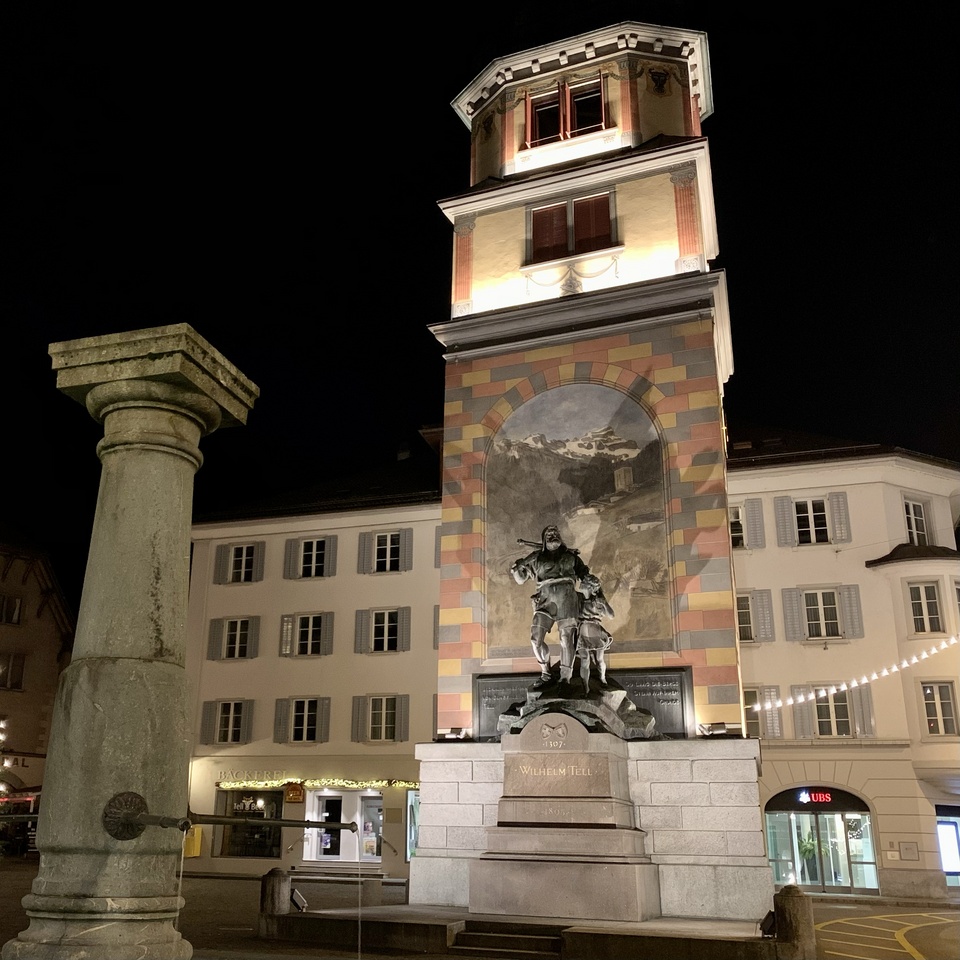
—Why did a simple man like you, a hunter from Bürglen, join our oath against so great a house as the Habsburgs?
Because a simple man is precisely the one who has everything to lose, Walter. The Habsburgs are a great house, you say? I have only a wooden house in Bürglen, a wife, children, and a bit of common pasture. But that little house, I want it free. The bailiff wanted to treat us as serfs, levy his dues, plant his hats and his bailiffs everywhere we go. A distant lord may well possess crowns; he will not possess the breath of a mountaineer from Uri. I joined your oath because the freedom of one man is worth nothing if the neighbor's is in chains. We stand together, or we fall one after another.
The freedom of one man is worth nothing if the neighbor's is in chains.
—The bards already sing of your shot and your arrow. Does it trouble you, my son, to see yourself becoming a story told by the fireside?
You ask a strange question, Walter. I do not know what they will say of me when our bones are dust. Perhaps they will forget me; perhaps they will magnify my bow into a giant's weapon. What I fear is not being told — it is that they will tell the apple shot so well that they forget the oath of the Rütli. I am only an arrow; the true bow is the alliance of the cantons. If the storytellers keep only the archer and lose the freedom he defended, then my legend will be a beautiful lie. Keep the full memory for them, you who know. Let them remember the apple, yes, but let them never forget why I shot.
I am only an arrow; the true bow is the alliance of the cantons.
—One last thing, William. If only one word of yours were to be remembered for the children yet unborn, which would you leave?
One word? You ask much of a man who speaks little. I would tell them: stand tall. Before the bailiff's hat, before fear, before anyone who wants to make you bend for the mere pleasure of seeing you stooped — stand tall. I was not braver than another, Walter; I only refused to kneel once, and then again, until the whole country rose with me. Freedom is not a gift from lords; it is something you keep every morning, like sharpening a blade. Tell them that the archer of Uri had nothing extraordinary about him, except that he preferred to die standing than to live on his knees.
Stand tall — before the bailiff's hat, before fear, before anyone who wants to see you stooped.
Read further
This imaginary interview was generated by artificial intelligence from sources documented in William Tell's profile. It dramatises what the figure might have said based on what we know about them, but does not constitute attested historical testimony. For primary sources and factual documentation, refer to the full profile.