Imaginary interview with Gustave Courbet
by Charactorium · Gustave Courbet (1819 — 1877) · Visual Arts · 6 min read
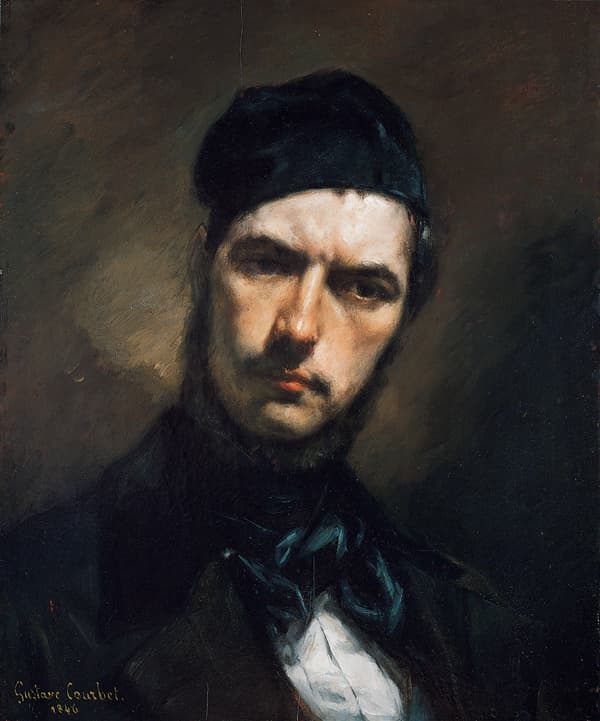
Autumn 1876. On the shores of Lake Geneva, in the small town of La Tour-de-Peilz where exile has relegated him, a massive man with graying beard receives between two still-wet canvases. Ruined, condemned, but with a still-vivid eye and thundering voice, Gustave Courbet agrees to look back on a life spent painting the truth against the entire French Academy.
—Where do you come from, and what have you kept of that land in your painting?
I was born in Ornans, in the Doubs, in 1819, son of landowners who smelled of vine and honest earth. They call me rough, and I am: I have kept in my wrist the strength of men who walk in the mud of the Jura and hunt deer in the forests above the Loue. In Paris, they took my manners for coarseness; I saw in them a fidelity to what I was. When I wrote to my parents after the Salon, I told them: “In civilized society, I must lead the life of a savage; I must free myself even from governments.” It was not a salon pose. My sympathy went to the people, and I wanted to address them directly.
In Paris, they took my manners for coarseness; I saw in them a fidelity.
—What happened at the 1850 Salon, when you exhibited your large canvas from Ornans?
Imagine a canvas over six meters wide, A Burial at Ornans, where I painted neither god, nor hero, nor battle — only the people of my village gathered around a grave: the priest, the mayor, the mourners, the kneeling gravedigger. The critics were stunned. Granting peasants the format reserved for kings and saints was, for them, an insolence, almost a blasphemy. I saw only a truth: those faces were worth those of painted battles. The Salon then held a painter’s career in its hands, and its jury decided who had the right to exist. I understood that day in 1850 that my painting would be a struggle, and that scandal would be my ally rather than my enemy.
—Why did you paint two men breaking stones by the roadside?
One day, on a road near Ornans, I came across two wretches breaking stones — an old man whose hammer fell back without strength, and a boy whose shirt hung in tatters. I made The Stone Breakers from it. No lesson, no discourse: only the fatigue of a bent back and the gray dust on broken clogs. They reproached me for painting ugliness; I answered that I painted what I saw, no more, no less. That canvas left France for a museum in Dresden, and God knows when I will see it again. But I had put into it all that I believe about painting — that it must look the poor man in the face, without beautifying him or pitying him, simply show him as he toils under the sun.
—In 1855, you set up your own pavilion facing the Universal Exhibition. What drove you to do that?
The jury of the Universal Exhibition of 1855 had refused my largest canvases, including The Painter’s Studio, that real allegory where I painted myself in the center, brush in hand, surrounded by all the figures that peopled my era. Rather than bend, I had built at my own expense, right next to the official exhibition, a shack I named the Pavilion of Realism. Forty paintings, a manifesto nailed at the entrance, and the public paying their penny to come in to me. It was a magnificent effrontery. In my text, I wrote: “The title of realist has been imposed on me as the title of romantic was imposed on the men of 1830.” I had not chosen that word, but since they threw it at me, I made it my banner.
I had not chosen that word, but since they threw it at me, I made it my banner.
—What did you reproach in the art taught by the Academy?
Academism trained you to paint goddesses no one has ever seen, theatrical Romans, angels with flesh as smooth as marble — a whole polished lie called the ideal beautiful. You learned to copy the antique before having looked at a single living face. I held that a painter must paint only what exists, what he can touch and see with his own eyes. I told students who begged me to open a studio: art cannot be taught; it is entirely individual; for each it is only the talent drawn from his own inspiration. A master only produces pupils who ape him. Nature, however, never lies, and it is the only academy before which I consent to set up my easel.
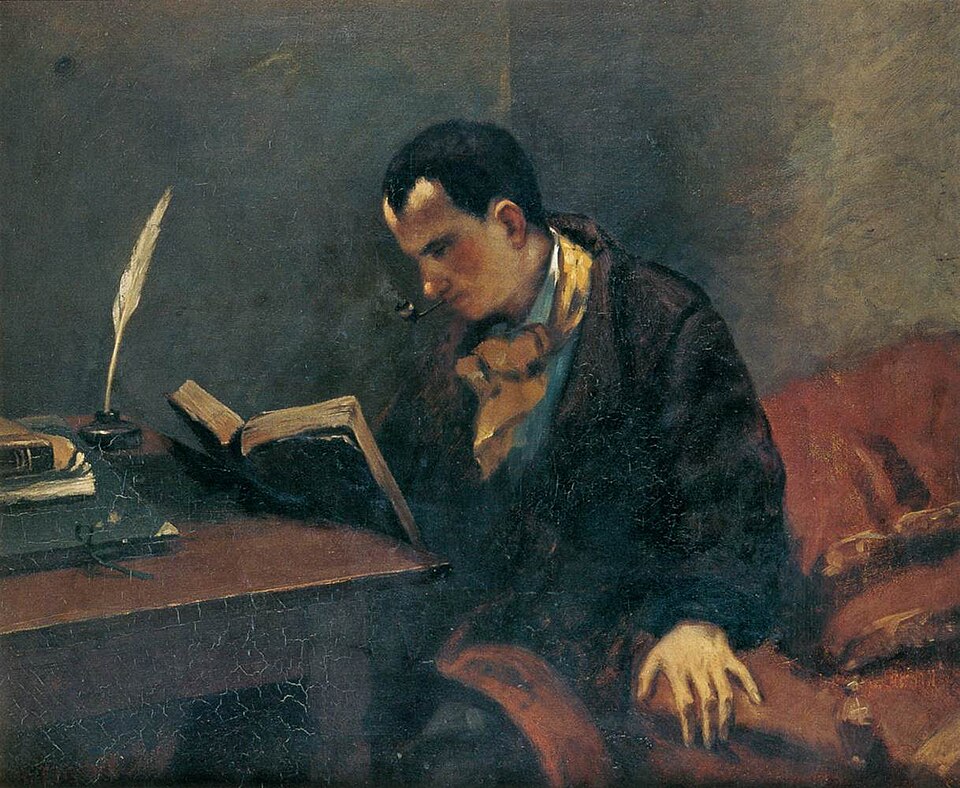
—How did you work the very matter of paint?
I loved nothing so much as the palette knife. The brush caresses; the knife, on the other hand, grips. I spread the paste in thick layers, scraped it, reloaded it — that is what they call impasto — until the cliff became stone and the wave truly weighed its weight of water. Touch one of my canvases: it has relief, ridges, hollows, almost a geography under the finger. They said I painted like a mason mixing his mortar; I took it as a compliment. Color is not a dye politely applied; it is a material you build. Before The Wave, people step back as if the foam were going to splash them — and that is precisely the effect I sought with strokes of the blade.
The brush caresses; the knife, on the other hand, grips.
—You painted the sea a lot in Normandy. What were you looking for there?
On the coasts of Normandy, at Étretat, I took my field easel and sat facing the open sea, sometimes after a storm, when the sky tears open and the light suddenly falls on the dripping cliffs. It is there, en plein air, before the motif, that one learns the truth of a landscape — never in the tepid gloom of a studio. The Cliff at Étretat after the Storm was born on one of those days when the sea had just calmed down and still smoked with its anger. I painted quickly, with the knife, the rock and salt water, while the light changed before my eyes. The young who come after me may perhaps make this habit a rule; I knew only one thing: nature does not pose; you must seize it alive or miss it.
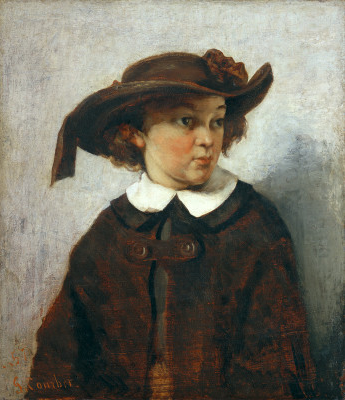
—You portrayed yourself very often in your canvases. Was that vanity?
Pride, yes; vanity, no. In The Desperate Man, I painted myself with eyes wide, hands clutching my hair, like a man on the edge of the abyss — a staging, granted, but I believed in it with all my flesh. And in Bonjour Monsieur Courbet, you see me on the road to Montpellier, staff on shoulder, greeting my patron Alfred Bruyas with head held high: the artist who bows to no one, not even to the one who pays him. I showed myself in an artisan’s smock, pipe in mouth, black beard in disarray, because I wanted people to know where I came from. Painting myself was planting my face in the middle of my work and saying: here is the man, take him or leave him, but above all do not disguise him.
—How did you come to sit on the Paris Commune?
In 1871, Paris starved by the Prussian siege rose up, and I, who had always taken the side of the people, could not stand idly by. I was elected to the Council of the Commune and placed at the head of the Federation of Artists — I dreamed of making art free, reopening museums to the public, wrenching creation from the hands of bureaucrats in black coats. And then there was the Vendôme Column, that bronze cast to sing the victories of an emperor, that mast of military pride erected in the middle of a square. It was toppled. I had wished they would unbolt it, store it elsewhere as a relic, not make it a crime of blood. But history, when it tips over, no longer distinguishes the wish from the act.
—That toppled column, what did it cost you in the end?
Everything. They held me responsible for its reconstruction and presented me with a bill of 323,000 francs — a sum no painter could pay in ten lifetimes in the studio. To escape this debt and prison, I crossed the border and took refuge here, at La Tour-de-Peilz, on the shores of Lake Geneva, where I speak to you today. I still paint trout and landscapes that dealers come to buy to offset my condemnation, but my heart is no longer in it, and beer, that old Franche-Comté friend, is finishing what sorrow began. I wanted a free painting and a free man; they made me grow old far from my Doubs, debtor for a bronze column. Let them at least remember that I never lied about what I saw.
Let them at least remember that I never lied about what I saw.
This imaginary interview was generated by artificial intelligence from sources documented in Gustave Courbet's profile. It dramatises what the figure might have said based on what we know about them, but does not constitute attested historical testimony. For primary sources and factual documentation, refer to the full profile.